Last Updated on August 30, 2018
Colombian court orders Ecopetrol to halt production on Bari land
by: Lisa Garrigues – www.indiancountry.com
February 26, 2007
LA PAZ, Bolivia – In a victory for the Bari people of Colombia, the national constitutional court has ordered the state oil company Ecopetrol to halt oil production on their land.
According to the judgment, ”We have observed not just damage to the fundamental right of the Motilon Bari Indigenous People to be consulted beforehand, but profound harm to the legitimate confidence that traditional authorities have deposited in government authorities.”
The judgment was first reported Feb. 2 in the Colombian newspaper La Republica, and later confirmed by Ecopetrol officials, who have not commented on the decision.
It called for the suspension of oil exploration in the Alamo 1 installation in the municipality of Gebarra, in Norte de Santander, and asked for the Minister of Defense to provide the necessary support to ensure company compliance with the judgment.
Though lawyers for the Bari praised the judgment, they also questioned why the Bari had to wait so long for a response to their complaints while Ecopetrol, which is currently undergoing privatization, continued oil exploration on their territory.
The suit, filed in October 2005, claimed that Ecopetrol began exploration in Bari territory without first consulting with leaders of the community or checking to see if indigenous people lived on the land, and did no environmental studies on the impact of their exploration.
The Colombian Ministries of the Environment, Interior and Justice, Territorial Development and Defense, who gave permission for Ecopetrol to begin exploration, were also named in the suit.
In a statement sent last year to the court and the Colombian government, Chief Gonzalo Arabadora of the Motilon Bari Community Association said oil exploration was taking place on sacred land where Bari ceremonies were performed.
He also said the Bari were insulted, beaten and forbidden from speaking their language by soldiers who guarded the oil installations on their territories and prevented the Bari from entering their ceremonial grounds.
Around 1,000 Colombian soldiers are stationed in the war-torn territory of the Bari.
The U.S. government provides funding for Colombia’s armed forces under its drug eradication program Plan Colombia, which has facilitated the expansion of multinational oil companies in the region as well as the privatization of Ecopetrol.
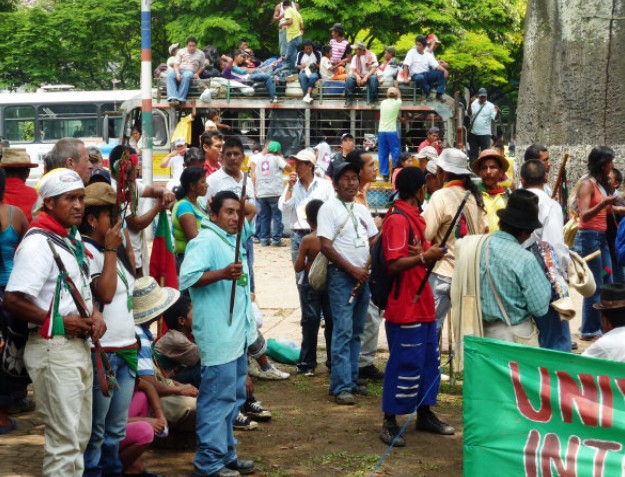
In addition to the lawsuit, the Bari conducted a letter-writing campaign and demonstrations against Ecopetrol and the Colombian government, including a demonstration on Oct. 12, 2006, in which 700 people marched to the nearby town of Tibu carrying bows and arrows; and one Bari leader asked, ”Why is the Colombian state not respecting our rights?”
Ashcayra Acrora, another Bari leader, has said, ”Mother Earth is a living being; we cannot understand this type of activity and we oppose it. Many animals in our region have disappeared. Life is the Earth, she maintains life; life is water and sun; for us, oil is a problem. It brings us a lot of violence. Together with the oil companies come armed groups.”
The court judgment said Colombian government officials had ignored ”the obligation to meet with the claimants in good faith, to respect their rights, to not abuse their own prerogatives, to defend and propagate human rights, to maintain the peace and to protect the natural resources of the country.”
Lawyers claim other companies, like the CGL, the Geophysical Company of Latin America, are exploring the region and will not be affected by the judgment.
The Bari are not the only one of Colombia’s indigenous peoples that have been opposing oil exploration on their territory.
Others include the Guahibo and the U’Wa, who suffered a setback in December when Colombia’s Interior Ministry allowed Ecopetrol to begin explorations on their territory on behalf of the Spanish company Repsol.
Attorney Melisa Ballesteros said the court order to cease production was significant, not just for the Bari but for other indigenous peoples in Colombia.
”This not only sets a precedent for Ecopetrol,” she told the Web site Actualidad Etnica, ”but also for the Ministry of Interior and Justice in their certification of the presence of indigenous peoples on territories where they are planning projects like this; and for the Ministry of Environment who gives environmental licenses to projects that involve indigenous people.”
—
© 1998 – 2007 Indian Country Today
(source)
Across the world right now, Indigenous peoples are facing a renewed assault on their lands, rights, and ways of life.
From extractive industries pushing deeper into ancestral territories, to governments rolling back hard-won protections,
the threat is global—and it is growing.
What makes this moment especially dangerous is how little attention it receives.
Stories like this are disappearing in real time. Mainstream media
barely covers it and the coverage is fragmented. The public is left without the context
needed to understand what is truly at stake.
That is exactly why IC Magazine exists..
For more than 20 years, IC has reported on Indigenous struggles worldwide — consistently, independently, and without compromise.
We don’t follow news cycles; we trace patterns. We don’t sensationalize; we provide context.
And when the world looks away, we stay focused.
But this work is increasingly difficult to sustain.
We refuse to lock our reporting behind a paywall. We don’t sell access through subscriptions.
And we don’t answer to advertisers. IC Magazine survives solely because readers like you choose to
support independent Indigenous journalism.
Please donate today if you can. Every contribution helps us to continue this crucial work.
Thank you,
John Ahni Schertow
Founder and Editor in Chief