
Last Updated on January 27, 2026
Canada’s justice system is failing Indigenous women and girls, a new data investigation suggests, with killers of Indigenous victims far more likely to face lenient charges and plea deals than those in cases involving non-Indigenous women.
An Investigative Journalism Bureau review of 1,329 cases of women and girls killed or otherwise deceased under suspicious circumstances between 2019 and 2025 found Indigenous women accounted for just over 25 per cent — 340 victims — despite comprising a much smaller share of the population.
Of the Indigenous cases resolved in court, 46 per cent ended in a manslaughter conviction, a charge that typically carries no mandatory prison minimum unless a firearm was involved. That contrasts with 24 per cent of non-Indigenous cases resulting in manslaughter, where second-degree murder — with a mandatory minimum of 10 years’ imprisonment — was more common.
Only a quarter of accused in Indigenous killing cases faced first-degree murder charges, compared with 37 per cent in similar cases involving non-Indigenous victims, the data show. Plea bargains were more frequent in Indigenous cases, occurring 64 per cent of the time versus 57 per cent for non-Indigenous victims.
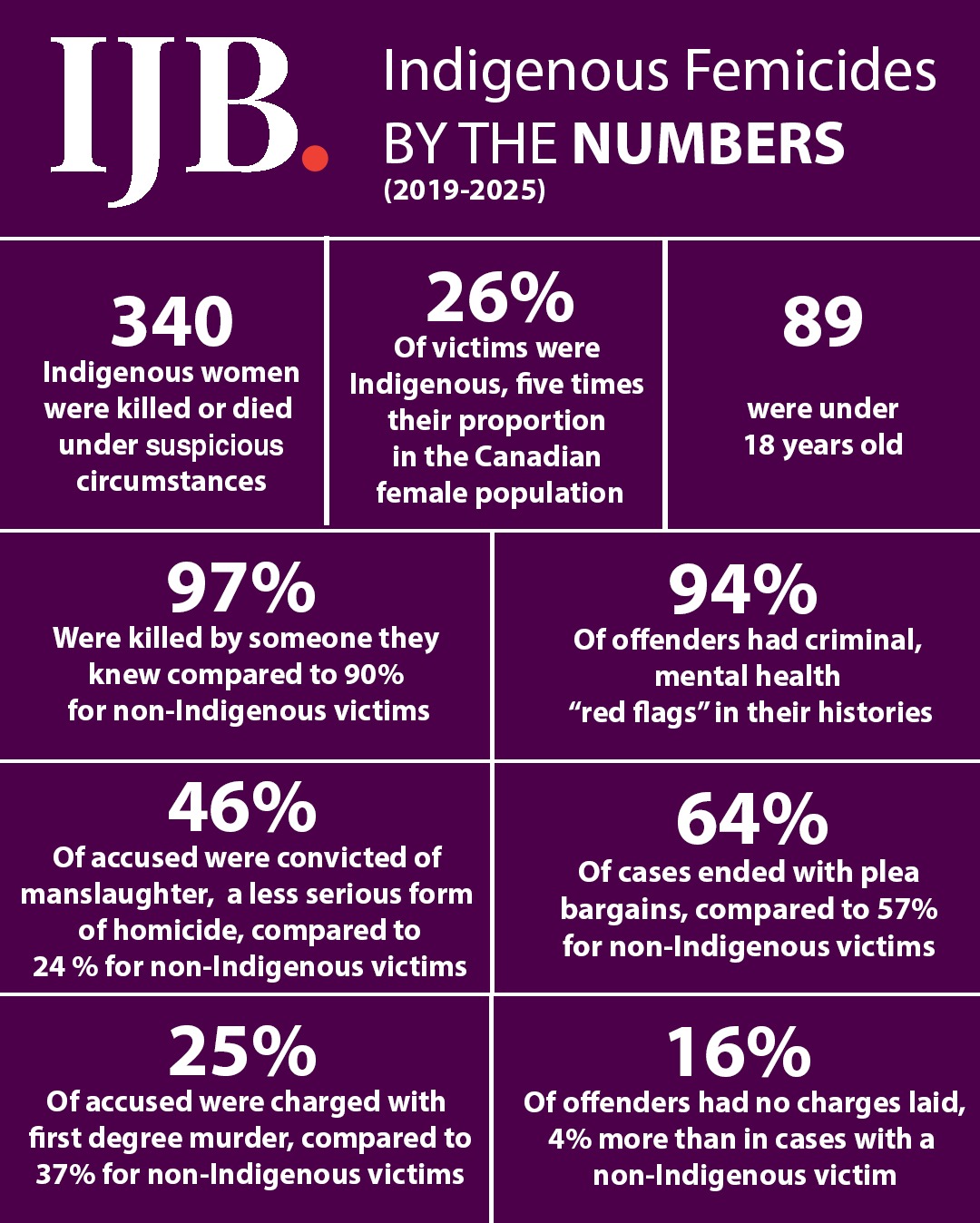
Graphic by the Investigative Journalism Bureau
Legal experts and Indigenous leaders say the statistics point to systemic inequities in how the justice system treats Indigenous victims. Ottawa defense lawyer Michael Spratt described the pattern as evidence that Indigenous women’s “lives and their health and their safety are not valued as highly.”
Marion Buller, a former judge and chief commissioner of the 2016 National Inquiry into Missing and Murdered Indigenous Women and Girls, called the findings indicative of broader structural problems — from policing to prosecutorial decisions — that shape case outcomes long before trial.
The analysis also revealed that 16 per cent of killings or suspicious deaths of Indigenous women remain unsolved, a rate higher than for non-Indigenous victims, and that in the vast majority — 97 per cent — of resolved cases, the victim knew the accused.
Indigenous advocates say these disparities have real-world repercussions. Ann Maje Raider, executive director of the Liard Aboriginal Women’s Society in the Yukon, warned that perceptions of leniency embolden perpetrators and erode community trust in policing and courts.
“(Perpetrators) know they’re not going to get anything,” Raider said. “And the reason is that the justice institution has failed us.”
In remote and on-reserve communities, where access to shelters and protective services can be limited, advocates argue that restraining orders and other legal tools often fail to protect women from domestic violence, further compounding risks.
Grand Chief Stewart Phillip of the Union of B.C. Indian Chiefs said without changes to how abusers are charged and sentenced, the cycle of violence will persist.
The findings come as police services and provincial justice ministers face renewed scrutiny over rising gender-based violence in Canada. According to the Canadian Femicide Observatory for Justice and Accountability, at least one woman or girl is killed every 48 hours nationwide.
Across the world right now, Indigenous peoples are facing a renewed assault on their lands, rights, and ways of life.
From extractive industries pushing deeper into ancestral territories, to governments rolling back hard-won protections,
the threat is global—and it is growing.
What makes this moment especially dangerous is how little attention it receives.
Stories like this are disappearing in real time. Mainstream media
barely covers it and the coverage is fragmented. The public is left without the context
needed to understand what is truly at stake.
That is exactly why IC Magazine exists..
For more than 20 years, IC has reported on Indigenous struggles worldwide — consistently, independently, and without compromise.
We don’t follow news cycles; we trace patterns. We don’t sensationalize; we provide context.
And when the world looks away, we stay focused.
But this work is increasingly difficult to sustain.
We refuse to lock our reporting behind a paywall. We don’t sell access through subscriptions.
And we don’t answer to advertisers. IC Magazine survives solely because readers like you choose to
support independent Indigenous journalism.
Please donate today if you can. Every contribution helps us to continue this crucial work.
Thank you,
John Ahni Schertow
Founder and Editor in Chief