Last Updated on June 18, 2014
Semunying Jaya, an indigenous village in Borneo, speaks out about the destruction and deforestation of their land by the Palm Oil plantation industry.
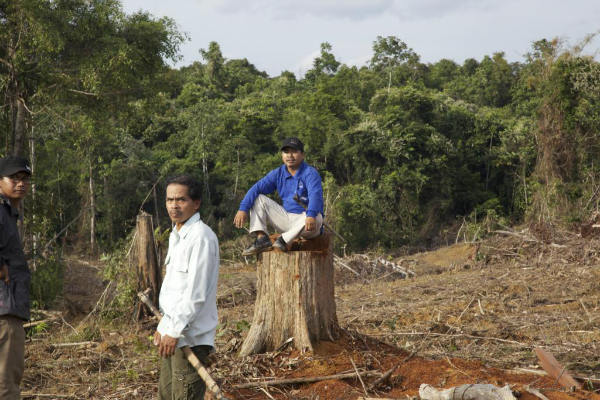
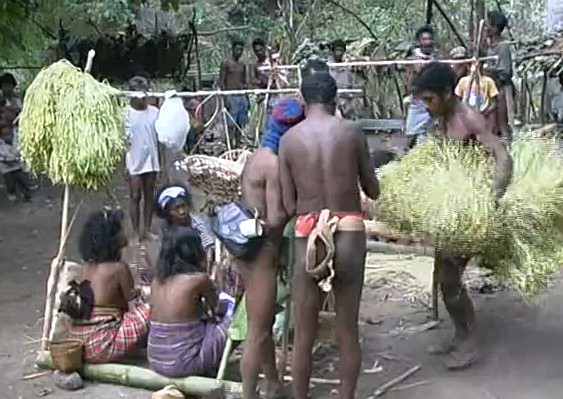
The Dayak village of Semunying Jaya, located in West Kalimantan, a province bordering the Malaysian state of Sarawak, has struggled for more than 20 years from successive companies destroying their customary lands.
According to testimony from the village, discussed in the 2008 report Losing Ground, the destruction began with PT Yamaker Kalbar Jaya, “a logging concessionnaire and part of a foundation established by the Indonesian armed forces” in the 1980s. Then, in 1998, the “torch” was handed over to Perum Perhutani, a state-owned company, who logged Semunying Jaya until 2000. One year after that, it was PT Lundu’s turn. Lundu, a Malaysian sawmill company, allegedly logged the forest illegally.
Then in 2002, the private palm oil company Agung Multi Perkasa “obtained permits to develop an oil palm plantation in the area”, says Losing Ground. However, after two years of operation the permits were canceled because the company did not plant any oil palm. Instead, the,y too, illegally logged the forest. The permits were then handed to another palm oil company, PT Ledo Lestar.
In July 2005 Ledo Lesta destroyed the indigenous village’s rubber plantations as roads were layed out in preparation for the coming oil palm.. One month later, “in August 2005 PT Ledo Lestari began to clear areas of land in Semunying Jaya including primary forest protected by the community for generations to ensure the irrigation of their rice fields, areas of community rubber plantations and other cash crops, secondary forest and sacred forests of spiritual significance to the community.”
“Despite repeated community complaints in meetings with the company and district and sub-district authorities, the company continued to clear up to 9,000 hectares of community forest, apparently without a forest conversion licence (IPK – Izin Pemanfaatan Kayu),” says the report.
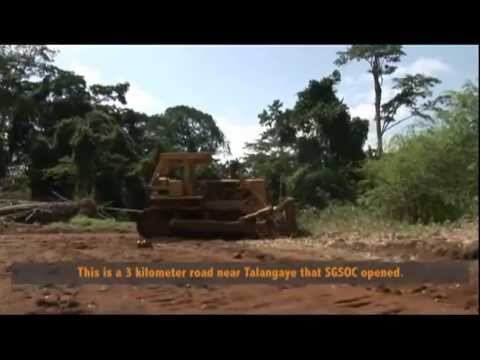
Despite protests, declarations, invitations to meet with the company owner and other “interventions”, Ledo Lestari has continued to burn down and replace Semunying Jaya’s land with oil palm, destroying along with it a culture and way life developed over tens of thousands of years .
Duta Palma’s Filthy Palm Oil, a short film produced for the Rainforest Action Network, stands a testament of Ledo Lestari’s destruction, and Semunying Jaya’s unequivocal need to have their lands and rights respected.
Losing Ground was authored by Friends of the Earth, LifeMosaic and Sawit Watch. You can download a copy of the report from the World Rainforest Movement’s website.
Across the world right now, Indigenous peoples are facing a renewed assault on their lands, rights, and ways of life.
From extractive industries pushing deeper into ancestral territories, to governments rolling back hard-won protections,
the threat is global—and it is growing.
What makes this moment especially dangerous is how little attention it receives.
Stories like this are disappearing in real time. Mainstream media
barely covers it and the coverage is fragmented. The public is left without the context
needed to understand what is truly at stake.
That is exactly why IC Magazine exists..
For more than 20 years, IC has reported on Indigenous struggles worldwide — consistently, independently, and without compromise.
We don’t follow news cycles; we trace patterns. We don’t sensationalize; we provide context.
And when the world looks away, we stay focused.
But this work is increasingly difficult to sustain.
We refuse to lock our reporting behind a paywall. We don’t sell access through subscriptions.
And we don’t answer to advertisers. IC Magazine survives solely because readers like you choose to
support independent Indigenous journalism.
Please donate today if you can. Every contribution helps us to continue this crucial work.
Thank you,
John Ahni Schertow
Founder and Editor in Chief