Last Updated on June 15, 2026
A new federal bill aimed at addressing water and wastewater services on First Nations lands is drawing criticism after Prime Minister Mark Carney’s government omitted language recognizing the human right to clean drinking water.
The legislation, introduced by the federal government this week, seeks to establish a framework for water, source water protection, drinking water, wastewater management and related infrastructure on First Nations lands. However, critics say the bill represents a step backward because it no longer explicitly affirms First Nations’ right to access clean drinking water.
The new bill replaces legislation that died following the end of the previous Parliament. That earlier proposal, known as Bill C-61 or the First Nations Clean Water Act, was introduced in December 2023 after years of consultation with First Nations.
According to reporting by The Canadian Press, lawyers and First Nations representatives have raised concerns that the new legislation removes key rights-based language that had formed part of previous commitments made by the federal government. Those commitments included recognition of clean drinking water as a fundamental human right and acknowledgment of the Crown’s responsibilities toward First Nations communities.
The controversy comes against the backdrop of a decades-long struggle over access to safe drinking water in First Nations communities across Canada.
For many Indigenous communities, boil-water advisories have become symbols of systemic inequality. In 2015, the federal government pledged to eliminate all long-term drinking water advisories on public systems on reserves by 2021. While significant progress has been made, dozens of advisories remain in effect today. Federal data shows that as of June 2026 there were 38 active long-term drinking water advisories affecting approximately 5,400 homes and more than 300 community buildings in 36 First Nations communities.
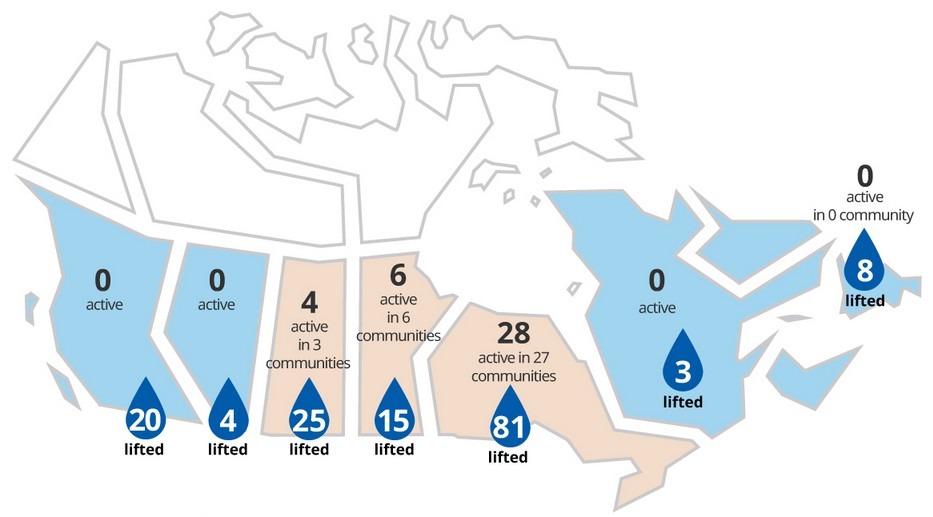
credit: government of Canada
The roots of the crisis are closely tied to the broader history of colonial policies that placed First Nations communities under federal administration while failing to provide services comparable to those available elsewhere in Canada.
Unlike municipalities, which generally operate under provincial regulatory regimes and tax bases that support water infrastructure, First Nations communities have long depended on federal funding decisions for the construction, operation and maintenance of water systems. Indigenous leaders, auditors and parliamentary committees have repeatedly argued that this funding model left many communities with aging infrastructure, chronic underinvestment and insufficient resources to train and retain certified water operators.
Warnings about the growing crisis emerged years before the issue gained national attention. Reports by the Office of the Auditor General of Canada in 2005 and again in 2011 found that the federal government lacked a comprehensive plan to ensure residents on reserves had access to safe drinking water. The audits concluded that living conditions in many First Nations communities were significantly below those enjoyed by most Canadians and that longstanding deficiencies persisted despite years of federal commitments.
In 2011, a national assessment commissioned by Indigenous Services Canada found that nearly 40 per cent of water systems in First Nations communities posed a high overall risk to water quality or safety. The study identified hundreds of systems requiring major repairs, upgrades or replacement and highlighted ongoing challenges related to infrastructure, operator training and long-term maintenance.
The consequences were felt across the country. Communities such as the Anishinaabe community of Neskantaga First Nation in northern Ontario became symbols of the crisis. Neskantaga has lived under a boil-water advisory since 1995, making it one of the longest-running drinking water advisories in Canadian history. Other First Nations experienced repeated system failures, contamination concerns and prolonged restrictions on drinking water, cooking and bathing.
As pressure mounted, the federal government passed the Safe Drinking Water for First Nations Act in 2013. Ottawa argued the legislation would create enforceable standards for drinking water on reserves. However, many First Nations organizations opposed the law, arguing that it imposed regulatory requirements without providing the funding necessary to meet them. Critics also warned that the legislation had been developed without adequate consultation and failed to recognize First Nations jurisdiction over water management.
The issue gained even greater prominence following the election of Prime Minister Justin Trudeau’s government in 2015. One of the Liberals’ most publicized commitments was a promise to end all long-term drinking water advisories on public water systems on reserves within five years. Billions of dollars were subsequently invested in water infrastructure projects, treatment plants and operator training programs.
While those investments led to substantial improvements, the government’s target proved more difficult to achieve than anticipated. New advisories continued to emerge even as older ones were lifted, and many communities argued that federal measurements of success failed to capture the full scope of water insecurity, including problems affecting private wells, distribution systems and source water contamination.
The struggle eventually moved into the courts. In 2019, a national class-action lawsuit brought by First Nations affected by long-term drinking water advisories resulted in a historic settlement agreement. Approved by the Federal Court in 2021, the settlement provided billions of dollars in compensation and committed Canada to significant reforms, including repealing the 2013 Safe Drinking Water for First Nations Act and working with First Nations to develop new legislation grounded in Indigenous rights and self-determination.
That commitment led to the introduction of Bill C-61, the First Nations Clean Water Act, in 2023. The bill was widely seen as a departure from previous approaches because it explicitly recognized access to clean drinking water as a human right, acknowledged First Nations’ inherent rights and jurisdiction over water, and sought to establish stronger protections for source water and long-term funding.
For many First Nations leaders, those provisions reflected lessons learned from decades of advocacy, litigation and community organizing. They argued that the water crisis was never solely about infrastructure. It was also about jurisdiction, accountability and the persistent gap between the services available to First Nations communities and those enjoyed by other Canadians.
After decades of promises, reports, lawsuits and negotiations, the struggle for clean water on reserve continues.
Across the world right now, Indigenous peoples are facing a renewed assault on their lands, rights, and ways of life.
From extractive industries pushing deeper into ancestral territories, to governments rolling back hard-won protections,
the threat is global—and it is growing.
What makes this moment especially dangerous is how little attention it receives.
Stories like this are disappearing in real time. Mainstream media
barely covers it and the coverage is fragmented. The public is left without the context
needed to understand what is truly at stake.
That is exactly why IC Magazine exists..
For more than 20 years, IC has reported on Indigenous struggles worldwide — consistently, independently, and without compromise.
We don’t follow news cycles; we trace patterns. We don’t sensationalize; we provide context.
And when the world looks away, we stay focused.
But this work is increasingly difficult to sustain.
We refuse to lock our reporting behind a paywall. We don’t sell access through subscriptions.
And we don’t answer to advertisers. IC Magazine survives solely because readers like you choose to
support independent Indigenous journalism.
Please donate today if you can. Every contribution helps us to continue this crucial work.
Thank you,
John Ahni Schertow
Founder and Editor in Chief