Last Updated on August 3, 2018
By Gloria Muñoz Ramírez, La Jornada
November 27, 2006
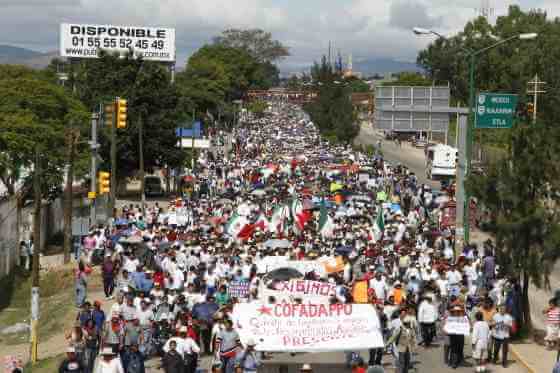
The popular movement of Oaxaca has gained ground and legitimacy in the world of resistance. It is no longer only the repression that has brought together activists, collectives, political, religious and human rights groups, people of the art community, and academic and cultural representatives of more than 20 countries, but the expression of an organized form of autonomy that has become, little by little, a referendum of political transformation spurred from below.
An act of repression instigated the creation of the Popular Assembly of the Peoples of Oaxaca (APPO) this past June, as well as another sudden attack from the federal and state governments, initiated October 27 and 29, that included nine new assassinations, detentions and the occupation of the city by the Federal Preventive Police (PFP), detonated an international solidarity movement comparable in intensity only to that which has brought together the Zapatistas and the people of San Salvador Atenco (with their own and unique histories).
Up until this moment more than 160 actions in solidarity with Oaxaca have been registered in different international communication sites in less than one month. During the workday of November 20 alone, brought about and driven by the Zapatista National Liberation Army and guided by the appropriate legitimacy the movement has gained, 47 mobilizations in 46 cities across the planet were reported.
The Mexican embassies and consulates have been blank regarding the protests against the political repression of the government. Marches, political meetings, evening gatherings, conferences, blockades, performances and other cultural activities have accompanied these actions. People have taken to the streets not only to condemn the wave of institutional violence, but they have now initiated informative talks and debates in Europe, the United States and Latin America about the importance of accompanying an autonomous movement that confronts power on a daily basis with a practice whose principal force and drive is its own people.
Collectives of international solidarity with the people of Oaxaca are already forming, or assemblies of support, that is to say, have begun to build the mobilization and conformation of an organized network that accompanies the movement politically. And in this process emerges debate and questions regarding the constitution and strategy of the APPO, so it is politically correct to manifest themselves against impunity and oppression in any part of the world, but to invocate themselves with a new political experience that has already come to pass.
In Salamanca, Spain, for example, the Assembly of Solidarity with Oaxaca was formed, which simultaneously begins a debate about the political character of the APPO, for which “all the persons, peoples, collectives and movements that struggle with the people of Oaxaca” have convened. Without any pretence available to de-legitimize a movement that walks openly in the streets, barricades and assemblies, amidst everyday repression, they make clear they need an interchange of ideas. The difficult road, evidently, has barely begun, with profound and authentic roots.
Originally published in Spanish November 26
From Narconews
Across the world right now, Indigenous peoples are facing a renewed assault on their lands, rights, and ways of life.
From extractive industries pushing deeper into ancestral territories, to governments rolling back hard-won protections,
the threat is global—and it is growing.
What makes this moment especially dangerous is how little attention it receives.
Stories like this are disappearing in real time. Mainstream media
barely covers it and the coverage is fragmented. The public is left without the context
needed to understand what is truly at stake.
That is exactly why IC Magazine exists..
For more than 20 years, IC has reported on Indigenous struggles worldwide — consistently, independently, and without compromise.
We don’t follow news cycles; we trace patterns. We don’t sensationalize; we provide context.
And when the world looks away, we stay focused.
But this work is increasingly difficult to sustain.
We refuse to lock our reporting behind a paywall. We don’t sell access through subscriptions.
And we don’t answer to advertisers. IC Magazine survives solely because readers like you choose to
support independent Indigenous journalism.
Please donate today if you can. Every contribution helps us to continue this crucial work.
Thank you,
John Ahni Schertow
Founder and Editor in Chief