Last Updated on August 3, 2018
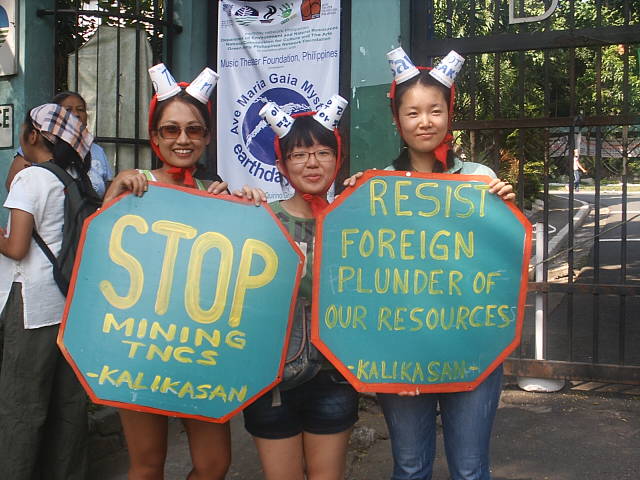
Kalikasan People’s Network for the Environment (Kalikasan PNE) has denounced the Arroyo government for permitting oil and gas exploration activities by ExxonMobil in the Philippines.
“ExxonMobil has a notorious environmental record, yet it was given permission to exploit vast tracts of our territory for its own end,” states Clemente Bautista Jr., the national coordinator of Kalikasan PNE.
“The exploration activities of ExxonMobil and of other foreign companies will most likely damage the fragile marine ecosystem in the Sandakan Basin. This includes Tubbatha Reef, one of the leading nominees for the Seven Wonders of the World. Millions of fisher folks who depend on Sulu Sea for their food and livelihood will also be affected,” adds Bautista.
The Sulu Sea Basin is one of several areas that the Arroyo government opened for oil and gas exploration. The basin is estimated to hold about about 203 million barrels of oil.
ExxonMobil, in partnership with Malaysian exploration group Mitra Energy Ltd., was given a contract by the government to enter the deepwater region of the Sandakan Basin, which covers an 8,500 hectare region in the Sulu Sea.
Aside from this contract, there are six others currently in the works.
“There is nothing wrong in the exploration and development of our energy resources, if it is to benefit majority of the Filipinos and our economy. However, based on the current energy framework of the Arroyo government, foreign companies are allowed to own and control these resources for their own profit and interest,” says Dr. Giovanni Tapang, chairperson of AGHAM, Advocates for Science and Technology for the People.
“The policies of Arroyo government of privatizing our energy resources run counter to the interest of our people. It is basically a sell-out of our national patrimony.”
Across the world right now, Indigenous peoples are facing a renewed assault on their lands, rights, and ways of life.
From extractive industries pushing deeper into ancestral territories, to governments rolling back hard-won protections,
the threat is global—and it is growing.
What makes this moment especially dangerous is how little attention it receives.
Stories like this are disappearing in real time. Mainstream media
barely covers it and the coverage is fragmented. The public is left without the context
needed to understand what is truly at stake.
That is exactly why IC Magazine exists..
For more than 20 years, IC has reported on Indigenous struggles worldwide — consistently, independently, and without compromise.
We don’t follow news cycles; we trace patterns. We don’t sensationalize; we provide context.
And when the world looks away, we stay focused.
But this work is increasingly difficult to sustain.
We refuse to lock our reporting behind a paywall. We don’t sell access through subscriptions.
And we don’t answer to advertisers. IC Magazine survives solely because readers like you choose to
support independent Indigenous journalism.
Please donate today if you can. Every contribution helps us to continue this crucial work.
Thank you,
John Ahni Schertow
Founder and Editor in Chief