Last Updated on August 3, 2018
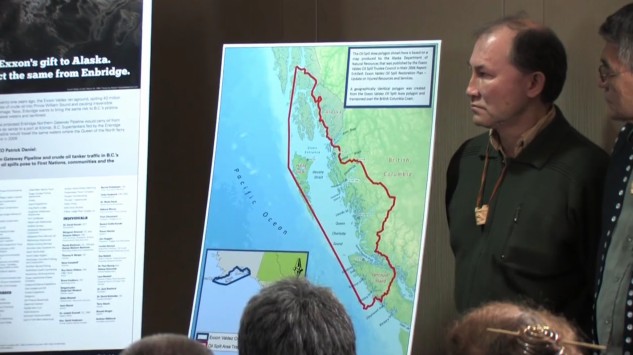
The Council of the Haida Nation has rejected Enbridge Inc.’s plans to construct an 1170-km pipeline for moving petroleum from Alberta’s tar sands to the deepsea port in Kitimat, British Colombia, because it would force the Haida to bear a substantial “burden of risk”.
Known as “the Northern Gateway project,” the pipeline would carry some 525,000 barrels of petroleum per day, bringing to the edge of Haida territory more than 150 oil tankers a year.
This means the lands and livelihoods of the Haida would be endangered about three times a week — something they are just not willing to accept.
“The Haida Nation will certainly not accept tanker traffic where we would bear the burden of risk and oil spills in our waters” says Robert Davis, a Representative of the Council of the Haida Nation. “Our livelihoods would be jeopardized.”
Davis was in attendance at the Nov. 28 First Nations Summit meeting in Vancouver, which brought forward a resolution to demand an independent, native-led environmental review of the $4-billion project.
“… The pipeline is slated to undergo a Joint Review Panel (JRP) process beginning in early 2009, [however] the JRP does not account for risks from coastal tanker traffic and tar sands expansion that would follow pipeline construction,” explains a press release from the Wet’suwet’en First Nation. “Moreover, the JRP process was developed without meaningful Aboriginal consultation; it is currently designed to grant approvals irrespective of potential harms in First Nation communities.”
“We… have a constitutional right to make decisions based on independent information about risks and benefits,” says Chief Larry Nooski of the Nadleh Whut’en. “Until such assessments take place, no-one has the authority to make commitments on our behalf.”
Anne Marie Sam, a councilor with the Nak’azdli, reiterates: “Our position is simple… We won’t accept a decision-making process that undermines our rights.”
As for the Haida, they won’t accept it either way.
Across the world right now, Indigenous peoples are facing a renewed assault on their lands, rights, and ways of life.
From extractive industries pushing deeper into ancestral territories, to governments rolling back hard-won protections,
the threat is global—and it is growing.
What makes this moment especially dangerous is how little attention it receives.
Stories like this are disappearing in real time. Mainstream media
barely covers it and the coverage is fragmented. The public is left without the context
needed to understand what is truly at stake.
That is exactly why IC Magazine exists..
For more than 20 years, IC has reported on Indigenous struggles worldwide — consistently, independently, and without compromise.
We don’t follow news cycles; we trace patterns. We don’t sensationalize; we provide context.
And when the world looks away, we stay focused.
But this work is increasingly difficult to sustain.
We refuse to lock our reporting behind a paywall. We don’t sell access through subscriptions.
And we don’t answer to advertisers. IC Magazine survives solely because readers like you choose to
support independent Indigenous journalism.
Please donate today if you can. Every contribution helps us to continue this crucial work.
Thank you,
John Ahni Schertow
Founder and Editor in Chief