Last Updated on October 7, 2013
Indigenous peoples in Africa face many obstacles to living a free and independent life: Chinese, European and American corporations, AFRICOM, Christian evangelicals and Islamic fundamentalists to name a few. Awash with weapons from the Pentagon and corrupted by the corporations, states like Uganda are a nightmare for environmental and human rights activists, Indigenous or otherwise. Attempting to protect Indigenous peoples property like traditional knowledge, sacred sites, medicines and forest foods means confronting all the above.
An example of how American meddling by Christian evangelicals alone poses a problem for the inhabitants of America’s heavily-armed ally, Uganda, serves to illustrate the complexity of politics there. While this example concerns gays, it isn’t difficult to imagine a similar threat to Indigenous peoples. Throw in some Blackwater mercenaries, and you have a Made in the USA humanitarian tragedy ready to happen.
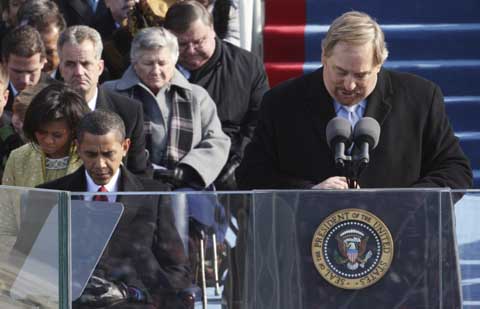
When President-elect Barack Obama selected Rick Warren to read the invocation at his swearing-in ceremony, American liberals wondered why human rights activists were in an uproar. As Pastor Warren’s fervent bigotry came to light, though, even ill-informed liberals came to understand that maybe promoting an avowed anti-gay Christian evangelical might not be a good idea for the newly-elected president.
Now that the proteges of Warren in Uganda have passed legislation denying gays civil rights, and nearly succeeded in making homosexuality punishable by death, one has to ask why even a neoliberal like Obama would reach out to right-wing Christian hatemongers. While we wait for the answer to such questions, Political Research Associates takes a closer look at the US Christian right and the attack on gays in Africa.
In Globalizing the Culture Wars: U.S. Conservatives, African Churches, and Homophobia, PRA examines the projection of American bigotry into the heart of Africa.
Across the world right now, Indigenous peoples are facing a renewed assault on their lands, rights, and ways of life.
From extractive industries pushing deeper into ancestral territories, to governments rolling back hard-won protections,
the threat is global—and it is growing.
What makes this moment especially dangerous is how little attention it receives.
Stories like this are disappearing in real time. Mainstream media
barely covers it and the coverage is fragmented. The public is left without the context
needed to understand what is truly at stake.
That is exactly why IC Magazine exists..
For more than 20 years, IC has reported on Indigenous struggles worldwide — consistently, independently, and without compromise.
We don’t follow news cycles; we trace patterns. We don’t sensationalize; we provide context.
And when the world looks away, we stay focused.
But this work is increasingly difficult to sustain.
We refuse to lock our reporting behind a paywall. We don’t sell access through subscriptions.
And we don’t answer to advertisers. IC Magazine survives solely because readers like you choose to
support independent Indigenous journalism.
Please donate today if you can. Every contribution helps us to continue this crucial work.
Thank you,
John Ahni Schertow
Founder and Editor in Chief