Last Updated on August 14, 2026
A coalition of Indigenous Nations have issued a declaration barring the proposed Enbridge Northern gateway pipeline from transporting crude oil from the Alberta Tar Sands through their territories along Canada’s west Coast.
The coalition of nine First Nations say the project, regardless of any economic benefits it may hold, poses an imminent threat to the environment, as well as their territories, cultures and livelihoods.
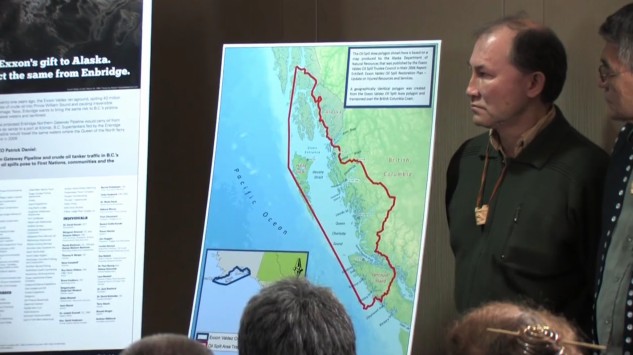
The Enbridge pipeline–stretching 1,170 kilometres to a deepsea port in Kitimat, B.C–would be stapled to several indigenous territories and cross more than 1,000 rivers and streams before reaching through the delicate ecosystems of the west coast, including the Great Bear Rainforest.
“We all believe the Enbridge Gateway pipeline project is a threat to the very existence of our culture and our way of life,” says Art Sterritt, executive director of the Coastal First Nations.
Speaking about the Great Bear Rainforest, he states, “An oil spill there would be devastating to the environment… It would literally wipe out all of our cultures. And we know it is not a question of if, but when there would be an oil spill.”
A backgrounder by the Coastal First Nations explains that Enbridge recorded 67 spills from its pipelines in 2006 and 65 spills in 2007. Indeed, oil spills are far more common than the public has been led to believe.
In addition to the pipeline, more than 150 supertankers–roughly one every two days–would traverse the coastal waters to pick up the crude oil and export it to various countries.
The Supertankers are being compared to the infamous Exxon Valdez Supertanker, which spilled 40 million litres of crude oil into Prince William Sound 21 years ago. Each of the BC supertankers would hold about 300 million litres.
In their March 23 declaration, which was quickly endorsed by more than 150 First Nations, businesses, environmental groups, and prominent Canadians, the Coastal First Nations state:
“…Our laws and customs define our responsibilities to protect our lands and waters. We embrace this solemn and sacred duty to our ancestors to pass our territories and our cultures to the following generations in good order.
“As Nations of the Central and North Pacific Coast and Haida Gwaii, it is our custom to share our wealth and live in harmony with the broader human community. However, we will not bear the risk to these lands and waters caused by the proposed Enbridge Northern gateway pipeline and crude oil tanker traffic.
“…Therefore, in upholding our ancestral laws, rights and responsibilities, we declare that oil tankers carrying crude oil from the Alberta Tar Sands will not be allowed to transit our lands and waters.
“To those who share our commitment to the well being of the planet we invite you to join us in defending this magnificent coast, its creatures, cultures and communities.”
The Coastal First Nations include the Wuikinuxv Nation, Heiltsuk, Kitasoo/Xaixais, Holmalco, Gitga’at, Haisla, Metlakatla, Old Massett, Skidegate, and the Haida Nation.
Across the world right now, Indigenous peoples are facing a renewed assault on their lands, rights, and ways of life.
From extractive industries pushing deeper into ancestral territories, to governments rolling back hard-won protections,
the threat is global—and it is growing.
What makes this moment especially dangerous is how little attention it receives.
Stories like this are disappearing in real time. Mainstream media
barely covers it and the coverage is fragmented. The public is left without the context
needed to understand what is truly at stake.
That is exactly why IC Magazine exists..
For more than 20 years, IC has reported on Indigenous struggles worldwide — consistently, independently, and without compromise.
We don’t follow news cycles; we trace patterns. We don’t sensationalize; we provide context.
And when the world looks away, we stay focused.
But this work is increasingly difficult to sustain.
We refuse to lock our reporting behind a paywall. We don’t sell access through subscriptions.
And we don’t answer to advertisers. IC Magazine survives solely because readers like you choose to
support independent Indigenous journalism.
Please donate today if you can. Every contribution helps us to continue this crucial work.
Thank you,
John Ahni Schertow
Founder and Editor in Chief