
Last Updated on April 10, 2025
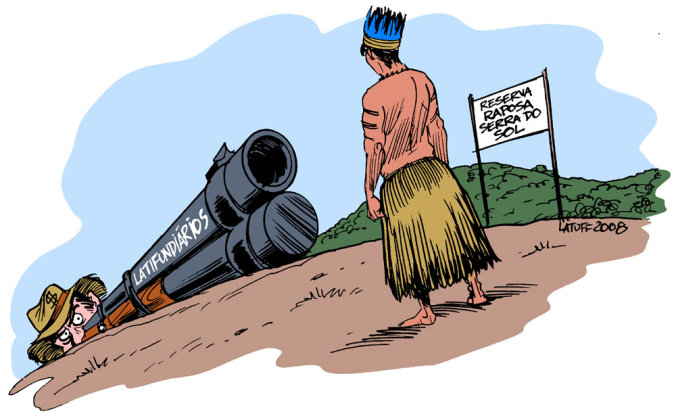
The first of eleven Supreme Court Judges cast his vote in the landmark case that will decide the future of Raposa-Serra do Sol, a legally-recognized Indigenous Territory in the Brazilian state of Roraima.
“Magistrate Carlos Ayres de Britto, the first and only judge to have voted so far, used the Portuguese word ‘esbulho’ (dispossession or unlawful possession) to describe the occupation of parts of the reservation by non-indigenous landowners who want to break up the 1.7 million hectare reserve in order to hold on to the land that they farm,” writes IPS News.
Here, Britto is referring to the group of vigilante rice farmers that have refused to leave the territory, despite being ordered to do so by a 2005 Presidential decree.
A key judge in the case, Britto further stated that the reservation must remain intact in order for Brazil to uphold the constitutional rights of the the Makuxi, Wapixana, Ingariko, Taukepang, and Patamona peoples who share the territory.
He also emphasized that the five communities are the region’s original occupants, and that “territories like Raposa-Serra do Sol which border other countries are not incompatible with national security, as the military have claimed,” notes a press release by Survival International.
Following Britto’s ruling, which took about two hours to deliver, the next judge in line to vote requested an adjournment to further examine the case.
A final ruling is expected to be handed down by the end of the year.
Photo: www.sisejuferj.org.br c/o brasil.indymedia.org
Across the world right now, Indigenous peoples are facing a renewed assault on their lands, rights, and ways of life.
From extractive industries pushing deeper into ancestral territories, to governments rolling back hard-won protections,
the threat is global—and it is growing.
What makes this moment especially dangerous is how little attention it receives.
Stories like this are disappearing in real time. Mainstream media
barely covers it and the coverage is fragmented. The public is left without the context
needed to understand what is truly at stake.
That is exactly why IC Magazine exists..
For more than 20 years, IC has reported on Indigenous struggles worldwide — consistently, independently, and without compromise.
We don’t follow news cycles; we trace patterns. We don’t sensationalize; we provide context.
And when the world looks away, we stay focused.
But this work is increasingly difficult to sustain.
We refuse to lock our reporting behind a paywall. We don’t sell access through subscriptions.
And we don’t answer to advertisers. IC Magazine survives solely because readers like you choose to
support independent Indigenous journalism.
Please donate today if you can. Every contribution helps us to continue this crucial work.
Thank you,
John Ahni Schertow
Founder and Editor in Chief


