
Last Updated on August 3, 2018
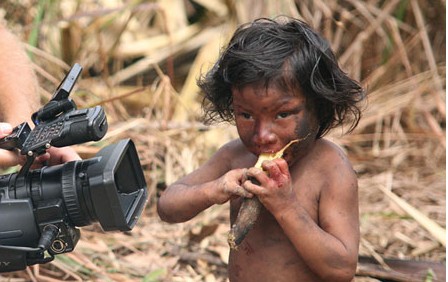
The Karitiana, a People indigenous to Brazil have recently discovered that blood and DNA collected from them in 1996–under the guise of a reasonable exchange of medicine which the never received–is being sold to scientists around the world for $85 a sample.
The Karitiana now want this stopped, and are demanding compensation for this violation and lack of integrity on part of the scientists.
From the New York Times – “We were duped, lied to and exploited,” Renato Karitiana, the leader of the tribal association, said in an interview here on the tribe’s reservation in the western Amazon, where 313 Karitiana eke out a living by farming, fishing and hunting. “Those contacts have been very injurious to us, and have spoiled our attitude toward medicine and science.”
Two other Brazilian tribal peoples complain of similar experiences and say they are also seeking to stop the distribution of their blood and DNA by Coriell Cell Repositories, a nonprofit group based in Camden, N. J. They are the Suruí people, whose homeland is just south of here, and the Yanomami, who live on the Brazil-Venezuela border.
Coriell stores human genetic material and makes it available for research. It says the samples were obtained legally through a researcher and approved by the National Institutes of Health.
“We are not trying to profit from or steal from Brazilians,” Joseph Mintzer, executive vice president of the center, said in a telephone interview. “We have an obligation to respect their civilization, culture and people, which is why we carefully control the distribution of these cell lines.”
Like a similar center in France that has also obtained blood and DNA samples of the Karitiana and other Amazon tribes, Coriell says it provides specimens only to scientists who agree not to commercialize the results of their research or to transfer the material to third parties.
The indigenous peoples of the Amazon are ideal for certain types of genetic research because they are isolated and extremely close-knit populations, allowing geneticists to construct a more thorough pedigree and to track the transmission of illnesses down generations.
The practice of collecting blood samples from Amazon Indians, though, has aroused widespread suspicions among Brazilians, who have been zealous about what they call “bio-piracy” ever since rubber seedlings were exported from the Amazon nearly a century ago. The rise of genome mapping in recent years has only exacerbated such fears.(source)
A worldwide fight against biopiracy and patents on life
Captain Hook Awards for Biopiracy
Campaign to Stop the genographic project (news)
Privatizing our `genetic commons’
Across the world right now, Indigenous peoples are facing a renewed assault on their lands, rights, and ways of life.
From extractive industries pushing deeper into ancestral territories, to governments rolling back hard-won protections,
the threat is global—and it is growing.
What makes this moment especially dangerous is how little attention it receives.
Stories like this are disappearing in real time. Mainstream media
barely covers it and the coverage is fragmented. The public is left without the context
needed to understand what is truly at stake.
That is exactly why IC Magazine exists..
For more than 20 years, IC has reported on Indigenous struggles worldwide — consistently, independently, and without compromise.
We don’t follow news cycles; we trace patterns. We don’t sensationalize; we provide context.
And when the world looks away, we stay focused.
But this work is increasingly difficult to sustain.
We refuse to lock our reporting behind a paywall. We don’t sell access through subscriptions.
And we don’t answer to advertisers. IC Magazine survives solely because readers like you choose to
support independent Indigenous journalism.
Please donate today if you can. Every contribution helps us to continue this crucial work.
Thank you,
John Ahni Schertow
Founder and Editor in Chief