Last Updated on August 4, 2018
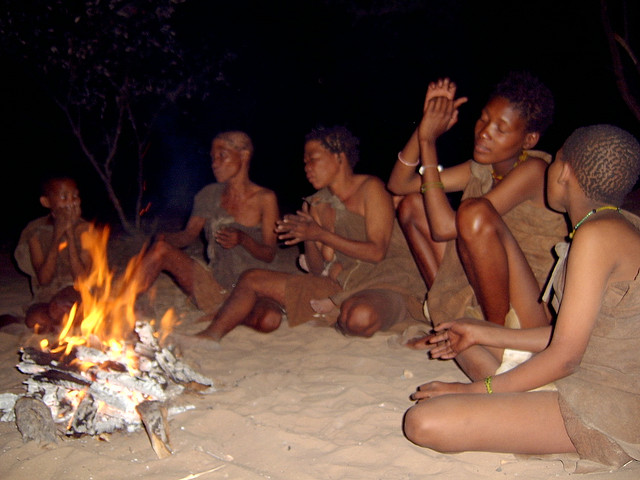
December 13th marked the first anniversary of the Kgeikani Kweni’s (First People of the Kalahari) landmark victory in Botswana’s High Court. As relayed in the following video produced shortly after the victory, the court ruled the government’s eviction of the Kgeikani Kweni was ‘unlawful and unconstitutional’, and that they have the right to live, hunt, and gather on their ancestral land in the Central Kalahari Game Reserve.
After the court ruling, the government continued to deny their rights. In fact, they stepped up their persecution of those who try to hunt on the reserve. At least 53 Kgeikani Kweni have been arrested for hunting in 2007, and many have been tortured. The government also refuses to let them access their water borehole inside the reserve, and many Kgeikani Kweni remain stranded in the resettlement camps they were dragged into last year.
If you’re wondering why they’re doing this, I need only say one word: diamonds.
The Kalahari Game Reserve “lies in the middle of the richest diamond-producing area in the world. There is known to be at least one major diamond deposit in the reserve, at a Bushman community called Gope. Many other ‘kimberlites’ (volcanic rock in which diamonds are found) are present in the reserve.
In May 2007 De Beers sold its deposit at Gope to Gem Diamonds, for $34 million. Gem Diamonds’ chief executive called the Gope deposit ‘a problematic asset for De Beers’ because of the Bushmen campaign.
Although De Beers had repeatedly claimed that the find was ‘sub-economic’, Gem Diamonds has stated publicly that it contains more than $2.2 billion-worth of diamonds, and it plans to develop a mine at Gope as quickly as possible.”

Across the world right now, Indigenous peoples are facing a renewed assault on their lands, rights, and ways of life.
From extractive industries pushing deeper into ancestral territories, to governments rolling back hard-won protections,
the threat is global—and it is growing.
What makes this moment especially dangerous is how little attention it receives.
Stories like this are disappearing in real time. Mainstream media
barely covers it and the coverage is fragmented. The public is left without the context
needed to understand what is truly at stake.
That is exactly why IC Magazine exists..
For more than 20 years, IC has reported on Indigenous struggles worldwide — consistently, independently, and without compromise.
We don’t follow news cycles; we trace patterns. We don’t sensationalize; we provide context.
And when the world looks away, we stay focused.
But this work is increasingly difficult to sustain.
We refuse to lock our reporting behind a paywall. We don’t sell access through subscriptions.
And we don’t answer to advertisers. IC Magazine survives solely because readers like you choose to
support independent Indigenous journalism.
Please donate today if you can. Every contribution helps us to continue this crucial work.
Thank you,
John Ahni Schertow
Founder and Editor in Chief