
Last Updated on May 4, 2015
Pipiisiiq is a traditional artist who creates Yup’ik dance fans. He recently returned home to Aleknagik, for fishing. The Bristol Bay region has the healthiest salmon and trout fisheries in our world, which the Alaska Native Peoples depend on for their subsistence and livelihoods. Alaska Native Peoples are unanimously opposed to the development of Pebble Mine within their sacred homeland.
“Waq’aa Amy la. Assirtua unuamek. I am back almost home, aang……Well, the Yup’ik law is alive in Yuguai’yak and my people.
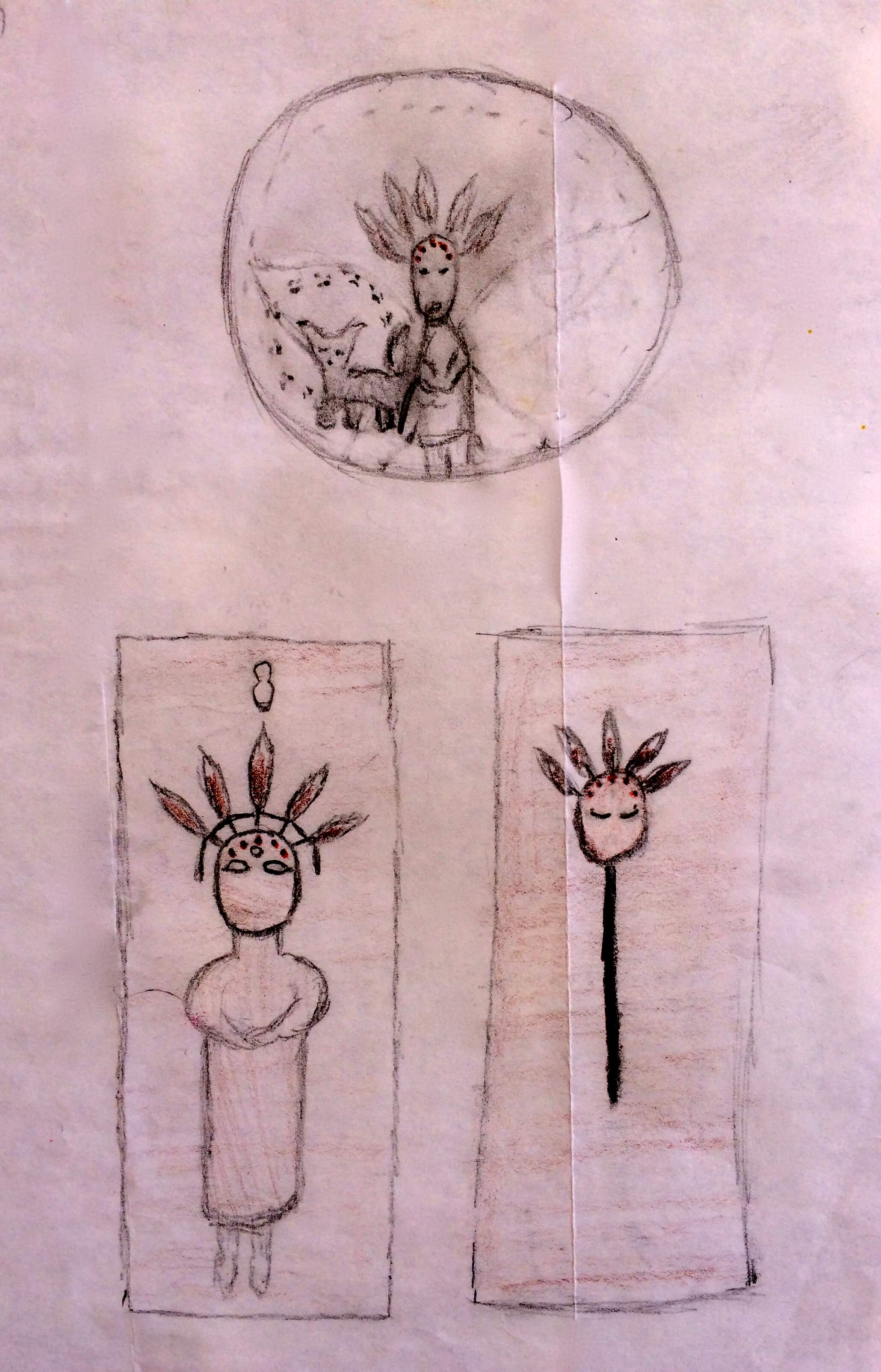
I, Shane Henry Nukwak, hereby consent to publish my perspectives concerning my people, the Yup’ik of Southwest Alaska. I am sending you a drawing. It is a burial drawing of one who has crossed over to the One Who Inherits our Spirits! Ellam Yua, Inheritor of my spirit, has revealed much about my people through the story of Yuguai’yak.
Russian missionaries misunderstood our culture and disrupted our connection with our Angalkut, our spiritual leader. We once always celebrated together and brought our problems to Angalkut for advice and help. People were natural. Children had purity rituals, men had spiritual visitors and everyone got together and convened for the spirit visitor. He came through Ellam Yua, who gives, who taught us how to give and to help.
My people were controlled. Everything we did was heathenistic to the missionaries. Angalkuts were ordered to change or be killed. Punishment was priority to this principle of conversion. After they stopped our ways, dysfunction and disconnection ensued, for our youth were not with the help of the community.
In the dance of commencing a spirit, the figure is a representation of the spirit visitor. Some reveal through the order of life – lynx or wolf or fox. Angalkuts lead my people with the Elders. I would enjoy watching a celebration of a visiting Yuk cenirtaaqing (human being). Masks would be purified and ordained for the Yuk who visits.
I drew a funeral portrait. Usually the box would be smaller and the man crunched within. The circle is a spirit visitor as a fox, like my Grandmother Annie. Villagers would commence intricately making masks specified for this ongoing visit. Everyone would find out about it and would fill with revelations. Children would fast for hunts because they are pure. Mystical masks – I want to visit my masks that were taken to Europe, like my Great Ila, Annie Blue.
My culture was observed, and also misunderstood – Ceremonies, purity rituals, rites, festivals of giving, and ceremonies of spirit visitors. Ellam Yua, Inheritor of Spirits, allowed a spirit to visit the people through the order of life. People in the community talked of the spiritual existence with the Angalkuq. The Angalkuq was most respected among my people. He was the one who commenced the ceremonies that were ordained by Ellam Yua. Without him, communication was short. Community celebrated the spiritual visitor with the help and advice of the medicine man or woman. The order of life was sacred and to be respected. Bones had to be properly disposed of. Masks were to be disposed of through fire or burial, depending on the ceremonies. Some were handed to the children.
Dysfunction settled among my people after the Russians ordered the Angalkut ways to cease or be killed. The Angalkut helped the people with matters and situations. Ceremonies, festivals and rites were considered punishable and had to cease.
People connected with the One Who Inherits Spirits and enjoyed his presence. They loved helping and giving to each other just like Ellam Yua. There were phases of the Spirit Visitor’s visit and more visits were prophesied by the Angalkut and even requested by the Angalkut and Yuk. Animals were celebrated. People were celebrated. The universe was revered as Holy. The weather was respected. Everything was respected. Stories were passed on and created. Spirit visitors talked of the moon and its environment. That is part of my perspective on my culture. That is what I feel concerning my people.
Across the world right now, Indigenous peoples are facing a renewed assault on their lands, rights, and ways of life.
From extractive industries pushing deeper into ancestral territories, to governments rolling back hard-won protections,
the threat is global—and it is growing.
What makes this moment especially dangerous is how little attention it receives.
Stories like this are disappearing in real time. Mainstream media
barely covers it and the coverage is fragmented. The public is left without the context
needed to understand what is truly at stake.
That is exactly why IC Magazine exists..
For more than 20 years, IC has reported on Indigenous struggles worldwide — consistently, independently, and without compromise.
We don’t follow news cycles; we trace patterns. We don’t sensationalize; we provide context.
And when the world looks away, we stay focused.
But this work is increasingly difficult to sustain.
We refuse to lock our reporting behind a paywall. We don’t sell access through subscriptions.
And we don’t answer to advertisers. IC Magazine survives solely because readers like you choose to
support independent Indigenous journalism.
Please donate today if you can. Every contribution helps us to continue this crucial work.
Thank you,
John Ahni Schertow
Founder and Editor in Chief

