Last Updated on March 17, 2025
The Wixarika people, after campaigning for seventeen straight months to protect their sacred territory, have been granted a major reprieve by the federal courts in Mexico.
As of this moment,
Below, a statement by the Wirikuta Defense Front
Feb. 26, 2012 – The federal courts have definitively granted the suspension of the violations claimed by the Wixarika (Huichol) People in order that no exploitation permit be granted for the La Luz mining project, in the Municipality of Catorce in San Luis Potosí, so long as the core issue remains unresolved.
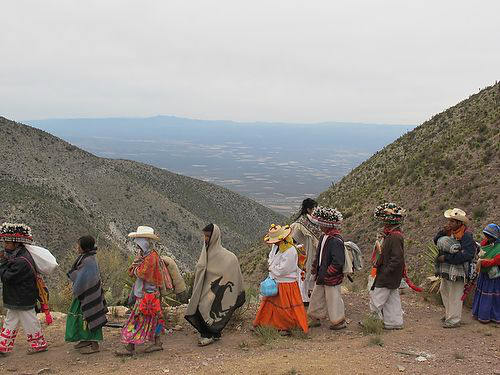
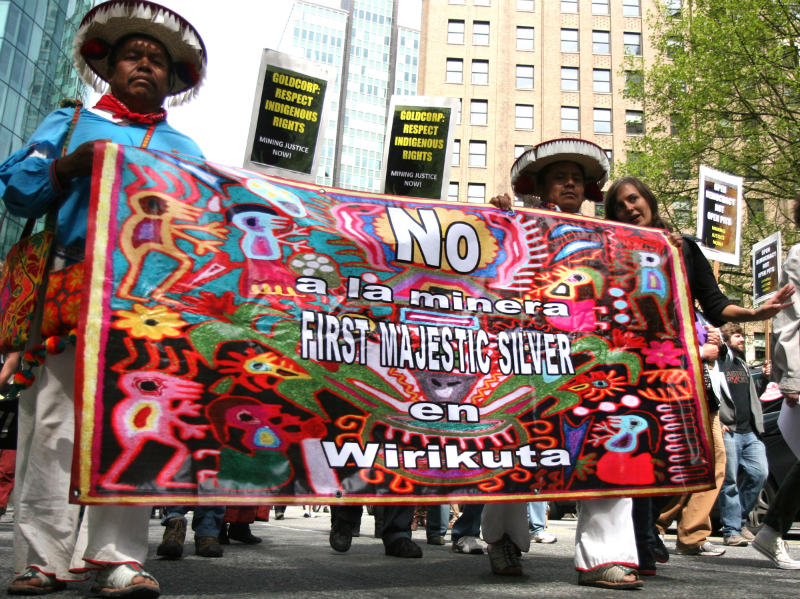
Given the failure of the Mexican government to guarantee their human rights and with the immovable objective of the integral protection of the sacred territory of Wirikuta, given the agroindustrial and metalurgical mining threats, the Wixarika people presented the judiciary with an injunction for legal protection demanding respect for the rights that the Mexican government had committed itself to protect at the national and international levels.
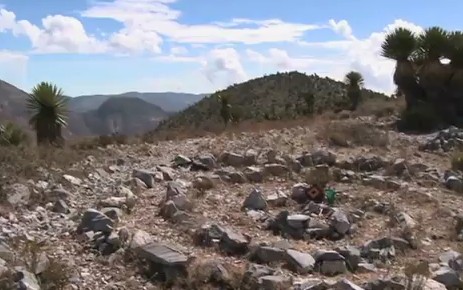
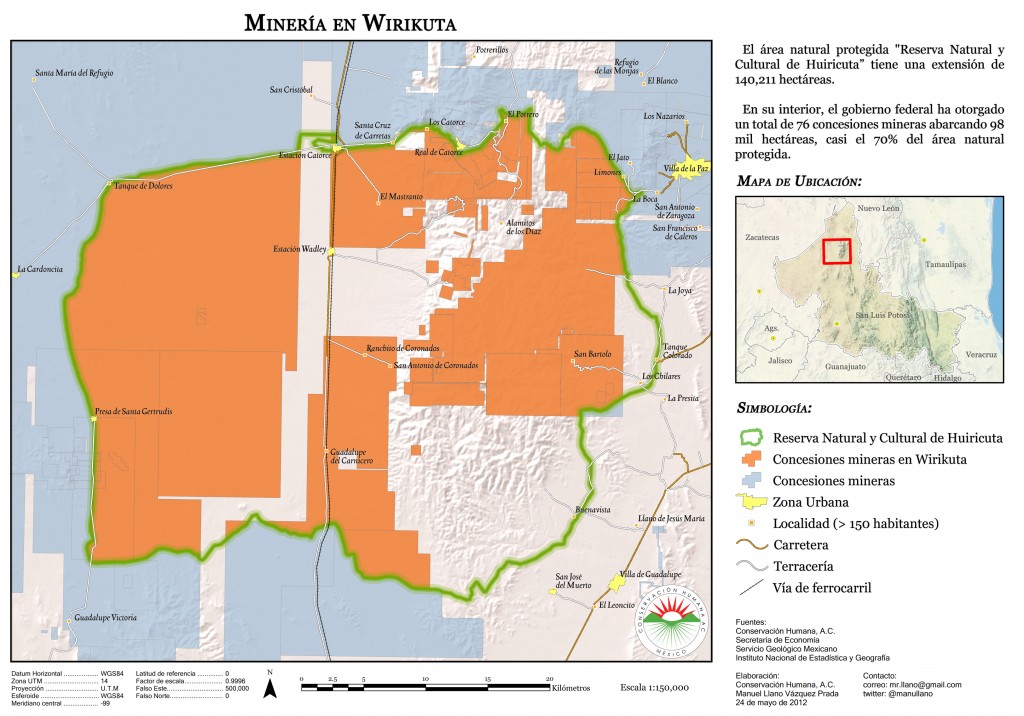
Wirikuta, sacred territory of the Wixaritari (Huichols), covers the municipalities of Catorce, Charcas, Matehuala, Villa de Ramos, Villa de Guadalupe y Villa de la Paz en el Estado de San Luis Potosí, was declared in 1994 a Natural Protected Area and Natural Sacred Site by the government of San Luis Potosí and includes approximately 140,000 hectares, a place where the federal government has granted at least 38 mineral concessions to exploit the mineral resources, putting at risk the biodiversity, the continuity of the Chihuahua Desert ecosystem, the water quality, the health of the population and the Wixarika people.
The territorial rights of the indigenous people recognizes not only the lands or surfaces in which the peoples are established, but also contemplates the spaces and territories where they traditionally have access, which includes the habitat and surroundings, meaning the integrity of the natural elements that conform the ecosystem.
The territory of Wirikuta represents for the Wixarika cosmogony the place where the essences of life and the birth of the sun are founded, which represents and indispensable element of their cultural identity and for their subsistence as a native people. In this context it is indispensable that the Mexican government consult with the Wixarika people to obtain their free, previous and informed consent in agreement with the current legislation, in order to guarantee in an effective manner their fundamental rights.
The demand for the rights of the Wixarika people has been accompanied by the National Commission for Human Rights and the Office of the UN High Commission for Human Rights in Mexico, who have shown their interest and disposition for the defense of the sacred territory.
Wirikuta Defense Front – Tamatsima Wahaa (the water of our elder brother) by the authorization of the Wixarika Regional Council for the Defense of Wirikuta.
Across the world right now, Indigenous peoples are facing a renewed assault on their lands, rights, and ways of life.
From extractive industries pushing deeper into ancestral territories, to governments rolling back hard-won protections,
the threat is global—and it is growing.
What makes this moment especially dangerous is how little attention it receives.
Stories like this are disappearing in real time. Mainstream media
barely covers it and the coverage is fragmented. The public is left without the context
needed to understand what is truly at stake.
That is exactly why IC Magazine exists..
For more than 20 years, IC has reported on Indigenous struggles worldwide — consistently, independently, and without compromise.
We don’t follow news cycles; we trace patterns. We don’t sensationalize; we provide context.
And when the world looks away, we stay focused.
But this work is increasingly difficult to sustain.
We refuse to lock our reporting behind a paywall. We don’t sell access through subscriptions.
And we don’t answer to advertisers. IC Magazine survives solely because readers like you choose to
support independent Indigenous journalism.
Please donate today if you can. Every contribution helps us to continue this crucial work.
Thank you,
John Ahni Schertow
Founder and Editor in Chief