Last Updated on July 23, 2018
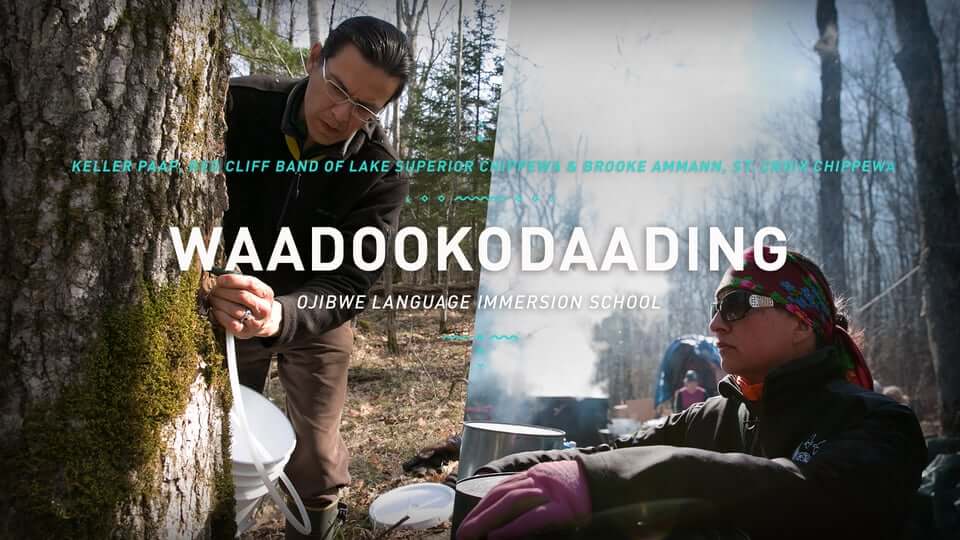
Christi Belcourt and Issac Murdoch are looking to revitalize Anishinabemowin language skills through the Nimkii Aazhibikong camp they started last year on Ompa Lake north of Elliot Lake.
“We are trying something a little bit new, but new is old,” says Belcourt, an Indigenous artist and coordinator of Walking With Our Sisters, a community-driven project that honours murdered or missing Indigenous women. “We’re trying something old by reviving our best practices of living on the land together in a way that goes by the seasons and goes by the sun and goes by the weather rather than going by a calendar or a clock schedule.”
Belcourt says the camp has had a variety of participants over the past year, including one young family who stayed at the camp during the winter.
“They’re homeschooling their children to give them the language,” Belcourt says. “Others bring their children out when school is out, so like (in the) summertime. There is no set schedule for it. We start every day with our opening prayer with our Elders and we do the language all day.”
Belcourt and Murdoch started working on the 24-hour, 365-day-a-year camp on June 7, 2017.
“We went out with some Elders and some youth and held a ceremony on the spot within traditional Anishinabek territory,” Belcourt says. “We had a ceremony to introduce ourselves to the spirits of the land, and after that we started building.”
Belcourt says the camp provides people with the opportunity to learn Anishinabemowin while on the land.
“When we look at our education that let us survive for thousands of years on the land, I find that education is of very high importance and high value,” Belcourt says. “We are at kind of a really important point in our history as Indigenous nations where we are seeing such a rapid loss of our languages that we simply can’t rely on programs and services or government initiatives to turn this around for us. This is something we have to take on ourselves and not look at funding but just go do it.”
Murdoch, an Indigenous storyteller and traditional knowledge holder, says there is a huge grassroots movement to revitalize Indigenous languages all across North America.
“We decided to set up a language camp, a language nest, to ensure that our languages survive and to provide a nest, a living place, for our young people and also a place for our Elders to come and teach,” Murdoch says. “We really believe in connecting young people and Elders together so that the language can be passed on.”
Murdoch says the Elders provide language lessons based on the participants’ activities throughout the day.
“So if we’re fishing, the language is all about fishing,” Murdoch says. “If we’re building a house, it is language all about building a house. And in the evenings we play all sorts of games, board games, card games, language games, and it is all in the language. So the people’s vocabulary has absolutely skyrocketed.”
Murdoch says there are currently about half a dozen young people who are participating in the camp.
“As soon as June comes to an end, we can double that,” Murdoch says. “We’ll probably have about a dozen young learners and about a dozen adults learning. They will come for the summer and it will be all language immersion with the Elders — it will be great.”
Murdoch says the participants “love” the opportunity to learn Anishinabemowin at the camp.
“Unfortunately, we are at the tipping point,” Murdoch says. “We have to make sacrifices if we are going to save this language.”
Belcourt says people who are interested in participating can drop by the camp, which is located about 20 kilometres north of Elliot Lake.
Across the world right now, Indigenous peoples are facing a renewed assault on their lands, rights, and ways of life.
From extractive industries pushing deeper into ancestral territories, to governments rolling back hard-won protections,
the threat is global—and it is growing.
What makes this moment especially dangerous is how little attention it receives.
Stories like this are disappearing in real time. Mainstream media
barely covers it and the coverage is fragmented. The public is left without the context
needed to understand what is truly at stake.
That is exactly why IC Magazine exists..
For more than 20 years, IC has reported on Indigenous struggles worldwide — consistently, independently, and without compromise.
We don’t follow news cycles; we trace patterns. We don’t sensationalize; we provide context.
And when the world looks away, we stay focused.
But this work is increasingly difficult to sustain.
We refuse to lock our reporting behind a paywall. We don’t sell access through subscriptions.
And we don’t answer to advertisers. IC Magazine survives solely because readers like you choose to
support independent Indigenous journalism.
Please donate today if you can. Every contribution helps us to continue this crucial work.
Thank you,
John Ahni Schertow
Founder and Editor in Chief