
Last Updated on June 18, 2014
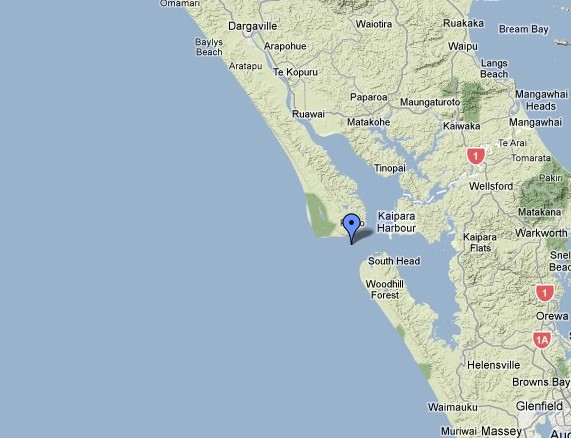
Kaipara guardians are getting ready to place a cultural ban against a new tidal energy power project at the mouth of the Kaipara Harbour in northern New Zealand.
This past February, the NZ power company Crest Energy got the OK to install 200 tide-driven turbines along the seabed at the mouth of the harbour. The openhydro-style power plant would be the first of its kind in New Zealand and the largest in the world.
However, Te Uri o Hau hapu of Ngati Whatua, which has a kaitiakitanga (guardianship) role in Kaipara harbour, explains the Northern Advocate, is deeply concerned about the possible impacts of the project, from the massive turbines to the power-line that would be buried along the sea floor.
The Hapu (extended family, a basic political unit within Maori society) says the project could damage the delicate underwater ecosystem around Kaipara Harbour and severely impact local marine life including maui dolphins and the west coast snapper.
The survival of the snapper is a particular concern. Historical over-fishing has reduced the snapper’s population to a mere 8% of its original stock. According to the Northland Regional Council, commercial catch quotas for the snapper were recently cut back to protect the species and give them a chance to recover.
Just 2 years ago, scientists from the National Institute of Water & Atmospheric Research (NIWA) discovered that some 98% of all west coast snapper come from nurseries in the Harbour.
Once the the Traditional ban–known in the Maori language as “aukati”–has been imposed, Crest Energy and its contractors will be prohibited from entering an area about 7km long and 2km wide.
Te Uri O Hau environment spokesman, Mikaera Miru, said the aukati doesn’t stop people from going fishing in the harbour; it’s just meant to stop the company.
“The aukati is only for a particular group and that’s what makes this type of rahui unique. It’s only for Crest Energy. It’s not going to prevent people from coming out there and fishing in the graveyard area because that’s the last fishing ground in the Kaipara where you can catch big fish,” he said.
Elsewhere, Miru said the ban is protected by legislation, under section 6(e) of the Resource Management Act 1991, “where it acknowledges the relationship of Maori and their culture and traditions with ancestral lands, water, sites, wahi tapu and other taonga should be recognized” notes freelance journalist Suzan Phillips.
The company, on the other hand, dismisses the ban, alleging that it has the lawful right to proceed with the project. It is planning to install the first three turbines as previously scheduled.
The Maori aren’t taking the situation lightly. According to Miru, once the aukati has been imposed a flotilla is going to show up in the harbour to chase away any Crest Energy boats.
Updates are being posted at: http://www.facebook.com/pages/Keep-The-Kaipara-Turbine-Free/199509196741605
Across the world right now, Indigenous peoples are facing a renewed assault on their lands, rights, and ways of life.
From extractive industries pushing deeper into ancestral territories, to governments rolling back hard-won protections,
the threat is global—and it is growing.
What makes this moment especially dangerous is how little attention it receives.
Stories like this are disappearing in real time. Mainstream media
barely covers it and the coverage is fragmented. The public is left without the context
needed to understand what is truly at stake.
That is exactly why IC Magazine exists..
For more than 20 years, IC has reported on Indigenous struggles worldwide — consistently, independently, and without compromise.
We don’t follow news cycles; we trace patterns. We don’t sensationalize; we provide context.
And when the world looks away, we stay focused.
But this work is increasingly difficult to sustain.
We refuse to lock our reporting behind a paywall. We don’t sell access through subscriptions.
And we don’t answer to advertisers. IC Magazine survives solely because readers like you choose to
support independent Indigenous journalism.
Please donate today if you can. Every contribution helps us to continue this crucial work.
Thank you,
John Ahni Schertow
Founder and Editor in Chief


