Last Updated on August 3, 2018
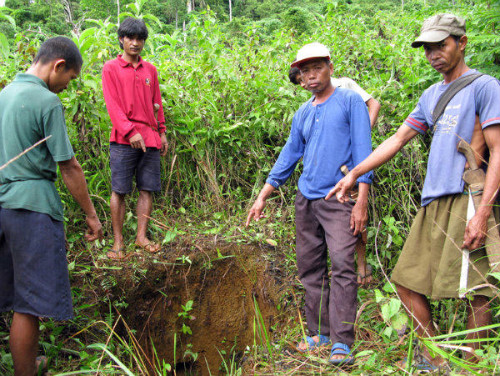
The community of Anislagan on the island of Mindanao has successfully blocked the Philex mining company from entering their lands.
According to a press release from the Legal Rights and Natural Resources Center-Kasama sa Kalikasan (LRC-CdO), nearly the entire community gathered to greet Philex, the largest mining firm in the Philippines, with a makeshift checkpoint they put together, on January 11, 2010.
The company was planning to commence work on a “livelihood training center.” However, “The Philex 6-vehicle convoy backed out after they failed to pass through the thousand residents of Anislagan,” states the LRC-CdO.
To reinforce the checkpoint, the community formed into a human a human barricade, leaving the company with nowhere else to go
“Women and children here are ready anytime to defend our land. This land is where we survived. We should fight for it!” said Rizalina Lisbos, a mother of four, who was on the front line of the barricade.
Providing some background, the LRC-CdO explains: “Philex started its actual mining operation in the adjacent Barangay (village) of Timamana, Tubod, Surigao del Norte in the 1st quarter of 2009. Philex’s operation in Tubod, also known as the ‘Bayugo Project’, started as early as 1999 for their exploration activities. There was strong opposition from the Tubod people until the mining company started their community relations projects, like livelihood, drainage improvement, sports activities etc. After that people started to begrudgingly agree to the mining project.”
“However, the adjacent village of Anislagan sustained their opposition to mining for almost ten years, led by Anislagan Bantay Kalikasan Task Force (ABAKATAF), which is composed of multi-sectoral and interfaith groups in the village.”
“Anislagan provides irrigation to rice field in their village and to adjacent villages.We don’t need a livelihood training center inside our village from a mining company. What for?” states Mr. Ormega, the new president of ABAKATAF. “We have an existing self-sustaining and community livelihood here. The mining company already affected our irrigation, our rivers, and even to our water supply from their Bayugo project and now they are proposing a livelihood center.”
If the proposed “livelihood center” is the insult, than the mining project is the injury—and its bitterly ironic: If mining in the region goes ahead as planned, it would destroy the communities’ livelihood and their natural resources.
For more information, please visit: http://saveanislaganwatershed.blogspot.com and http://lrcksk.org
Across the world right now, Indigenous peoples are facing a renewed assault on their lands, rights, and ways of life.
From extractive industries pushing deeper into ancestral territories, to governments rolling back hard-won protections,
the threat is global—and it is growing.
What makes this moment especially dangerous is how little attention it receives.
Stories like this are disappearing in real time. Mainstream media
barely covers it and the coverage is fragmented. The public is left without the context
needed to understand what is truly at stake.
That is exactly why IC Magazine exists..
For more than 20 years, IC has reported on Indigenous struggles worldwide — consistently, independently, and without compromise.
We don’t follow news cycles; we trace patterns. We don’t sensationalize; we provide context.
And when the world looks away, we stay focused.
But this work is increasingly difficult to sustain.
We refuse to lock our reporting behind a paywall. We don’t sell access through subscriptions.
And we don’t answer to advertisers. IC Magazine survives solely because readers like you choose to
support independent Indigenous journalism.
Please donate today if you can. Every contribution helps us to continue this crucial work.
Thank you,
John Ahni Schertow
Founder and Editor in Chief