Last Updated on March 29, 2015
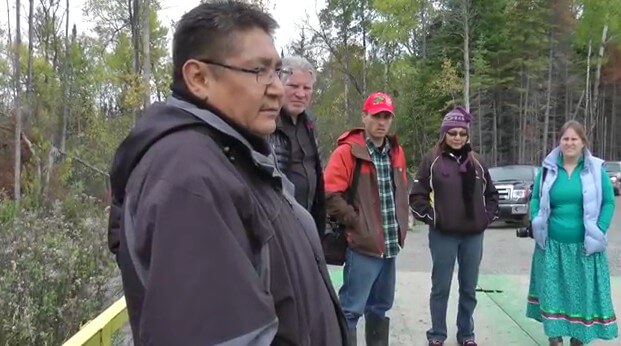
Winnipeg, Man. — A group of Pimicikamak citizens from Cross Lake will arrive at Manitoba Hydro headquarters tomorrow, June 19, to deliver their own version of the “Friendly Reminder Notices” that Hydro has sent to many homes in Cross Lake.
The notice will be accompanied with the signatures of over 1,000 Pimicikamak citizens behind the action.
The friendly notice will remind Hydro of its legal and moral commitment to ensure that all hydro-affected communities share in the abundant wealth created by the dams.
Since last fall, Hydro has begun cutting off some of the roughly 280 Cross Lake households believed to be on its disconnection list.
The citizen’s group will hold a press conference:
– outside Manitoba Hydro’s downtown office, on the Graham Avenue side, at 10:30 am on June 19.
– They will attempt to deliver the notice to Hydro CEO Scott Thomson.
“We want to be able to pay our bills,” says William Osborne , who speaks for the group, “but we also want Hydro to honour its obligations to us.”
Those two things go together. “When we consented to the hydro project in our homeland, Hydro and governments promised to work with us to address poverty and unemployment,” says Osborne, a former Pimicikamak Vice Chief. “If they would have fulfilled these commitments over the past three decades, far more of us would be able to pay our bills now.”
For him, the underlying question is simple: “who owes who?”
Contact:
Tommy Monias
204-676-0098
thomdmon@msn.com
Across the world right now, Indigenous peoples are facing a renewed assault on their lands, rights, and ways of life.
From extractive industries pushing deeper into ancestral territories, to governments rolling back hard-won protections,
the threat is global—and it is growing.
What makes this moment especially dangerous is how little attention it receives.
Stories like this are disappearing in real time. Mainstream media
barely covers it and the coverage is fragmented. The public is left without the context
needed to understand what is truly at stake.
That is exactly why IC Magazine exists..
For more than 20 years, IC has reported on Indigenous struggles worldwide — consistently, independently, and without compromise.
We don’t follow news cycles; we trace patterns. We don’t sensationalize; we provide context.
And when the world looks away, we stay focused.
But this work is increasingly difficult to sustain.
We refuse to lock our reporting behind a paywall. We don’t sell access through subscriptions.
And we don’t answer to advertisers. IC Magazine survives solely because readers like you choose to
support independent Indigenous journalism.
Please donate today if you can. Every contribution helps us to continue this crucial work.
Thank you,
John Ahni Schertow
Founder and Editor in Chief