Last Updated on January 12, 2026
Onondaga Lake, located in Upstate NY, has long been recognized as one of the most polluted lakes in North America. Now, the county plans to open a $100 million aquarium on its polluted shores, partly funded by Honeywell, the very corporation whose toxic waste contributed to the ecological disaster in the first place.
The bigger irony is that the millions utilized to construct the over-budget aquarium come from a fund intended to restore the lake ecosystem. In other words, the aquarium is directly defunding restoration efforts.
The aquarium is a distraction, not a restoration.
This should not come as a surprise, but rather be understood as symptomatic of settler colonial land relations, in which nature is eliminated with Indigenous ownership of land, and people and resources are polluted, as Max Liboiron explains.
Onondaga Lake is seen as an ancestor by the Onondaga Nation, one of the five nations of the Haudenosaunee Confederacy. It has been valued as sacred for thousands of years. The Onondaga Nation has been fighting against land theft, pollution, and exploitation for centuries, in the hope of maintaining and healing its relationship with its sacred lake.
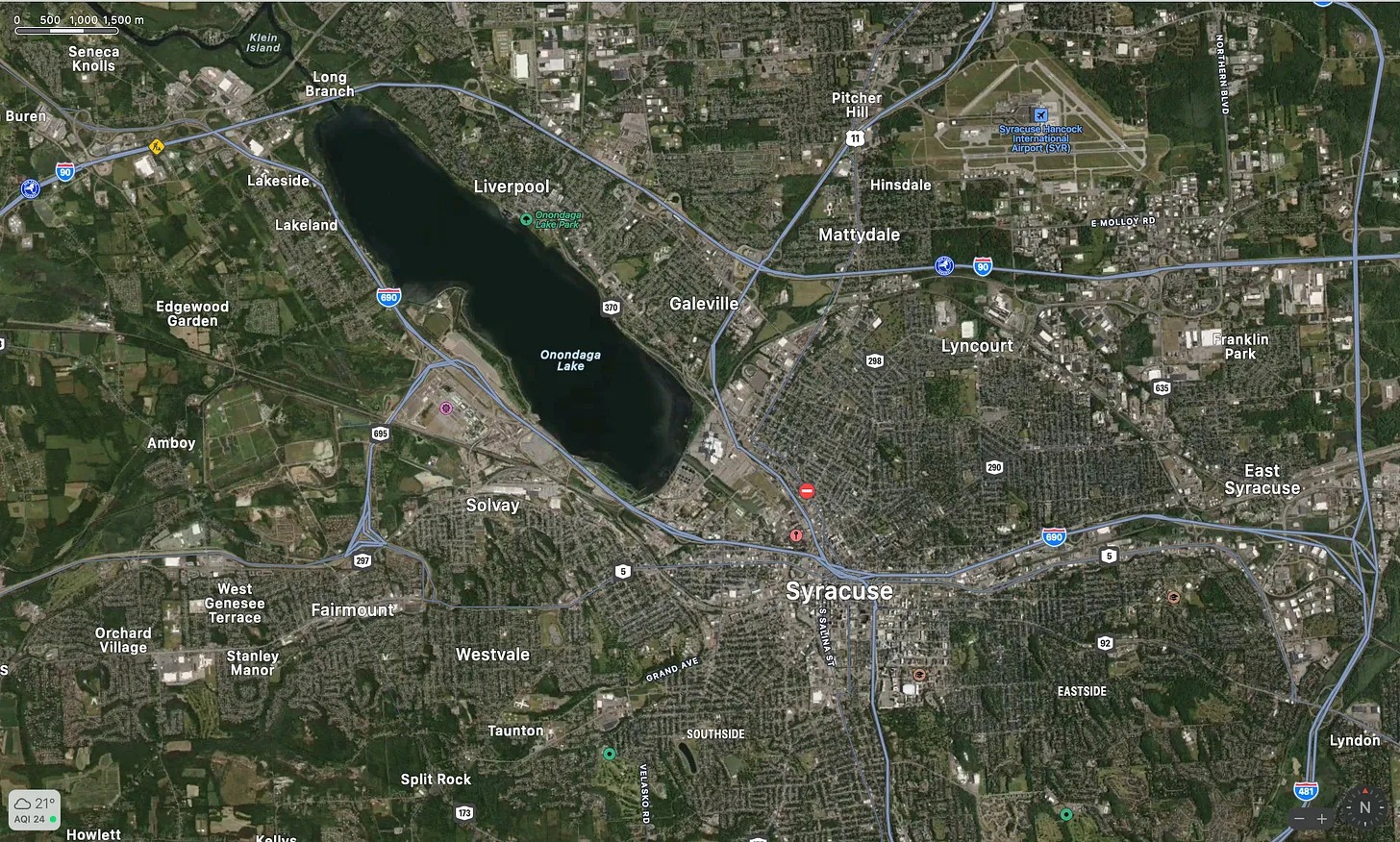
Map: OpenStreetMap
Onondaga Lake’s sacredness to the Haudenosaunee Confederacy and Nations means that decisions made about the lake today are not merely environmental or economic – they are political and ethical acts that either honor or, in the case of the aquarium funds, further violate Indigenous sovereignty.
Between 1788 and 1822, the United States stole roughly 2.5 million acres of Onondaga Nation territory, approximately 95% of their homeland. They were left with just 7,300 acres. Once the Nation was pushed to the margins of its own territory, their sacred lake was left open to becoming a means for profit-driven extraction.
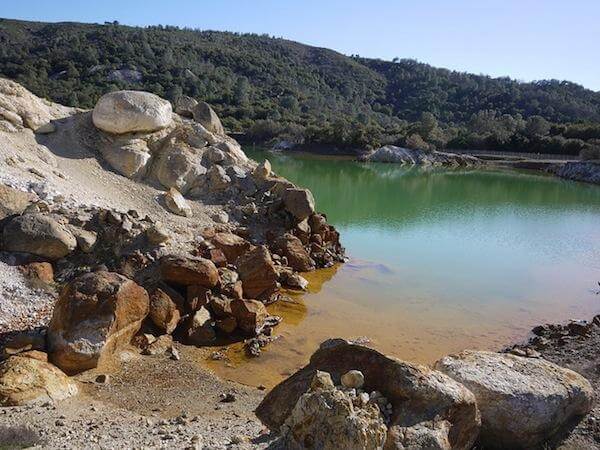
The largest polluter of Onondaga Lake was established in 1884 on its western shore. The Solvay Process Company, later known as Allied Chemical, and now renamed Honeywell, used Onondaga Lake as an industrial waste disposal site for over a century. More than 165,000 pounds of mercury were released into the lake, contaminating over seven million cubic yards of sediment and poisoning an entire ecosystem that had sustained the Onondaga people for thousands of years.
By 1994, the Environmental Protection Agency (EPA) categorized Onondaga Lake as a national superfund site, devising a cleanup plan with Honeywell and other responsible parties.
However, instead of removing toxic waste, the parties merely dredged limited areas and placed a cap over the lake bottom, trapping mercury and other pollutants beneath a barrier. Despite the EPA’s claims that caps put into place in 2012 solve the crisis, they have, in fact, trapped pollutants under a barrier without removing them.
The Onondaga Nation Government is not fooled: These measures “will fail, and whether it is in 10 years or 110 years, it is only a matter of time. And when that happens, the chemicals will be released into the ecosystem.”
“Mother Earth is a relative, not a resource”, Tonya Gonnella Frichner (Onondaga) explains. “Harmony with Nature, for Indigenous Peoples, has been our worldview goal and the basis of our existence. We have always served as stewards of Mother Earth, and we share with humanity these beliefs, which serve as the basis of our lifestyles.”
“It’s a reciprocal relationship that we have with all the living things around the lake and the water, it’s not a commodity,” adds Betty Lyons.
Gonella Frichner, who passed away in 2015, was the founder of the American Indian Law Alliance (AILA), with Betty Lyons serving as the current president. The foundation seeks to amplify Indigenous voices in their lakeback project, with hopes of a complete restoration of Onondaga Lake.
This history of land theft, industrial poisoning, failed remediation, and unfilled commitments forms the context for the county’s newest project: a $100 million aquarium built with money designated for the lake’s restoration. Seen in light of the Onondaga Lake’s history, the aquarium is neither a positive development nor a neutral one; it is the newest chapter in a long pattern of prioritizing profit, distraction, and spectacle over actual restoration with self-determination.
Long before Onondaga Lake became an industrial dumping ground, it was a central site of significance to Indigenous governance. Over a thousand years ago, the Nations that would form the Haudenosaunee Confederacy ended cycles of warfare through the creation of the Gayanashagowa, also known as the Great Law of Peace. This political transformation was rooted in place; Onondaga Lake sits at the geographic and diplomatic center of the Confederacy, where peace was established and continues to be upheld.
Under the great law of peace, the Seneca, Mohawk, Onondaga, Cayuga, and Oneida nations were united through a system of governance grounded in consent, responsibility, and long-term relations of reciprocity. Decisions were to be made with the welfare of future generations in mind, a principle often referred to as seven-generation thinking.
The great law of peace is remembered and reaffirmed through the Hiawatha wampum belt, a legal and material record of the Confederacy’s political order. The belt encodes a vision of governance based on balance and reciprocity, not on extraction or accumulation.
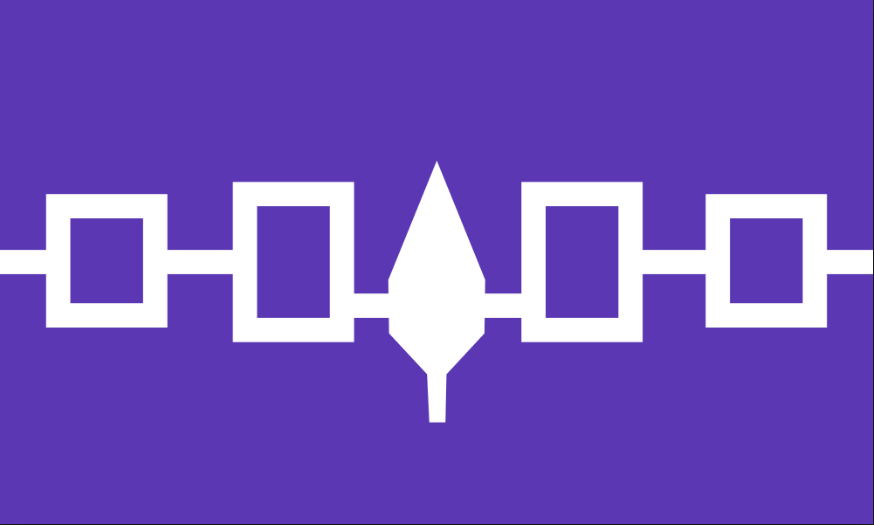
The Hiawatha Belt
This political philosophy profoundly shaped democratic thought in the United States. Benjamin Franklin acknowledged the influence of the Haudenosaunee governance on the formation of the United States, as well as the US Senate, through a formal declaration in 1987. Yet as settler colonial institutions borrowed democratic principles, they simultaneously violated the very Indigenous stems that provided them – seizing land, erasing Native sovereignty, and severing relationships to places like Onondaga Lake.
The lake not only holds spiritual sacrality; it is central to a system of governance that views land and water as integral to a collective way of life.
The pollution of Onondaga Lake – and the decisions made in the name of its “restoration” – must be understood against this backdrop. What is at stake is not simply environmental harm, but the continued isolation of relations that ground political order and Indigenous flourishing.
The Aquarium is a predictable continuation of the settler-colonial relations that destroyed Onondaga Lake long ago: a worldview in which industrial development is mistaken for progress, extraction is mistaken for restoration, and Indigenous governance is ever erased.
Although the project is thought to be the product of democratic decision-making, the lack of democracy itself is a part of the problem. The Onondaga Nation – the people this lake rightfully belongs to – had no consent or decision-making authority in whether an aquarium should rise on their relatives’ shores.
This redirection of restoration funds serves as a form of ecological laundering, a greenwashing of sorts that protects the reputations of polluters and political leaders while diverting the public’s attention from the underlying harm that remains unaddressed. Spectacle replaces substance, and markets replace healing.
“At every turn, the County prioritizes spectacle over substance, distraction over justice,” writes Adam Brett and Betty Lyons.
The deeper issue is not whether people should enjoy the lake. It is the assumption that enjoyment and economic benefit are the lake’s primary purposes.
As Onondaga teachers explain, the lake possesses agency, dignity, needs, and most importantly, rights. By building an aquarium on its shoreline, the county reproduces the same colonial land relations that enabled extraction. Entertainment becomes the newest form of settler-colonial extraction, as the lake continues to be treated as property, not kin.
Restoration cannot be measured solely by the tons of sediment removed. A lake that has been treated as disposable for centuries cannot be healed by technical solutions alone. It requires a transformation in who holds authority and responsibility over its future.
The Onondaga Nation estimated that a complete and sufficient cleanup would cost over $2 billion. No political leader or corporation is willing to bear this cost.
The refusal to commit to a genuine cleanup is also a refusal to confront the historical and political conditions that enabled the pollution of Onondaga Lake and the violation of the Onondaga Nation’s rights.
“No more band-aid solutions like capping mercury at the bottom of the lake,” write Brett and Lyons. “The only true path to restoration is the one the county continues to block; the return of Onondaga Lake to its rightful caretakers.”
To restore the lake, we must repair relations – not only with the water, but with the people who have maintained a reciprocal relationship with it for thousands of years. Onondaga History teaches that decisions ought to be grounded in responsibility, relationality, and long-term care.
“They need to think in terms of the seven generations,” Gonnella Frichner suggests. “You all have children and grandchildren, nieces and nephews who are dear to you, and you want to protect them. When do you start acting like a parent, a grandparent, an aunt, or an uncle, looking out for them and protecting them? Isn’t that your responsibility?”
Only by recognizing the sovereignty of the Onondaga Nation and returning authority over the lake can restoration move beyond spectacle to justice.
Restoration, in other words, is inseparable from self-determination. The future of Onondaga Lake depends on our willingness to restore relations with the Onondaga Nation that settler-colonialism has disrupted for centuries.
This article is a part of Hotspots, a journalistic collaboration between IC, Professor Manuela Picq and her students at Amherst College.
Across the world right now, Indigenous peoples are facing a renewed assault on their lands, rights, and ways of life.
From extractive industries pushing deeper into ancestral territories, to governments rolling back hard-won protections,
the threat is global—and it is growing.
What makes this moment especially dangerous is how little attention it receives.
Stories like this are disappearing in real time. Mainstream media
barely covers it and the coverage is fragmented. The public is left without the context
needed to understand what is truly at stake.
That is exactly why IC Magazine exists..
For more than 20 years, IC has reported on Indigenous struggles worldwide — consistently, independently, and without compromise.
We don’t follow news cycles; we trace patterns. We don’t sensationalize; we provide context.
And when the world looks away, we stay focused.
But this work is increasingly difficult to sustain.
We refuse to lock our reporting behind a paywall. We don’t sell access through subscriptions.
And we don’t answer to advertisers. IC Magazine survives solely because readers like you choose to
support independent Indigenous journalism.
Please donate today if you can. Every contribution helps us to continue this crucial work.
Thank you,
John Ahni Schertow
Founder and Editor in Chief