Last Updated on March 13, 2013
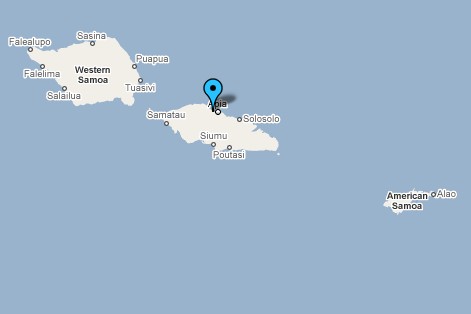
There is a tense standoff building in Samoa that “is likely to escalate into a violent confrontation if it is not resolved soon,” reports the Samoa Observer.
The Samoan government wants to remove a hedge fence that traces along the village of Lepea’s Malae – a sacred, traditional burial ground – so that it can expand the width of an existing road.
The Lepea village council is vehemently opposed to the plan, and have been so since it was first proposed more than two years ago. The council says they will not allow any part of the grounds to be used for the road.
Two weeks ago, Minister Fiame Naomi, from the Ministry of Women, Community and Social Development, fired the village’s Mayor and Intermediary, A’i Vavao, because he failed to obtain the village’s consent for the expansion.
“Unimpressed, the village council rejected Fiame’s directive,” and told A’i to ignore the dismissal and continue on with his role as Mayor — but only for the village, says A’i. “I will not be involved again with the government… This is what my village wants and I accept it.”
One week later, the Minister sent a letter to the council, asking if they’ve reached a decision on the road plan. The council responded by restating that they will not allow any part of the grounds to be used, because the area is important for future generations, but that they could use the opposite side of the road to expand if they wanted.
The village is now waiting for a response from the government.
“At this point, what we need to keep reminding ourselves is that problems are not solved by confrontation, but through the humbling practice called dialogue,” states Mata’afa Keni Lesa, Editor of The Samoa Observer.
“Since we know that confrontation will only aggravate and destroy, its important for us all to learn to forgive, forget and practise humility.
We believe the government should step in and end this fracas once and for all. If its not, we dread the day the project is scheduled to begin in Lepea.”
“Lets not forget that the Ministers and senior government officials who make these decisions will not be the ones driving the machines through Lepeas land. So lets pray that nothing nasty would happen as a result of all this.”
Across the world right now, Indigenous peoples are facing a renewed assault on their lands, rights, and ways of life.
From extractive industries pushing deeper into ancestral territories, to governments rolling back hard-won protections,
the threat is global—and it is growing.
What makes this moment especially dangerous is how little attention it receives.
Stories like this are disappearing in real time. Mainstream media
barely covers it and the coverage is fragmented. The public is left without the context
needed to understand what is truly at stake.
That is exactly why IC Magazine exists..
For more than 20 years, IC has reported on Indigenous struggles worldwide — consistently, independently, and without compromise.
We don’t follow news cycles; we trace patterns. We don’t sensationalize; we provide context.
And when the world looks away, we stay focused.
But this work is increasingly difficult to sustain.
We refuse to lock our reporting behind a paywall. We don’t sell access through subscriptions.
And we don’t answer to advertisers. IC Magazine survives solely because readers like you choose to
support independent Indigenous journalism.
Please donate today if you can. Every contribution helps us to continue this crucial work.
Thank you,
John Ahni Schertow
Founder and Editor in Chief