Last Updated on June 4, 2026
Seeking to deepen economic ties amid the turbulence of US trade tariffs, European and Mexican leaders have signed off on a revamped trade agreement.
The EU-Mexico Modernized Global Agreement (MGA), signed by European Commission President Ursula von der Leyen and Mexican President Claudia Shienbaum at a summit in Mexico city on 22nd May, aims to greatly expand trade between the partners by removing barriers remaining in the previous trade framework, in place since 2000.
Principally for Europe, the updated agreement empowers European companies to invest in Mexico’s national development strategy, Plan Mexico, and secures cheap access to critical raw materials–such as fluorspar, copper, and antimony–crucial to the European Union’s (EU) green and digital transformation.
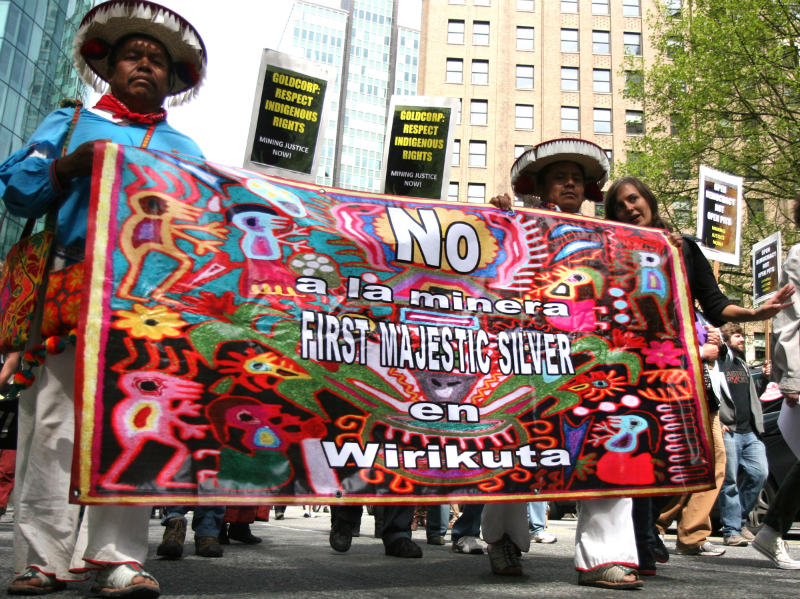
While the MGA contains commitments to human rights and civic participation, including a project to support the economic and social empowerment of Indigenous women, it falls short of establishing safeguards for Free, Prior and Informed Consent (FPIC) before extractive and industrial projects are launched by European companies on Indigenous lands. The omission leaves Indigenous communities exposed to environmental destruction and violence in the rush for development and critical minerals in Mexico.
“Mayan communities continue to face a lack of respect for free, prior and informed consent,” Said Bia’ni Madsa’ Juárez López, coordinator of Colectivo Comunidades por la Autonomía (Communities for Autonomy Collective), arguing that the MGA is likely to contribute to “the ongoing dispossession of Mayan lands [and] a rise in official and unofficial violence.”
Though not legally-binding, FPIC is a human right which provides the authority for Indigenous peoples to determine the terms of engagement and outcome of projects in their territories. The right is recognized in Mexican law, but spread incoherently across constitutional texts and treaties, creating confusion in its application. Within Mexico’s framework, responsibility lies with the project developer to decide if its actions require consent from indigenous communities.
FPIC in Mexico is routinely violated as a result. Last month, residents of Indigenous communities in the state of Sinaloa blocked access to a business event in protest of a planned methanol production plant developed by US company Transition Industries through its Mexican subsidiary Pacífico Mexinol. Residents claimed Pacifico Mexinol had not consulted communities set to face its environmental impact, which include “potential soil contamination from fuel, oil, or solvent spills” and “increased risks to worker and community health and safety”.
According to Fernando Hernandez, senior trade and investment policy officer at Both ENDS, an environmental justice NGO based in the Netherlands, the MGA was an opportunity to strengthen FPIC in Mexico by establishing proper safeguards and enforcement mechanisms. Instead, the agreement makes no reference to FPIC. In written input to the European Parliament’s Committee on International Trade last year, Hernandez wrote:
“[The MGA contains] no meaningful provisions on Indigenous rights. No safeguards for free, prior and informed consent before extractive projects are launched on Indigenous lands. These are not abstract concerns, they are lived realities, and when ignored, they are forms of exclusion.”
EU – Mexico trade is worth over $115b annually and the EU will invest across energy, transport, tourism and the digital transition as part of the updated agreement. Thousands of European companies already have a significant presence in Mexico, particularly across mining, machinery and transport. French company Alstom secured a government contract in 2021 to supply 42 trains, related railway systems and garages for the Tren Maya, a deeply controversial project in Yucatan criticised for causing severe damage to rainforest and cenotes – natural deepwater wells sacred to the Maya peoples.
“Projects such as the Mayan Railway and the CatVi (Chichén Itzá visitor centre) are being implemented in ways that are still directly affecting the way of life of the Pisté community,” said López. “These projects were given the green light without following the proper procedures, including the right to indigenous consent.”
López explained that the lack of provision strengthening FPIC in the MGA means the state, through the police, is likely to repress organized Indigenous movements with greater frequency as Yucatan sees an influx of foreign capital, using clashes between rival groups to achieve its objectives. “This is already happening in several cases with Maya communities”, she said.
A report released in April by the Mexican Centre for Environmental Rights (CEMDA in Spanish) found that acts of violence against environmental defenders in Mexico increased by 43% from 2024 to 2025, with 56.2% of these acts perpetrated by state authorities. Protecting existing and future foreign investment is known to motivate such state repression of civil action.
In addition, arbitration norms embedded in trade agreements, such as the investor-state dispute settlement (ISDS) mechanism, have been accused of incentivising state repression of environmental defenders by empowering multinational companies to sue states for damages to real, or predicted profits as a result of policy changes or civil action. EU companies have historically been the most active users of this mechanism globally, and Mexico is one of the most sued countries world-wide.
The MGA removes ISDS, replacing it with a new EU investor court system, but trade experts say that while the new system increases transparency in the arbitration, it does not fundamentally change the investment architecture empowering foreign investors to bring claims against Mexico (or the EU) if they consider their investments to be affected by regulation or civil action. Juan Miguel Alvarez Contreras, Lecturer and researcher in international economic law at Universidad Externado (Colombia), argues that the new court system “merely embraces modern treaty trends”, rather than changing the paradigm.
In his input to the European Parliament, Hernandez said “European investors will benefit from special protections through investment courts. But when communities in Mexico face land grabs or water contamination, their only recourse is domestic institutions already stretched thin. There is no parity here.”
Indigenous communities are at the forefront of impacts from extractive industries, particularly in Latin America and the Caribbean. A 2023 study found that the region has the highest proportion globally –73%–of transition minerals projects located on or near Indigenous peoples’ lands. Human rights networks, among them Mexican Network of Mining-Affected People (REMA), and academic studies have highlighted a systemic crisis in which corporate and political interests utilize armed groups to intimidate and displace communal landowners (‘ejidatarios’), allowing corporations to bypass community resistance to secure land for extractive projects.
Unless trade agreements such as the MGA actively safeguard FPIC and establish mechanisms for its enforcement, foreign investment is likely to continue to contribute towards this crisis of violence and dispossession in Mexico. For now, the MGA is agreed but not yet active; it must first be ratified by all constituent EU member states.
Across the world right now, Indigenous peoples are facing a renewed assault on their lands, rights, and ways of life.
From extractive industries pushing deeper into ancestral territories, to governments rolling back hard-won protections,
the threat is global—and it is growing.
What makes this moment especially dangerous is how little attention it receives.
Stories like this are disappearing in real time. Mainstream media
barely covers it and the coverage is fragmented. The public is left without the context
needed to understand what is truly at stake.
That is exactly why IC Magazine exists..
For more than 20 years, IC has reported on Indigenous struggles worldwide — consistently, independently, and without compromise.
We don’t follow news cycles; we trace patterns. We don’t sensationalize; we provide context.
And when the world looks away, we stay focused.
But this work is increasingly difficult to sustain.
We refuse to lock our reporting behind a paywall. We don’t sell access through subscriptions.
And we don’t answer to advertisers. IC Magazine survives solely because readers like you choose to
support independent Indigenous journalism.
Please donate today if you can. Every contribution helps us to continue this crucial work.
Thank you,
John Ahni Schertow
Founder and Editor in Chief