Last Updated on April 10, 2025
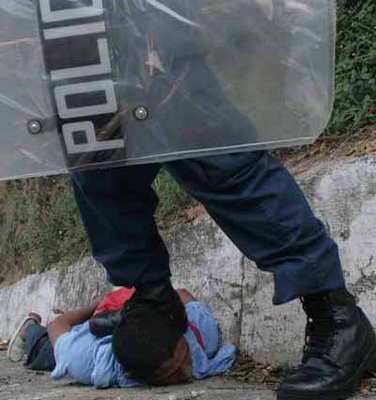
The Second International Congress of Indigenous People of the Americas (Abya Yala) began on Wednesday, October 8, in the Venezuelan state of Zulia.
The multi-national event, which concludes on October 12, will discuss a range issues, perhaps the most urgent being the matter of strengthening Indigenous peoples sovereignty throughout the hemisphere.
“One hundred international delegations and over 500,000 representatives from Venezuelan ethnic groups [are attending] the meeting”, reports Prensa Latina.
After the seminars and work groups come to an end, a closing ceremony will be held to coincide with the Indigenous Resistance day, in other places called the Day of the Race, and of course, Columbus Day, which marks 516 years since the “discovery” of America by
Christopher Columbus in 1492.
To mark the same day, October 12, Indigenous groups in Hawaii will be holding their 11th Annual Papal Bulls Burning ceremony.
The ceremony is a symbolic destruction of the Inter Caetera Bull of May 4, 1493, which is a decree that the Roman Catholic Church issued to Christopher Columbus on his second voyage to the Americas.
Along with the 1494 Treaty of Tordesillas, Inter Caetera sought to establish Christian
dominion over the world and called for the subjugation of non-Christian
peoples and seizure of their lands. De-humanizing them, the papal edict led the way to the genocide of an estimated 100 million indigenous people.
The papal bull has never been repealed by the Church.
For more information, visit www.bullsburning.itgo.com
Heading northward, several events have also been organized in Colorado. On October 11 there will be an “All Nations Four Directions” Resistance March — followed by
a gathering at the Iliff School of Theology in Denver that will aim to organize a new local alliance to act as a national vehicle for radicals.
For more information, visit www.coloradoaim.org and www.transformcolumbusday.org
Across the world right now, Indigenous peoples are facing a renewed assault on their lands, rights, and ways of life.
From extractive industries pushing deeper into ancestral territories, to governments rolling back hard-won protections,
the threat is global—and it is growing.
What makes this moment especially dangerous is how little attention it receives.
Stories like this are disappearing in real time. Mainstream media
barely covers it and the coverage is fragmented. The public is left without the context
needed to understand what is truly at stake.
That is exactly why IC Magazine exists..
For more than 20 years, IC has reported on Indigenous struggles worldwide — consistently, independently, and without compromise.
We don’t follow news cycles; we trace patterns. We don’t sensationalize; we provide context.
And when the world looks away, we stay focused.
But this work is increasingly difficult to sustain.
We refuse to lock our reporting behind a paywall. We don’t sell access through subscriptions.
And we don’t answer to advertisers. IC Magazine survives solely because readers like you choose to
support independent Indigenous journalism.
Please donate today if you can. Every contribution helps us to continue this crucial work.
Thank you,
John Ahni Schertow
Founder and Editor in Chief