Last Updated on February 8, 2016
A couple of bills are floating through the Washington Legislature to lower the bar for large cattle ranchers’ impacts on treaty-protected food.
The Lummi Nation has opposed the pair of bills (HB 2840 and SB 6568).
You can watch the testimony by the tribe’s lobbyist here.
No one has the right to pollute water resources relied on by others, particularly those citizens with a treaty-protected right to harvest shellfish. The… permit being developed by Ecology will not be perfect and is no panacea to stop all contamination and closure of shellfish beds. However, passing legislation to delay and dilute the CAFO permit that is under development is absolutely a step in the wrong direction.
Last year the Lummi Nation documented the huge impact water pollution is having on the tribe’s treaty-protected resources:
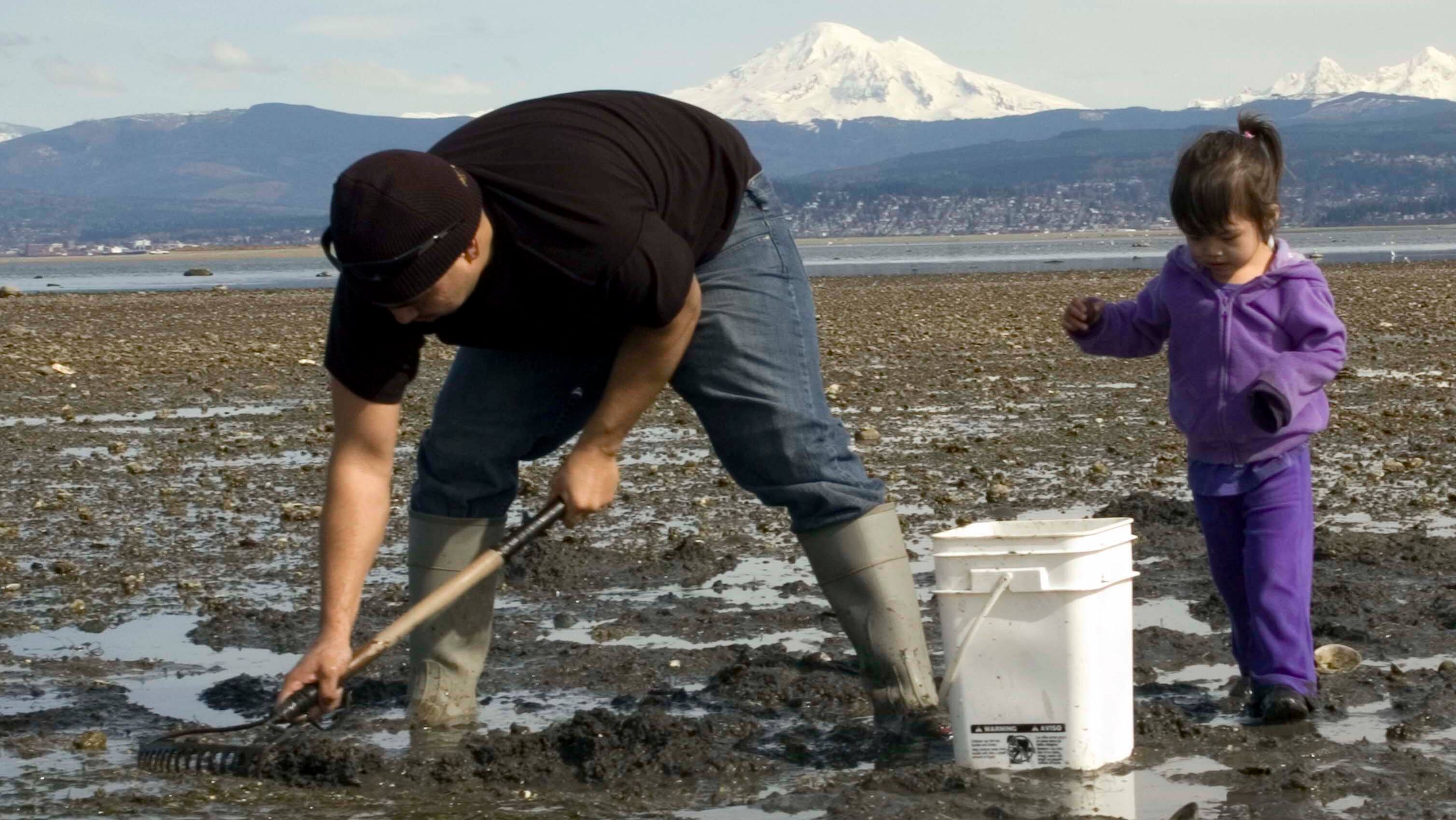
Manure from dairy cows is discharged either directly or indirectly into the Nooksack River, which flows into Portage Bay. In September, the tribe closed 335 acres of Portage Bay shellfish beds to harvest because of high fecal coliform levels that exceeded National Shellfish Sanitation Program standards. Continued poor water quality led to the closure of two additional areas in December, bringing the total to nearly 500 acres of shellfish beds that are unsafe to harvest. More areas may have to be closed in the coming months if conditions are not improved.
Lummi shellfish harvesters lost an estimated $8 million in revenue from 1996 to 2006, when 180 acres of Portage Bay shellfish beds were closed for the same reason. The Lummi Nation is pressing state and federal agencies to do a better job of keeping dairy farm manure out of the Nooksack River.
The tribe called on state regulators to do the right thing even earlier:
“I remember when the Portage Bay shellfish beds were re-opened in 2006 – unfortunately, some people haven’t kept up their end of the deal to keep waste out of our water,” said Merle Jefferson, Lummi natural resources director. “As a result, tribal members who did not pollute the water nevertheless have to suffer the consequences of actions or inactions of our upstream neighbors.”
About 200 Lummi families make their living harvesting shellfish, and as many as 5,000 community members rely on the shellfish beds for ceremonial and subsistence purposes.
“Failure of our upstream partners to follow the policies developed to respond to the last closure has led to this disaster,” said Lummi Nation Chairman Timothy Ballew II. “Immediate actions are needed to right the problem.”
Across the world right now, Indigenous peoples are facing a renewed assault on their lands, rights, and ways of life.
From extractive industries pushing deeper into ancestral territories, to governments rolling back hard-won protections,
the threat is global—and it is growing.
What makes this moment especially dangerous is how little attention it receives.
Stories like this are disappearing in real time. Mainstream media
barely covers it and the coverage is fragmented. The public is left without the context
needed to understand what is truly at stake.
That is exactly why IC Magazine exists..
For more than 20 years, IC has reported on Indigenous struggles worldwide — consistently, independently, and without compromise.
We don’t follow news cycles; we trace patterns. We don’t sensationalize; we provide context.
And when the world looks away, we stay focused.
But this work is increasingly difficult to sustain.
We refuse to lock our reporting behind a paywall. We don’t sell access through subscriptions.
And we don’t answer to advertisers. IC Magazine survives solely because readers like you choose to
support independent Indigenous journalism.
Please donate today if you can. Every contribution helps us to continue this crucial work.
Thank you,
John Ahni Schertow
Founder and Editor in Chief