
Last Updated on May 27, 2016
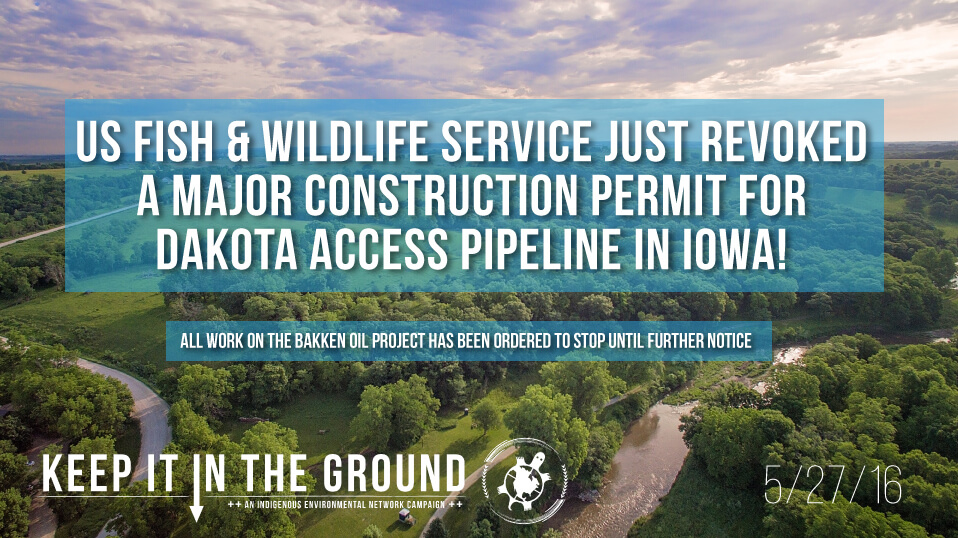
Des Moines, IA – The United States Fish and Wildlife Service has revoked its approval of a construction permit for the Dakota Access pipeline through the Big Sioux River Wildlife Management Area in Northeast Iowa. This permit is called the Sovereign Lands Construction Permit and was revoked because a significant Native American archaeological site was discovered along its proposed path. Due to the permit revocation, the Iowa Department of Natural Resources has ordered that Dakota Access LLC stop all construction work for its Bakken oil pipeline until a survey of the area is conducted and consultation with local agencies and tribes is completed.
The Dakota Access project is a 1,168-mile Bakken oil pipeline proposed to carry up to 450,000 barrels per day. The pipeline would cross the “Breadbasket of America” through the states of North Dakota, South Dakota, Iowa and Illinois.
Dallas Goldtooth, Keep It In the Ground Campaign Organizer for The Indigenous Environmental Network gives the following statement:
“This action by Fish & Wildlife Service sets a precedent we hope other local and federal agencies, like the Army Corps of Engineers, take notice of and follow. We must not allow Big Oil to trample Indigenous rights, landowner rights, and federal policies that aim to protect the land, water, and culturally significant sites. Dakota Access is against the ropes, now is the time to deliver the final blows and stop this pipeline.”
###
Press Contact:
Dallas Goldtooth, 708-515-6158, dallas@ienearth.org
Across the world right now, Indigenous peoples are facing a renewed assault on their lands, rights, and ways of life.
From extractive industries pushing deeper into ancestral territories, to governments rolling back hard-won protections,
the threat is global—and it is growing.
What makes this moment especially dangerous is how little attention it receives.
Stories like this are disappearing in real time. Mainstream media
barely covers it and the coverage is fragmented. The public is left without the context
needed to understand what is truly at stake.
That is exactly why IC Magazine exists..
For more than 20 years, IC has reported on Indigenous struggles worldwide — consistently, independently, and without compromise.
We don’t follow news cycles; we trace patterns. We don’t sensationalize; we provide context.
And when the world looks away, we stay focused.
But this work is increasingly difficult to sustain.
We refuse to lock our reporting behind a paywall. We don’t sell access through subscriptions.
And we don’t answer to advertisers. IC Magazine survives solely because readers like you choose to
support independent Indigenous journalism.
Please donate today if you can. Every contribution helps us to continue this crucial work.
Thank you,
John Ahni Schertow
Founder and Editor in Chief