Last Updated on August 13, 2026
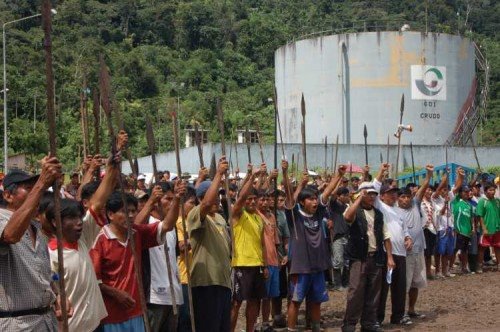
A group of previously-uncontacted Tribal People from the East Coast of Peru have recently appeared at a village in Brazil. The people fled from their territory, it is thought, because of illegal logging activities on their land. Loggers are currently sweeping through it, in search of an exceedingly rare kind of Mahogany tree, commonly referred to as “red gold”
From Survival International – A large group of uncontacted Indians has appeared in a remote village in the Amazon rainforest near the Peru-Brazil border, a Brazilian government official and expert on uncontacted tribes has reported.
The Indians are believed to have fled from Peru into Brazil because of illegal loggers sweeping through Peru’s rainforests in search of rare mahogany, known as ‘red gold.’ The loggers are destroying the Indians’ territories, forcing them to seek refuge elsewhere and leading to dangerous contacts with outsiders.
The Indians suddenly appeared at a village called Bananeira and spent a day and a night there. Another, smaller group of uncontacted Indians was also spotted at a nearby settlement called Liberdade.
‘We are on the verge of disaster. Illegal logging in protected areas in Peru is pushing the uncontacted tribes into Brazil, which could cause conflicts and lead to their appearance in places where they have never been seen before,’ said José Carlos dos Reis Meirelles Júnior, head of the Indian Protection post near the Peru border. Mr Meirelles made his statement in an urgent alert sent to the Brazilian government.
Peru has some of the world’s last commercially-viable mahogany stands in the world, growing in areas inhabited by some of the world’s last uncontacted tribes. Because of their isolation, the tribes do not have immunity to outsiders’ diseases and any form of contact with them can be fatal.
Stephen Corry, Survival’s Director, said today, ‘If it’s not ‘black gold’, it’s ‘red gold.’ The Peruvian government must act now to stop the logging on the uncontacted tribes’ land. If it doesn’t, they could be the first people to be made extinct in the 21st century.’ (source)
For further information contact Miriam Ross on (+44) (0)20 7687 8734 or email mr@survival-international.org
Across the world right now, Indigenous peoples are facing a renewed assault on their lands, rights, and ways of life.
From extractive industries pushing deeper into ancestral territories, to governments rolling back hard-won protections,
the threat is global—and it is growing.
What makes this moment especially dangerous is how little attention it receives.
Stories like this are disappearing in real time. Mainstream media
barely covers it and the coverage is fragmented. The public is left without the context
needed to understand what is truly at stake.
That is exactly why IC Magazine exists..
For more than 20 years, IC has reported on Indigenous struggles worldwide — consistently, independently, and without compromise.
We don’t follow news cycles; we trace patterns. We don’t sensationalize; we provide context.
And when the world looks away, we stay focused.
But this work is increasingly difficult to sustain.
We refuse to lock our reporting behind a paywall. We don’t sell access through subscriptions.
And we don’t answer to advertisers. IC Magazine survives solely because readers like you choose to
support independent Indigenous journalism.
Please donate today if you can. Every contribution helps us to continue this crucial work.
Thank you,
John Ahni Schertow
Founder and Editor in Chief