Last Updated on February 8, 2012
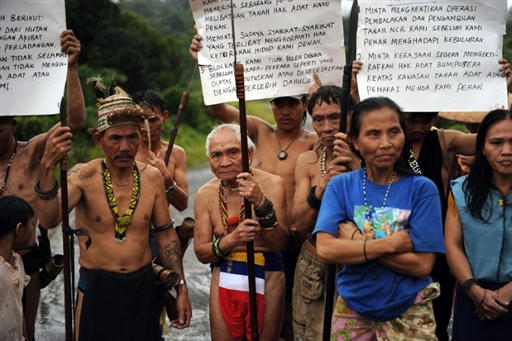
In this video, an Iban Dayak community in Sarawak, Malaysian Borneo describes ten years of struggle to protect their ancestral rainforests, using letter writing, blockades, community mapping and court action against Borneo Pulp and Paper and the Sarawak government.
In 2001, they won a landmark court case, where it was agreed that Rumah Nor did have a native customary land rights over their traditional territory (“pemakai menoa”) — including the “disputed area” which was being destroyed by Borneo Pulp Plantation, a subsidiary of Borneo Pulp & Paper and Asia Pulp & Paper.
Their victory was partially overturned in 2005 by the State Appeals Court, who said there was insufficient evidence to prove the “occupation of the disputed area”. Their rights over lands outside the area, however, continued to be acknowledged.
The community is appealing this decision in Federal Court. Once a decision is made, it will set an important precedent for hundreds of indigenous communities that are fighting for rights to their traditional lands.
This 27 minute film was produced by The Borneo Project and the community of Rumah Nor, Sebauh, Sekabai, Bintulu, Sarawak, Malaysia
If you would like to learn more about this issue, please visit The Borneo Project website, or see this article on ECOWorld
Across the world right now, Indigenous peoples are facing a renewed assault on their lands, rights, and ways of life.
From extractive industries pushing deeper into ancestral territories, to governments rolling back hard-won protections,
the threat is global—and it is growing.
What makes this moment especially dangerous is how little attention it receives.
Stories like this are disappearing in real time. Mainstream media
barely covers it and the coverage is fragmented. The public is left without the context
needed to understand what is truly at stake.
That is exactly why IC Magazine exists..
For more than 20 years, IC has reported on Indigenous struggles worldwide — consistently, independently, and without compromise.
We don’t follow news cycles; we trace patterns. We don’t sensationalize; we provide context.
And when the world looks away, we stay focused.
But this work is increasingly difficult to sustain.
We refuse to lock our reporting behind a paywall. We don’t sell access through subscriptions.
And we don’t answer to advertisers. IC Magazine survives solely because readers like you choose to
support independent Indigenous journalism.
Please donate today if you can. Every contribution helps us to continue this crucial work.
Thank you,
John Ahni Schertow
Founder and Editor in Chief