Last Updated on May 19, 2019
Plans are now underway to construct the largest coal export facility in North America at Cherry Point, in northwest Washington State. The Gateway Pacific Terminal, a project of Pacific International Terminals, would be owned by SSA Marine, which is owned by Carrix (who is partnered with Goldman Sachs).
Coal mined from the Powder River Basin by Peabody Energy would be hauled by train along the BNSF rail lines. The coal train corridor extends from mines in Montana and Wyoming through Sandpoint, Idaho to Spokane, down through the Columbia River Gorge, then up along the Puget Sound coast, passing through Longview, Tacoma, Seattle, Edmonds, Everett, MT. Vernon, Bellingham, Ferndale and all points in between.
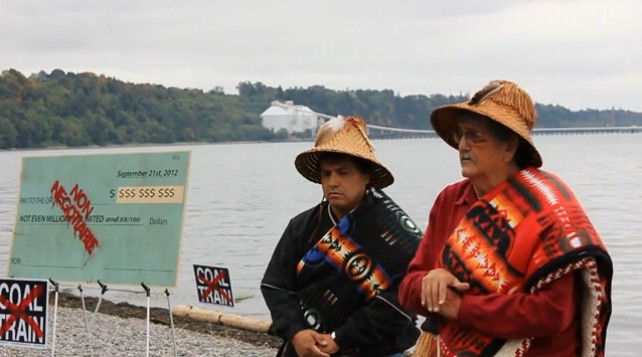
Costs to local economies, public health, and rail corridor communities are concerning to many, including Jay Julius, a fisherman and a member of the Lummi Nation tribal council. Lummi people have lived on the shores of Puget Sound for thousands of years. Not far from their reservation lies… Cherry Point (Xwe’ chi’ eXen).
In the waters off Cherry Point, Lummi fishers harvest halibut, salmon, herring, crab and shellfish. Julius worries that the increased coal tanker traffic would harm the tribe’s ability to exercise their treaty-guaranteed rights to harvest these fish and shellfish.
“One accident inside the Salish Sea and my way of life is gone,” Julius says.
If the terminal is built, he says, it could also destroy underwater archaeological sites and upland burial grounds.
It must be stopped.
audio by Ashley Ahearn, Katie Campbell / photography by Katie Campbell, Michael Werner / more voices of coal earthfix.info/coal
Across the world right now, Indigenous peoples are facing a renewed assault on their lands, rights, and ways of life.
From extractive industries pushing deeper into ancestral territories, to governments rolling back hard-won protections,
the threat is global—and it is growing.
What makes this moment especially dangerous is how little attention it receives.
Stories like this are disappearing in real time. Mainstream media
barely covers it and the coverage is fragmented. The public is left without the context
needed to understand what is truly at stake.
That is exactly why IC Magazine exists..
For more than 20 years, IC has reported on Indigenous struggles worldwide — consistently, independently, and without compromise.
We don’t follow news cycles; we trace patterns. We don’t sensationalize; we provide context.
And when the world looks away, we stay focused.
But this work is increasingly difficult to sustain.
We refuse to lock our reporting behind a paywall. We don’t sell access through subscriptions.
And we don’t answer to advertisers. IC Magazine survives solely because readers like you choose to
support independent Indigenous journalism.
Please donate today if you can. Every contribution helps us to continue this crucial work.
Thank you,
John Ahni Schertow
Founder and Editor in Chief