Last Updated on April 7, 2025
Western Sahara: dueling proposals on territory future
from the WW4Report
April 11, 2007
Morocco and the Polisario Front independence movement have both turned proposals for the future status of Moroccan-occupied Western Sahara over to the UN. The Moroccan proposal calls for regional autonomy for the region under Morocco’s sovereignty. The Polisario proposal calls for a referendum with three options: local autonomy, complete integration with Morocco, or independence. Polisario’s plan does offer a “special relationship” with Morocco, maintaining close economic and political ties, even in the case of independence.
The Moroccan plan “aims to allow all Saharawis to democratically manage their affairs, while respecting the sovereignty and territorial integrity of the kingdom,” Morocco’s ambassador, El Mostafa Sahel, said in a statement. (AP, April 11)
Polisario leader Mohamed Abdelaziz, said his organization’s proposal is “a flexible and constructive project” that guarantees the national rights of the Saharawi people, as demanded by UN General Assembly resolutions respecting the Saharawis’ “right to self-determination through a…referendum.” (Sahara Press Service, April 11)
Background
!n 1884/5, when the European States assembled at the Berlin Conference to divide Africa amongst its selves, Western Sahara was placed under the “protection of Spain” whom then occupied the region.
The Saharawi People, who had lived in the Western Sahara for over 2000 years, resisted the occupation… until 1934, when the resistance movement was considered to be ‘stamped out.’
In the late 1960’s, an anti-colonial movement called “Harakat Tahrir Saguia El Hamra wa Uad Ed-Dahab” or (Organization for the Liberation of Saguia El Hamra y Rio de Oro) took form. In 1970, the movement organized a large, peaceful gathering, demanding the right to independence. It ended with the massacre of civilians and the arrest of hundreds of citizens.
3 years later, the Polisario Front was founded, which then engaged in armed struggle to remove Spain and achieve independence for the People of Western Sahara.
Shortly after this, the Madrid Accords were signed between Spain, Morocco and Mauritania. Spain withdrew from the territory which was divided amongst Mococco and Mauritania.
Immediately after, the Polisario proclaimed the Sahrawi Arab Democratic Republic, evacuated thousands from the region, and waged war against both Morocco and Mauritania.
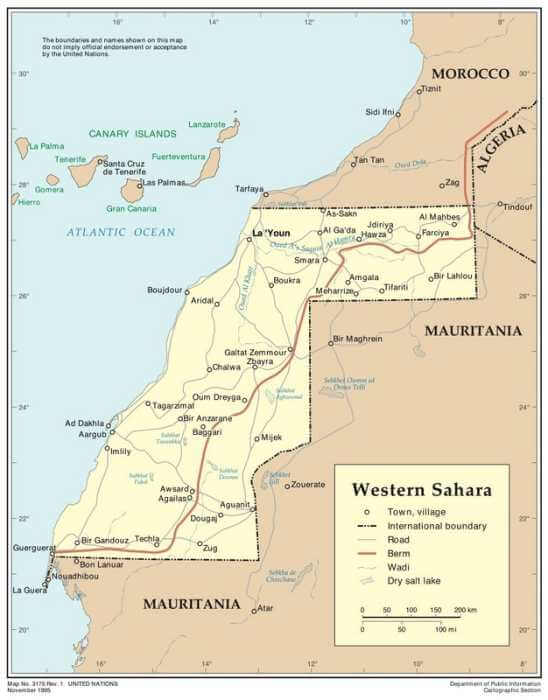
In 1979, the Polisario and Mauritania signed an agreement, when Mauritania renounced its claim to Western Sahara and promised to withdraw completely from the region. But this was not the case with Morocco, who actively engaged the Polisario, and constructed a berm that divided the region in two.
Conflict with Morocco continued until 1991, when a tentative ceasefire agreement was reached.
According to Wikipedia, the Polisario:
[stated] it will pursue its goal of Western Sahara’s independence by peaceful means as long as Morocco complies with the cease-fire conditions, which include arranging a referendum on independence, while reserving the right to resume armed struggle if terms are breached in its view.” (source)
The proposed referendum has been delayed atleast 12 times by Morocco (and by the UN) since 1991.
Further Reading
Across the world right now, Indigenous peoples are facing a renewed assault on their lands, rights, and ways of life.
From extractive industries pushing deeper into ancestral territories, to governments rolling back hard-won protections,
the threat is global—and it is growing.
What makes this moment especially dangerous is how little attention it receives.
Stories like this are disappearing in real time. Mainstream media
barely covers it and the coverage is fragmented. The public is left without the context
needed to understand what is truly at stake.
That is exactly why IC Magazine exists..
For more than 20 years, IC has reported on Indigenous struggles worldwide — consistently, independently, and without compromise.
We don’t follow news cycles; we trace patterns. We don’t sensationalize; we provide context.
And when the world looks away, we stay focused.
But this work is increasingly difficult to sustain.
We refuse to lock our reporting behind a paywall. We don’t sell access through subscriptions.
And we don’t answer to advertisers. IC Magazine survives solely because readers like you choose to
support independent Indigenous journalism.
Please donate today if you can. Every contribution helps us to continue this crucial work.
Thank you,
John Ahni Schertow
Founder and Editor in Chief