Last Updated on March 13, 2013
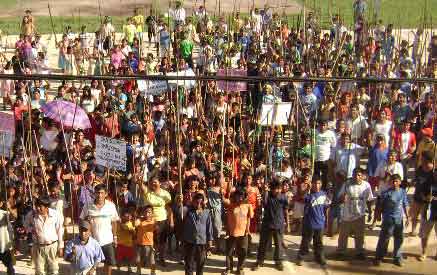
This is a trailer to the film Tambogrande (2003), the story of proud fruit growers from Peru’s northern coast who came together to defend their lands and culture from foreign (Canadian) mining interests.
Canadian-based Manhattan Minerals was granted concessions by the government in the 1990’s to extract an estimated US$1 billion in gold, silver, copper and zinc from beneath the streets of Tambogrande.
The people were at no point consulted about this; and even though Manhattan made some significant offers to them, it was just not worth the cost. “The proposed mine for Tambogrande would have comprised a kilometer-wide open pit, and required the relocation of roughly half the 16,000 residents.”
The People simply decided to keep their mangoes–and went on to launch “an innovative campaign to keep the mine out, drawing on traditional music, street art and colourful demonstrations. They’ve even sent an eclectic troupe of dancing limes to the streets of the nation’s capital.”
Manhattan responded with a veritable public relations war, drawing support from their allies and proponents, the members of the Peruvian Government, news media, the mining industry and the Canadian embassy in Lima.
Manhattan’s campaign however, proved to be fruitless. In June 2001, the people of Tambogrande organized and held the world’s first referendum on mining… All told, more than 70 percent of the community participated, 93 percent of them voting NO to the mine.
Following this historic precedent, a peaceful three-day strike was held in November 2003 by community residents to express continued opposition to the project. The strike culminated in a massive rally attended by 10,000 people in the main square of Tambogrande.
One month later, “Centromin Peru, the government agency with whom Manhattan has entered into an option agreement in respect of the Tambogrande concessions, decided to terminate Manhattan Minerals’ concession to develop the Tambogrande gold mine.”
Today, Tambogrande remains intact. However, Manhattan Minerals still holds concessions to large areas of land in the region.
Local communities continue their struggle to protect their agriculturally-based livelihoods from the impacts of mining.
Visit the official web page for the film
Across the world right now, Indigenous peoples are facing a renewed assault on their lands, rights, and ways of life.
From extractive industries pushing deeper into ancestral territories, to governments rolling back hard-won protections,
the threat is global—and it is growing.
What makes this moment especially dangerous is how little attention it receives.
Stories like this are disappearing in real time. Mainstream media
barely covers it and the coverage is fragmented. The public is left without the context
needed to understand what is truly at stake.
That is exactly why IC Magazine exists..
For more than 20 years, IC has reported on Indigenous struggles worldwide — consistently, independently, and without compromise.
We don’t follow news cycles; we trace patterns. We don’t sensationalize; we provide context.
And when the world looks away, we stay focused.
But this work is increasingly difficult to sustain.
We refuse to lock our reporting behind a paywall. We don’t sell access through subscriptions.
And we don’t answer to advertisers. IC Magazine survives solely because readers like you choose to
support independent Indigenous journalism.
Please donate today if you can. Every contribution helps us to continue this crucial work.
Thank you,
John Ahni Schertow
Founder and Editor in Chief