Last Updated on June 16, 2014
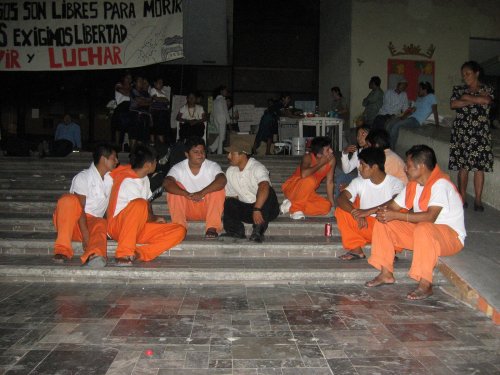
This past Sunday an assembly was held in the Acapulco municipality of Guerrero, Mexico to decide upon the fate of La Parota Dam…. This occurred a little over a week after Senator Felix Salgado Macedonio said the People who would be effected by the completion of La Parota must be allowed to do just that: decide on whether or not la Parota may be completed.
The community of Cacahuatepec agreed to reject La Parota.
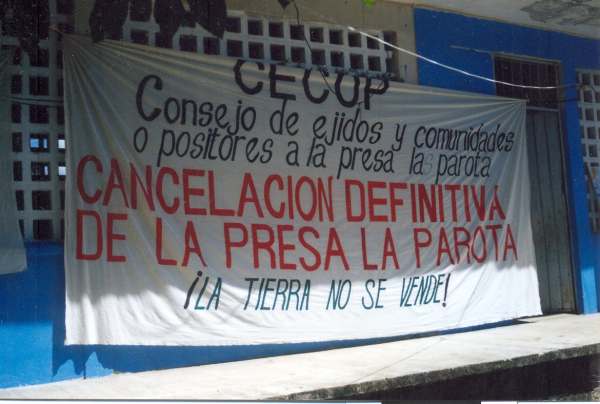
A Spokesperson from the Council of Ejidos and Communities Against La Parota Dam (CECOP) cried out “La Parota is over, colleagues, it is literally over, no more assemblies!” after he finished reading the agreement of the community.
Unfortunately, unsuprisingly—the Federal Electricity Commission considers the decision to be null—because they say the assembly was not ‘informative enough.’
From Real World Radio – Sunday’s assembly in Aguascalientes town, within Cacahuatepec community lands, in Acapulco municipality, unanimously decided to oppose La Parota dam planned to be built there, and to not carry out another assembly on the hydroelectric project. The resolutions were written in a document agreed between the opposers to the project, led by CECOP, and the residents of the area that supported it.
However, the Federal Electricity Commission, that promotes the construction of the dam, considers the decision of the peasants is null because the assembly was informative. Now the country’s agrarian authorities will have to decide on the implementation of the resolutions on Sunday.
La Parota, that would be a giant infrastructure work on Papagayo river, would imply flooding over 17,000 hectares of land, directly affecting nearly 25,000 peasants from five municipalities of Guerrero state, according to CECOP.
Another 50,000 peasants would be indirectly affected by the dam, which would be 190 meters tall in the area of Cacahiatepec community properties.
According to Mexican newspaper La Jornada, during Sunday’s assembly the Federal Electricity Commission defended the project before the peasants of the area. According to government officials, La Parota would only affect 250 people and there would be a short number of flooded lands, while the project would bring development, employment and prosperity.
Meanwhile, the CECOP invited some energy experts to submit their positions on the project. The experts considered that the work is just a pretext to privatize the Federal Electricity Commission and privatize water, and that the dam would affect the ecology, culture and livelihood of the peasants.
For CECOP the popular decision on La Parota was already made, while it announced that from now on, it will work with other hydroelectric projects of the country. (source)
See https://icmagazine.org/the-end-of-la-parota/ for background
Across the world right now, Indigenous peoples are facing a renewed assault on their lands, rights, and ways of life.
From extractive industries pushing deeper into ancestral territories, to governments rolling back hard-won protections,
the threat is global—and it is growing.
What makes this moment especially dangerous is how little attention it receives.
Stories like this are disappearing in real time. Mainstream media
barely covers it and the coverage is fragmented. The public is left without the context
needed to understand what is truly at stake.
That is exactly why IC Magazine exists..
For more than 20 years, IC has reported on Indigenous struggles worldwide — consistently, independently, and without compromise.
We don’t follow news cycles; we trace patterns. We don’t sensationalize; we provide context.
And when the world looks away, we stay focused.
But this work is increasingly difficult to sustain.
We refuse to lock our reporting behind a paywall. We don’t sell access through subscriptions.
And we don’t answer to advertisers. IC Magazine survives solely because readers like you choose to
support independent Indigenous journalism.
Please donate today if you can. Every contribution helps us to continue this crucial work.
Thank you,
John Ahni Schertow
Founder and Editor in Chief