Last Updated on April 10, 2025
The Dominion has recently published it’s special issue on the Alberta tar sands; and has since last Monday , been publishing roughly one article a day about this massive, barely understood human rights and environmental disaster.
Four of the articles published so far have focused on the impact of tar sands development on indigenous people. In light of the seriousness of this issue and in respect to the effort of the Dominion to raise peoples awareness, I thought I’d briefly outline them…
The first article, “Oil Versus Water,” details the impact oil extraction is having on the Athabasca river system, the land, and on the community of Fort Chipewyan. Among many disturbing points, the article shows the ready-made potential “breach of [the] massive tailing ponds near Fort McMurray, which now cover[s] an estimated 50-square kilometres. “Those ponds are acutely toxic material, so they would affect things probably well down the Athabasca and into the Slave River, and possibly beyond the Slave Delta.”
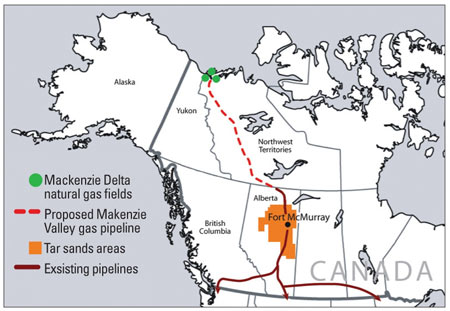
The second article, Gateway to Solidarity? discusses the struggle of the Carrier Sekani Tribal Council against the proposed pipeline that would lead from the tar sands right on to their territory (see map) without their involvement, consent, or benefit… The author notes how “Communities already dealing with a chronic lack of funding, time and personnel are now being forced to use scarce resources–rerouted from education, social services and other community portfolios–to try to stay ahead of the wave of large-scale industrial development and pressures resulting from the insatiable advances of industry;” and that the only viable option for justice seems to be an active relationship of solidarity between First Nations and Canadians.
The third article, “We Speak for Ourselves,” was published a few days ago. It discusses the impact of the unbridled development scheme that’s threatening the culture and livelihoods of The Dene, Cree and Metis communities in Treaty 8 and Treaty 11 Territories. The author raises an important point regarding the need of Dene, Cree and Metis leadership to “look beyond a dependence on a fossil-fuel regime and be visionaries and doers, supporting the development of clean production and clean renewable energy within their lands.”
Development does not have to entail the violation of the land, and it does not mean we need to compromise our Nations…. On top of “environmentally sound lifestyles, economic livelihoods and healthy, sustainable communities;” the article ends, “as Indigenous peoples, we have a sacred responsibility to protect our human rights and to practice our cultural and spiritual beliefs.” This means we set our own standards. There is no need to follow Canada’s lead, or be left in the cancer-ridden dirt because Canada is unable to engage in sustainable practices.
Finally, yesterday the Dominion published “A New Wave of Exploitation” which examines the struggles of the Lubicon and the growing sell-off of their traditional territory for tar sands exploitation.
This article reveals the full spectrum of problems facing not only the Lubicon, but all Indigenous People effected. The article explains, “these massive resource exploitation activities have decimated the Traditional Lubicon hunting and trapping economy and way of life;” “and threaten[ed] the very existence of the Lubicon Lake People as a distinct Indigenous society. With the onset of resource exploitation has come terrible social and health problems which the Lubicon people never had to face before, such as asthma and other respiratory problems, cancers of all kinds, skin diseases and miscarriages.”
“With a new wave of even more damaging resource exploitation arriving at their doorstep, the Lubicon people are bracing for the worst. Reckless water use, oil spills, further degradation of the groundwater, increased toxic emissions, further decimation of fisheries and wildlife, more roads, trucking, seismic lines and the spectre of nuclear waste haunt their future.”
I encourage you to learn more about the tar sands because the whole scheme is a massive assault on human rights and the environment—one of Canada’s best kept secrets.
You see all of the Dominions articles on the tar sands at http://www.dominionpaper.ca/issue/48
And if you’d like to help Dominion Paper get the word out, see http://www.dominionpaper.ca/tarsands
Across the world right now, Indigenous peoples are facing a renewed assault on their lands, rights, and ways of life.
From extractive industries pushing deeper into ancestral territories, to governments rolling back hard-won protections,
the threat is global—and it is growing.
What makes this moment especially dangerous is how little attention it receives.
Stories like this are disappearing in real time. Mainstream media
barely covers it and the coverage is fragmented. The public is left without the context
needed to understand what is truly at stake.
That is exactly why IC Magazine exists..
For more than 20 years, IC has reported on Indigenous struggles worldwide — consistently, independently, and without compromise.
We don’t follow news cycles; we trace patterns. We don’t sensationalize; we provide context.
And when the world looks away, we stay focused.
But this work is increasingly difficult to sustain.
We refuse to lock our reporting behind a paywall. We don’t sell access through subscriptions.
And we don’t answer to advertisers. IC Magazine survives solely because readers like you choose to
support independent Indigenous journalism.
Please donate today if you can. Every contribution helps us to continue this crucial work.
Thank you,
John Ahni Schertow
Founder and Editor in Chief