
Last Updated on October 7, 2013
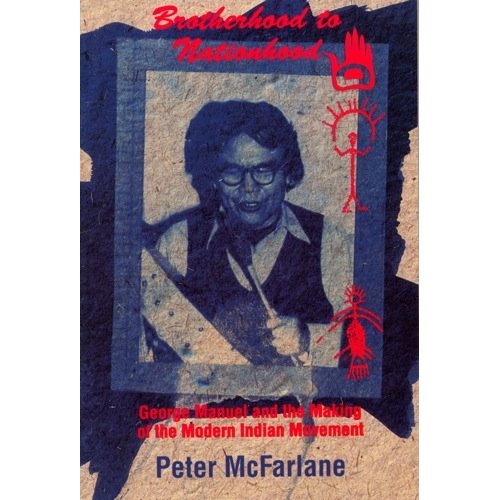
I just finished reading Brotherhood to Nationhood by Peter McFarlane, the biography of the legendary First Nations leader and world indigenous organizer, the late Grand Chief George Manuel from British Columbia. As the principal strategist and spokesman for the self-determination of Canadian Indians from the 1950s to the 1980s, it’s hard to overstate the key role he played in changing the relationship between Ottawa and the hundreds of Indian bands, as well as the public understanding of aboriginal rights worldwide.
Suffice to say that the voice the Maori, the Saami, the Bushmen, and the Basques now have in bodies like the UN, are in no small part due to his efforts. The fact that he gave his life to this cause is well-known; the fact that he was willing to die to preserve the Indian way of life perhaps less so.
Few likely recall that in the early 1970s, extermination of indigenous societies in North America was still the agenda of all three federal governments, forcing Mohawk, Lakota, and Maya warriors to literally take up arms in defense. As the premier leader of the liberation struggle in Canada, Manuel had to take into account the possibility of going underground should the Canadian government escalate its violence toward the First Nations movement.
Accordingly, Manuel assumed his responsibilities as a War Chief preparing for that eventuality should his diplomatic efforts fail–duties that prompted him to consult with both the African National Congress and the Irish Republican Army. To his relief, the pressure he was able to bring to bear against Canadian apartheid — through European states, organizations, and institutions — was sufficient to forestall armed conflict.
And maybe that’s his greatest legacy: the recognition and willingness of Euro-Canadians to respect and coexist with the First Nations as they continue to negotiate their relationships into the future–a future that was purchased by more than just rhetoric and public relations. Anyone who thinks that the powerful can be made to cooperate, through reason alone, should read this book.
Across the world right now, Indigenous peoples are facing a renewed assault on their lands, rights, and ways of life.
From extractive industries pushing deeper into ancestral territories, to governments rolling back hard-won protections,
the threat is global—and it is growing.
What makes this moment especially dangerous is how little attention it receives.
Stories like this are disappearing in real time. Mainstream media
barely covers it and the coverage is fragmented. The public is left without the context
needed to understand what is truly at stake.
That is exactly why IC Magazine exists..
For more than 20 years, IC has reported on Indigenous struggles worldwide — consistently, independently, and without compromise.
We don’t follow news cycles; we trace patterns. We don’t sensationalize; we provide context.
And when the world looks away, we stay focused.
But this work is increasingly difficult to sustain.
We refuse to lock our reporting behind a paywall. We don’t sell access through subscriptions.
And we don’t answer to advertisers. IC Magazine survives solely because readers like you choose to
support independent Indigenous journalism.
Please donate today if you can. Every contribution helps us to continue this crucial work.
Thank you,
John Ahni Schertow
Founder and Editor in Chief