Last Updated on April 10, 2025
Indigenous representatives from besieged Colombian communities call on Indigenous peoples in Canada for help in their struggle against extinction. APTN Reports.
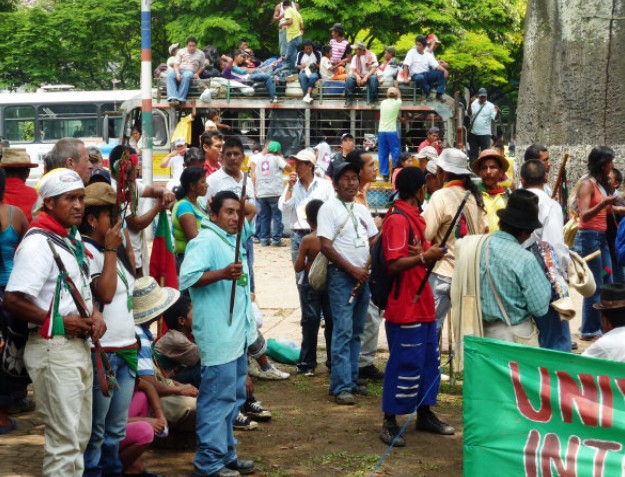
OTTAWA, Canada — The situation of Indigenous peoples in Colombia is so dire, that the UN Special Rapporteur on Indigenous Peoples Rights James Anaya has called for the UN special advisor on genocide to visit Colombia. Last week Indigenous representatives from besieged Colombian communities called on First Nations people in Canada to help in their struggle against extinction.
Two representatives from the National Organization of Indigenous Peoples of Colombia travelled to Ottawa Thursday to detail the assaults facing their communities in Colombia which have pushed them to the edge of annihilation, according to APTN National News.
Flaminio Onogama Gutierrez, of the Embera, and Dora Tavera Riano, of the Pijao, described how some Indigenous communities have been reduced to 50 people as a result of armed conflict with the military, guerrillas and paramilitaries in the South American country.
“To our Indigenous brothers in Canada, we are beyond boundaries, there are no boundaries in the brotherhood between peoples,” said Tavera Riano. “We were all one continent at one time…and we can again struggle against the loss of our people and our culture.”
Many Indigenous communities reside in traditional territories that are rich in biodiversity, minerals and oil eyed by foreign corporations, including from Canada.
Between 2002 and 2009, 74,000 people have been forced from their lands and, according to Amnesty International, the displacement is increasing.
Indigenous people in Colombia also often find themselves in the crossfire between the military, guerrillas and paramilitaries. [see the October 2010 report “Caught in the Crossfire: Colombia’s Indigenous Peoples”]
Of the 102 documented Indigenous nations in Colombia, 32 have populations under 500, 18 have populations of 200, while 10 have less than 100.
“We need to stop this violence, that is why we are calling for support and solidarity,” said Onogama Gutierrez. “Our children want to inherit our wisdom for years to come and they want to keep transferring our (indigenous) knowledge.”
Onogama Gutierrez said they came to Ottawa with their message because Canada had signed a free trade agreement with Colombia, which includes a side agreement that requires the Canadian and Colombian governments draft annual human rights reports on the impacts of the agreement. The first report is expected in May 2012.
Canada has also had strong historical ties to Colombia and Onogama Gutierrez said he hoped the federal government would use its relationship to advocate on behalf of Indigenous people in Colombia.
The situation of Indigenous peoples in Colombia is so dire, that the UN Special Rapporteur on Indigenous Peoples James Anaya has called for the UN special advisor on genocide to visit Colombia.
Video recorded by Ish Theilheimer in Ottawa for Straight Goods News on December 9, 2010. Watch the video on YouTube.
For more information, visit UN High Commissioner for Refugees (UNHCR), Colombia (in English); National Indigenous Association of Colombia (in Spanish); Information site on Colombia’s Indigenous Population (in Spanish).
Also see: Colombia: Indigenous Peoples Under Threat; Arhuaco Message to Indigenous Peoples.
Across the world right now, Indigenous peoples are facing a renewed assault on their lands, rights, and ways of life.
From extractive industries pushing deeper into ancestral territories, to governments rolling back hard-won protections,
the threat is global—and it is growing.
What makes this moment especially dangerous is how little attention it receives.
Stories like this are disappearing in real time. Mainstream media
barely covers it and the coverage is fragmented. The public is left without the context
needed to understand what is truly at stake.
That is exactly why IC Magazine exists..
For more than 20 years, IC has reported on Indigenous struggles worldwide — consistently, independently, and without compromise.
We don’t follow news cycles; we trace patterns. We don’t sensationalize; we provide context.
And when the world looks away, we stay focused.
But this work is increasingly difficult to sustain.
We refuse to lock our reporting behind a paywall. We don’t sell access through subscriptions.
And we don’t answer to advertisers. IC Magazine survives solely because readers like you choose to
support independent Indigenous journalism.
Please donate today if you can. Every contribution helps us to continue this crucial work.
Thank you,
John Ahni Schertow
Founder and Editor in Chief