
Last Updated on May 19, 2019
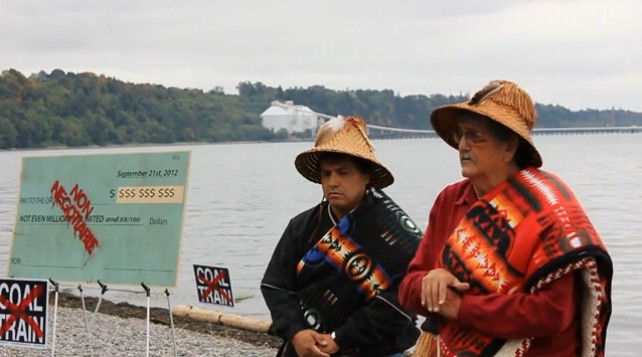
LUMMI INDIAN RESERVATION, BELLINGHAM, Wash.—A fleet of boats piloted by Native and non-Native fishers gathered today in the waters off Xwe’chi’eXen (Cherry Point, Wash.) to stand with the Lummi Nation in opposition to the proposed Gateway Pacific coal terminal at Xwe’chi’eXen.
“We have to say ‘no’ to the coal terminal project,” said Cliff Cultee, Chairman of the Lummi Nation. “It is our Xw’ xalh Xechnging (sacred duty) to preserve and protect all of Xwe’chi’eXen.”
A ceremony of thankfulness, remembrance and unity was held on the beach during the event. Lummi Indians maintain the largest Native fishing fleet in the United States, and Lummi fishers have worked in the Cherry Point fishery for thousands of years.
If constructed, the terminal would be the largest coal terminal on the West Coast of North America. It would significantly degrade an already fragile and vulnerable crab, herring and salmon fishery, dealing a devastating blow to the economy of the fisher community.
“This is not about jobs versus the environment,” said Jewell James of the Lummi Nation’s Sovereignty and Treaty Protection Office. “It is about what type of jobs are best for the people and the environment.”
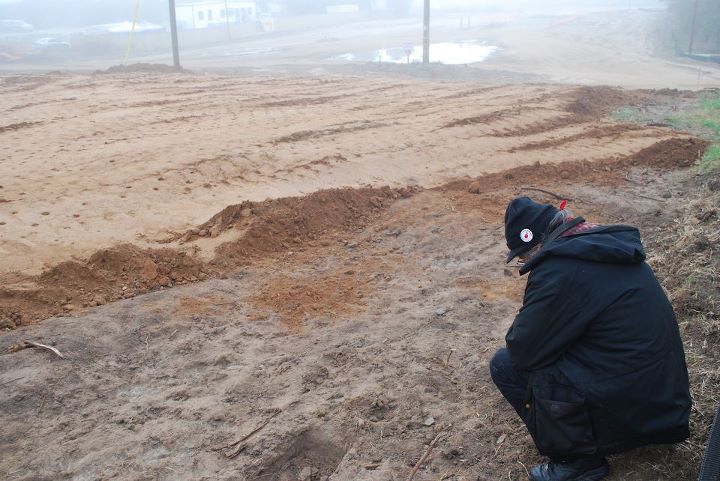
Another gathering of Lummi Indians and non-Indian residents from the local and regional community was held at Xwe’chi’eXen on Sept. 21 to call for the protection and preservation of Xwe’chi’eXen, which is the location of a 3,500 year old village site, and a landscape that is eligible for registry on the National Register of Historic Places.
A Lummi Nation Business Council Resolution declared Lummi “will continue to safeguard our ancestral and historical areas” and the ability of its members to “exercise treaty, inherent and inherited rights.”
The Lummi Nation is participating in a broad intertribal coalition to defeat the project and to ensure that the natural and cultural legacy of Xwe’chi’eXen is protected in perpetuity.
This article originally appeared on Terri Hansen’s website, Mother Earth Journal
Across the world right now, Indigenous peoples are facing a renewed assault on their lands, rights, and ways of life.
From extractive industries pushing deeper into ancestral territories, to governments rolling back hard-won protections,
the threat is global—and it is growing.
What makes this moment especially dangerous is how little attention it receives.
Stories like this are disappearing in real time. Mainstream media
barely covers it and the coverage is fragmented. The public is left without the context
needed to understand what is truly at stake.
That is exactly why IC Magazine exists..
For more than 20 years, IC has reported on Indigenous struggles worldwide — consistently, independently, and without compromise.
We don’t follow news cycles; we trace patterns. We don’t sensationalize; we provide context.
And when the world looks away, we stay focused.
But this work is increasingly difficult to sustain.
We refuse to lock our reporting behind a paywall. We don’t sell access through subscriptions.
And we don’t answer to advertisers. IC Magazine survives solely because readers like you choose to
support independent Indigenous journalism.
Please donate today if you can. Every contribution helps us to continue this crucial work.
Thank you,
John Ahni Schertow
Founder and Editor in Chief