Last Updated on April 10, 2025
Navajo Nation members launched a creative direct action Tuesday to protest the massive coal-fueled power plant that cuts through their Scottsdale, Arizona land.
After a winding march, approximately 60 demonstrators used a massive solar-powered truck to pump water from the critical Central Arizona Project (CAP) canal into barrels for delivery to the reservation.
Flanked by supporters from across the United States, tribe members created a living example of what a Navajo-led transition away from coal toward solar power in the region could look like.
Participants waved colorful banners and signs declaring ‘Power Without Pollution, Energy Without Injustice’.
“We were a small group moving a small amount of water with solar today,” declared Wahleah Johns with Black Mesa Water Coalition. “However if the political will power of the Obama Administration and SRP were to follow and transition NGS to solar all Arizonans could have reliable water and power without pollution and without injustice.”
The demonstration was not only symbolic: the reservation needs the water they were collecting.
While this Navajo community lives in the shadow of the Navajo Generating Station—the largest coal-powered plant in the Western United States—many on the reservation do not have running water and electricity themselves and are forced to make the drive to the canal to gather water for cooking and cleaning.
This is despite the fact that the plant—owned by Salt River Project and the U.S. Department of Interior—pumps electricity throughout Arizona, Nevada, and California.
Yet, the reservation does get one thing from the plant: pollution.
The plant is “one of the largest sources of harmful nitrogen oxide (NOx) emissions in the country,” according to the Environmental Protection Agency.
While plant profiteers argue it brings jobs to the area, plant workers describe harrowing work conditions. “We are the sweatshop workers for the state of AZ, declared Navajo tribe member Marshall Johnson. “We are the mine workers, and we are the ones that must work even harder so the rest don’t have to.”
These problems are not limited to this Navajo community. Krystal Two Bulls from Lame Deer, Missouri—who came to Arizona to participate in the action—explained, “We’re also fighting coal extraction that is right next to our reservation, which is directly depleting our water source.”
The action marked the kickoff to the national Our Power Campaign, under the banner of Climate Justice Alliance, that unites almost 40 U.S.-based organizations rooted in Indigenous, African American, Latino, Asian Pacific Islander, and working-class white communities to fight for a transition to just, climate friendly economies.
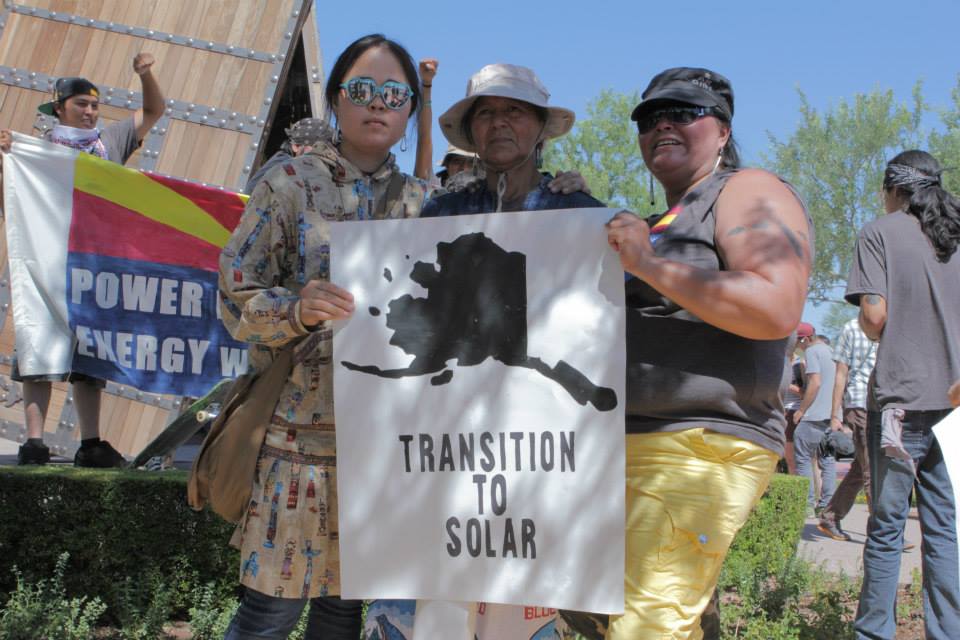
(Photo by Black Mesa Water Coalition)
Across the world right now, Indigenous peoples are facing a renewed assault on their lands, rights, and ways of life.
From extractive industries pushing deeper into ancestral territories, to governments rolling back hard-won protections,
the threat is global—and it is growing.
What makes this moment especially dangerous is how little attention it receives.
Stories like this are disappearing in real time. Mainstream media
barely covers it and the coverage is fragmented. The public is left without the context
needed to understand what is truly at stake.
That is exactly why IC Magazine exists..
For more than 20 years, IC has reported on Indigenous struggles worldwide — consistently, independently, and without compromise.
We don’t follow news cycles; we trace patterns. We don’t sensationalize; we provide context.
And when the world looks away, we stay focused.
But this work is increasingly difficult to sustain.
We refuse to lock our reporting behind a paywall. We don’t sell access through subscriptions.
And we don’t answer to advertisers. IC Magazine survives solely because readers like you choose to
support independent Indigenous journalism.
Please donate today if you can. Every contribution helps us to continue this crucial work.
Thank you,
John Ahni Schertow
Founder and Editor in Chief