Last Updated on May 19, 2019
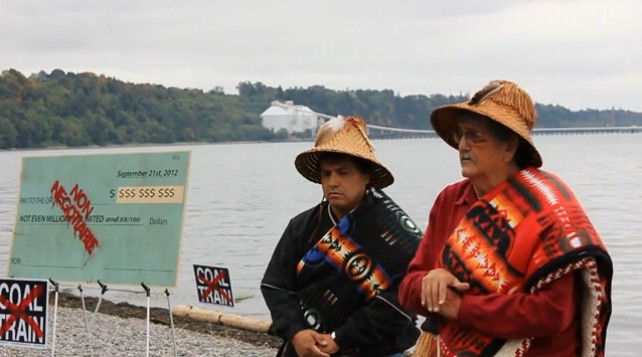
Controversy over the illegal desecration of a Cherry Point Native American archeological site omits a key fact: Cherry Point is still Lummi Indian land. While most mainstream media focuses on treaty fishing rights of Lummi Nation that would be impaired by the proposed Gateway Pacific Terminal, only Whatcom Watch in an article by Lummi scholar Jewell Praying Wolf James reveals the history of Cherry Point ownership.
Most significant, the Lummi people did not sign away Cherry Point in the 1855 Treaty of Point Elliot. Cherry Point was part of the original Lummi Reservation, not part of the lands ceded (not sold) under duress to the U.S. Government. Only in 1872 was Cherry Point illegally removed from the Lummi Reservation by Presidential Executive Order, in order for the Bureau of Indian Affairs to unlawfully sell the property to white squatters.
As one of the most important ancient Lummi village sites, Cherry Point ownership has been in dispute for 141 years.
Across the world right now, Indigenous peoples are facing a renewed assault on their lands, rights, and ways of life.
From extractive industries pushing deeper into ancestral territories, to governments rolling back hard-won protections,
the threat is global—and it is growing.
What makes this moment especially dangerous is how little attention it receives.
Stories like this are disappearing in real time. Mainstream media
barely covers it and the coverage is fragmented. The public is left without the context
needed to understand what is truly at stake.
That is exactly why IC Magazine exists..
For more than 20 years, IC has reported on Indigenous struggles worldwide — consistently, independently, and without compromise.
We don’t follow news cycles; we trace patterns. We don’t sensationalize; we provide context.
And when the world looks away, we stay focused.
But this work is increasingly difficult to sustain.
We refuse to lock our reporting behind a paywall. We don’t sell access through subscriptions.
And we don’t answer to advertisers. IC Magazine survives solely because readers like you choose to
support independent Indigenous journalism.
Please donate today if you can. Every contribution helps us to continue this crucial work.
Thank you,
John Ahni Schertow
Founder and Editor in Chief