Last Updated on August 4, 2018
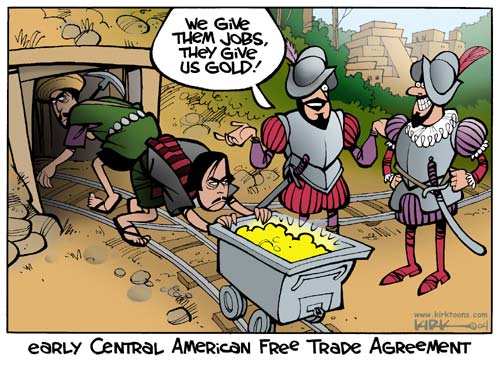
Last week, Costa Rica’s highest court overturned an intellectual property law the United states demands for the enactment of the US-Central America Free Trade Agreement, commonly referred to as “CAFTA.”
The court said that the law – which included provisions on biodiversity – was improperly passed because the government failed “…to consult the indigenous people, in accordance with Convention 169 of the International Labor Organization.”
Seen as a major victory for opponents to ‘free trade’, the government may now miss its Oct. 1 deadline to pass all the reforms needed to enter CAFTA.
“Following the ruling, the government issued a statement expressing concerns that Costa Rica might not make it to CAFTA, ratified here in referendum last October,” reports the Tico Times.
“The government is ‘greatly concerned about the impact of this ruling, in particular because of the issue of deadlines that Costa Rica has committed to,’ said a communique cosigned by the Presidency Ministry and the Foreign Trade Ministry, according to newswire EFE.”
“The government ‘will do everything possible and within its reach so that this doesn’t affect the ultimate incorporation of Costa Rica into CAFTA,’ the statement said.” However, its doubtful they’ll be able to pass a revamped version of the bill in time.
The victory will be short lived in any case. CAFTA, which essentially gives US corporations a high level of rights to operate in Central America, has already been ratified by El Salvador, Guatemala, Honduras and Nicaragua. It’s only a matter of time before Costa Rica manages to get in on the action.
Illustration by Kirk Andersen
Across the world right now, Indigenous peoples are facing a renewed assault on their lands, rights, and ways of life.
From extractive industries pushing deeper into ancestral territories, to governments rolling back hard-won protections,
the threat is global—and it is growing.
What makes this moment especially dangerous is how little attention it receives.
Stories like this are disappearing in real time. Mainstream media
barely covers it and the coverage is fragmented. The public is left without the context
needed to understand what is truly at stake.
That is exactly why IC Magazine exists..
For more than 20 years, IC has reported on Indigenous struggles worldwide — consistently, independently, and without compromise.
We don’t follow news cycles; we trace patterns. We don’t sensationalize; we provide context.
And when the world looks away, we stay focused.
But this work is increasingly difficult to sustain.
We refuse to lock our reporting behind a paywall. We don’t sell access through subscriptions.
And we don’t answer to advertisers. IC Magazine survives solely because readers like you choose to
support independent Indigenous journalism.
Please donate today if you can. Every contribution helps us to continue this crucial work.
Thank you,
John Ahni Schertow
Founder and Editor in Chief