Last Updated on April 20, 2025
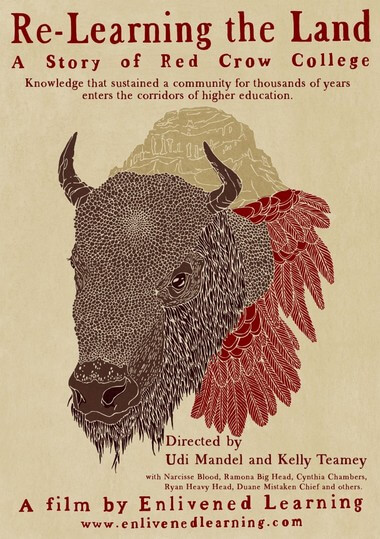
RE-LEARNING THE LAND is the story of a Blackfoot community in southern Alberta, Canada, and how they have re-taken control of their education system within Red Crow Community College. The film traces the decolonization of their learning and the development of an innovative program, Kainai Studies, within Red Crow College, the same site as a former Residential School. The Kainai Studies program is reclaiming and teaching to a new generation the Blackfoot knowledge system that sustained their community on their land for thousands of years.
The film raises a host of important questions related to the purpose of education and what it takes to create a deep ecological consciousness and connection with our local environment. By witnessing how students and faculty within Red Crow College are re-building relationships with the land around them, we see a greater sense of purpose, confidence and identity from amongst those participating and learning within the Kainai Studies program.
RE-LEARNING THE LAND explores how education can be used both to wipe out particular ways of knowing and lead to suffering, as in the case of residential schools, or else to promote healing and a transformation of individual and community through a reconnection to history and place. Based on a very different cosmology, set of values and ways of teaching, RE-LEARNING THE LAND is a subtle exploration of how an indigenous way of learning can create transformational relationships with the land, its beings, the community and one’s own self.
Across the world right now, Indigenous peoples are facing a renewed assault on their lands, rights, and ways of life.
From extractive industries pushing deeper into ancestral territories, to governments rolling back hard-won protections,
the threat is global—and it is growing.
What makes this moment especially dangerous is how little attention it receives.
Stories like this are disappearing in real time. Mainstream media
barely covers it and the coverage is fragmented. The public is left without the context
needed to understand what is truly at stake.
That is exactly why IC Magazine exists..
For more than 20 years, IC has reported on Indigenous struggles worldwide — consistently, independently, and without compromise.
We don’t follow news cycles; we trace patterns. We don’t sensationalize; we provide context.
And when the world looks away, we stay focused.
But this work is increasingly difficult to sustain.
We refuse to lock our reporting behind a paywall. We don’t sell access through subscriptions.
And we don’t answer to advertisers. IC Magazine survives solely because readers like you choose to
support independent Indigenous journalism.
Please donate today if you can. Every contribution helps us to continue this crucial work.
Thank you,
John Ahni Schertow
Founder and Editor in Chief