Last Updated on April 10, 2025
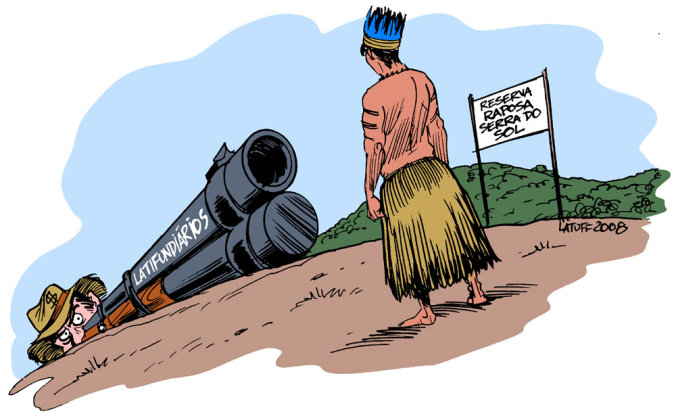
Indigenous people are celebrating after a majority of Brazil’s Supreme Court judges ruled to uphold indigenous land rights in Raposa-Serra do Sol.
Marking the 60th anniversary of the Universal Declaration of Human Rights, eight of the courts’ eleven judges yesterday “affirmed the Indians’ rights to the land, saying it had been demarcated according to the constitution,” explains Survival International. “They [also] affirmed the importance of maintaining indigenous territories as single, continuous areas and stated that territories on Brazil’s borders do not pose a risk to national sovereignty. [which various authorities have claimed]”
While a final judgment won’t be handed down until the remaining judges give their oral arguments, “the majority rules in the Supreme court”, Al Jazeera points out, which means the Indigenous people in Raposa and throughout the country have won a major victory.
Indigenous leaders and activists around the world have maintained that this case, no matter its outcome, would have far reaching effects on Indigenous land rights. The most immediate concern, that is, beyond the danger to indigenous rights if the court ruled against the demarcation, was that it would have justified the deplorable use of violence on part of the non-indigenous farmers currently illegally occupying the territory.
Earlier this year, in an attempt to event their eviction as ordered by the President in 2005, the farmers barricaded themselves into the territory, set up roadblocks, burned at least three bridges and attacked indigenous people with rifles and home-made bombs.
With the yesterday’s decision all but official, the farmers will once again have to vacate Raposa-Serra do Sol. Moreover, “The Brazilian government must now make sure that the farmers leave the area and that the campaign of terror against the Indians ends,” comments Stephen Corry, the Director of Survival International. “It must also ensure that Indian land rights are upheld nationwide, so that never again will we see such blatant attacks on Indians on their own land.”
Visit Survival International for background and more information. Photo: AP Photo/Eraldo Peres
Across the world right now, Indigenous peoples are facing a renewed assault on their lands, rights, and ways of life.
From extractive industries pushing deeper into ancestral territories, to governments rolling back hard-won protections,
the threat is global—and it is growing.
What makes this moment especially dangerous is how little attention it receives.
Stories like this are disappearing in real time. Mainstream media
barely covers it and the coverage is fragmented. The public is left without the context
needed to understand what is truly at stake.
That is exactly why IC Magazine exists..
For more than 20 years, IC has reported on Indigenous struggles worldwide — consistently, independently, and without compromise.
We don’t follow news cycles; we trace patterns. We don’t sensationalize; we provide context.
And when the world looks away, we stay focused.
But this work is increasingly difficult to sustain.
We refuse to lock our reporting behind a paywall. We don’t sell access through subscriptions.
And we don’t answer to advertisers. IC Magazine survives solely because readers like you choose to
support independent Indigenous journalism.
Please donate today if you can. Every contribution helps us to continue this crucial work.
Thank you,
John Ahni Schertow
Founder and Editor in Chief