Last Updated on April 14, 2025
“It almost feels as we are on a ‘death row’, we do not know yet when the first bulldozer will start flattening our land…but we know it’s happening”
A member of Brooke’s Point lowland Pala’wan communities
The Philippine province of Palawan has established a 50-year mining moratorium after massive environmental damage from nickel mining in the region. However, there still grave concern that it won’t be enough to protect this once-pristine land.
Proponents of Ordinance 3646, passed on March 5 2025, say the measure protects remaining forests and indigenous territories which have so far been spared from mining concessions. But the exemption of existing concessions from Ordinance 3646 leaves many indigenous communities facing a mineral rush brought on by high prices–and some activists doubt the new ban will actually stay in place after the May election.
The Philippines is already the World’s second-largest producer and exporter of nickel ore. According to the Legal Rights and Natural Resources Center, 60% of mineral deposits and 49% of mining projects in the Philippines are found on Indigenous Peoples’ land.
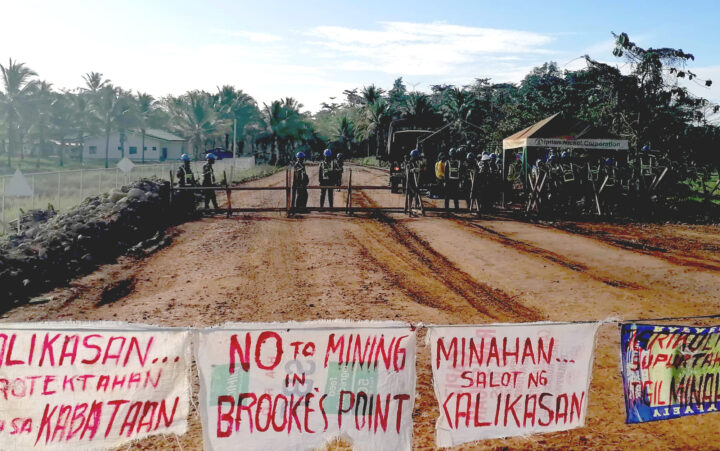
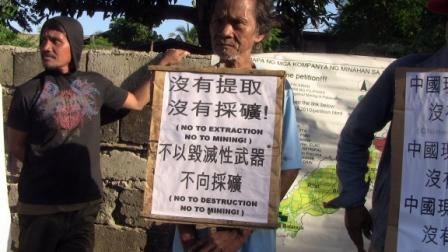
Protest in front of the entrance gate of Ipilan Nickel Corporation in Maasin, Brooke’s Point
Now, with many countries seeking to move away from dependence on hydrocarbons as part of the ‘green revolution’, there is a growing demand for the key minerals needed to produce electric vehicles, renewable energy technologies, and stainless steel.
The Philippine Government is trying to position itself as one of its most reliable providers.
Substantial environmental damage has already been caused by companies such as Rio Tuba Nickel Mining Corporation, Ipilan Nickel Corporation, Citinickel Mines and Development Corporation, and Berong Nickel Corporation. Open-pit and strip mining by these companies has resulted in the flattening of mountain tops, the destruction of precious forest, and the production of vast amounts of tailings that have contaminated the sea and various fresh water sources in Palawan.
Under the Philippine Mining Act of 1995, the central government cannot override the decisions of local governments, whose approval is required for mining projects to proceed. But whether the provincial government of Palawan will remain firm in protecting the island’s remaining biodiversity is hotly debated.
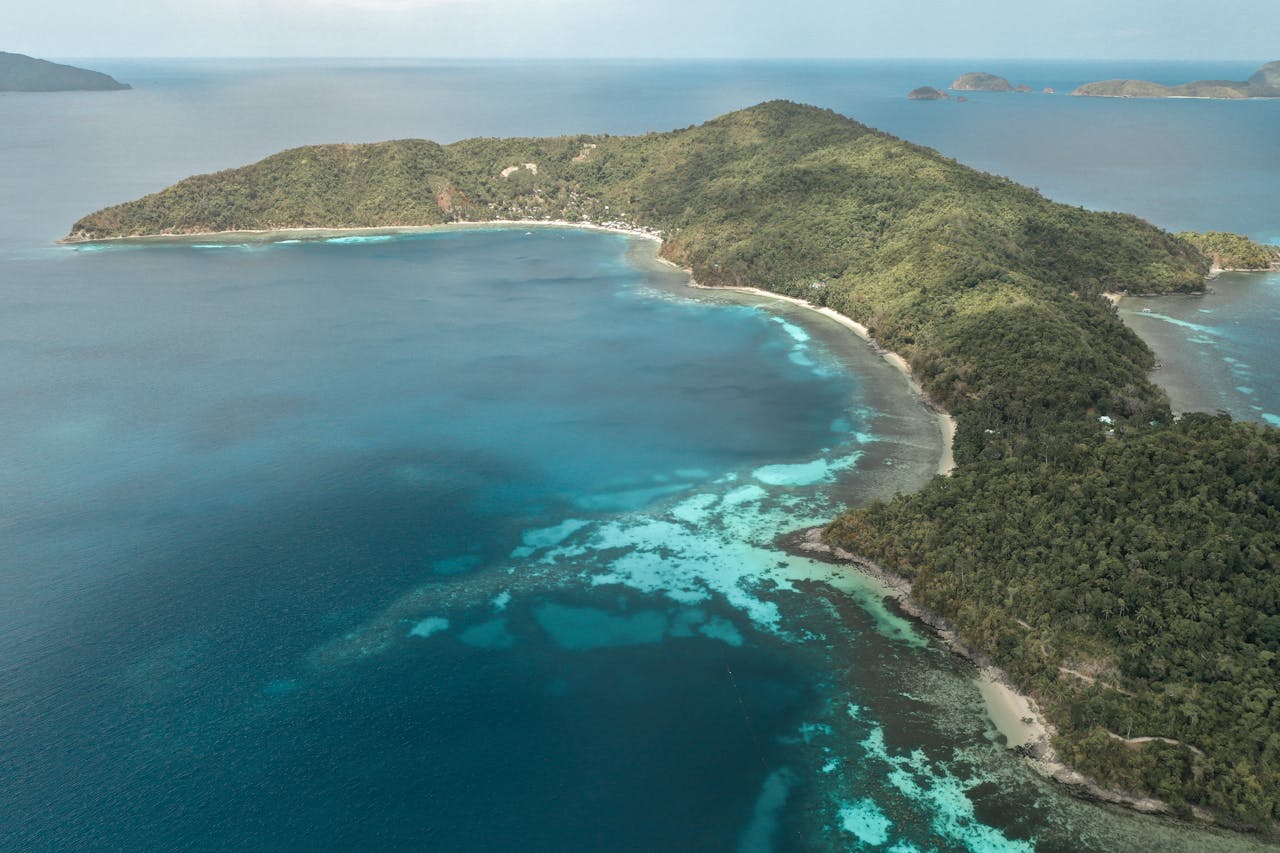
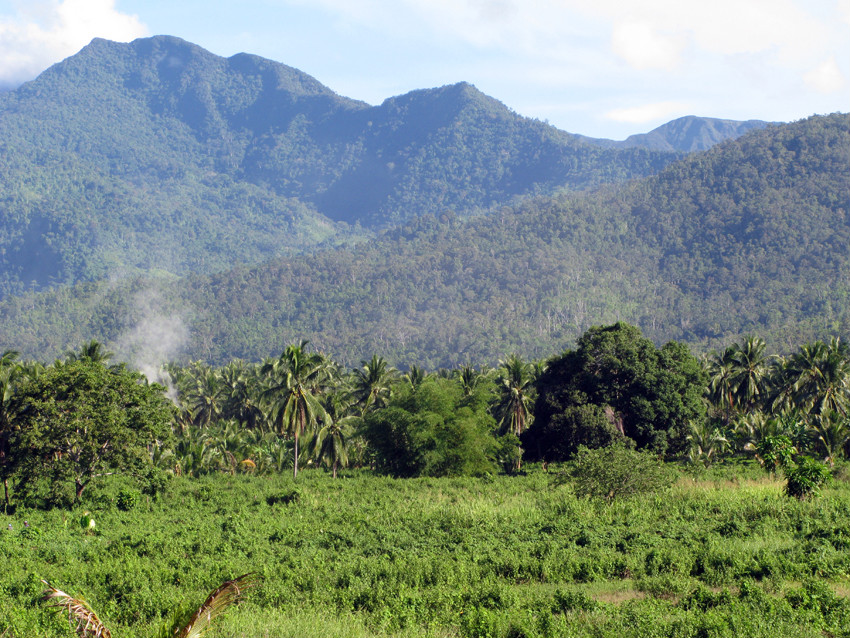
Palawan is home to multiple UNESCO World Heritage Sites
“I’m not so astonished that the moratorium was approved with haste” says C.B. a member of a local charity in Puerto Princesa: “we are getting close to elections and politicians want to look ‘green and smart’ and get the sympathy of civil society. At some stage, also this moratorium could be revoked when the election ends, especially if pro-mining politicians are going to sit in key positions”.
Under the moratorium’s Ordinance 3646, the many pending applications for mining concessions won’t receive the coveted green light. However, the Ordinance also gives ‘carte blanche’ to those companies whose Mineral Production Sharing Agreements (MPSAs) have already been approved. They may continue to exploit and even renew their permits providing they do not increase production or expand to new areas.
The 11 MPSAs exempted from the moratorium cover hundreds of hectares of pristine ecosystems and indigenous territories in Southern Palawan, subjecting the future of many southern indigenous, rural and fisher-folk communities to a handful of powerful, greedy and irresponsible mining tycoons and their cronies.
It appears that the Government has strategically set aside the more developed northern portion of the island for tourism and nature protection, while sacrificing the less-developed southern municipalities to extractive large-scale development.
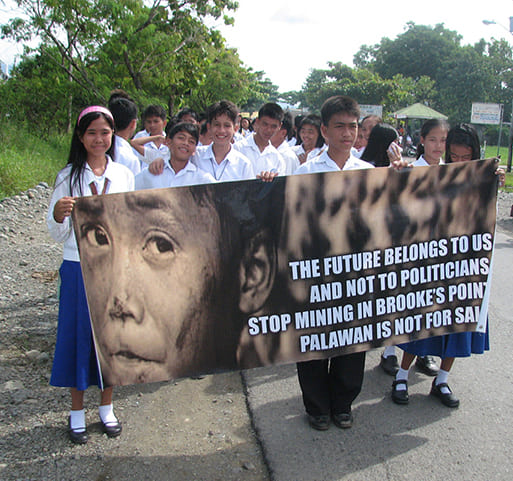
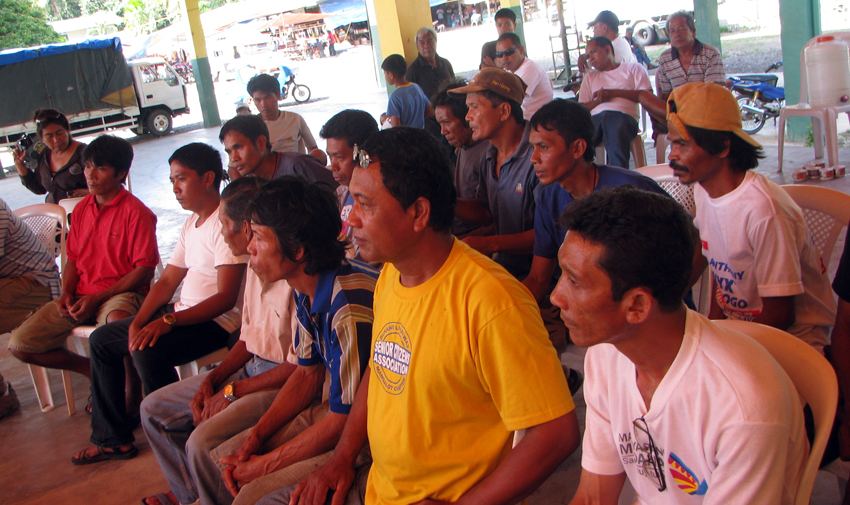
Students’ anti-mining protest in Brooke’s Point Municipality
A bleak future now beckons for southern Palawan: Amongst the eleven companies that could plunder Southern Palawan, at least three have already brought havoc to local communities, and their once-pristine land.
The Citinickel Mines and Development Corporation is responsible for a long series of violations of environmental laws, including silt spills into rivers, damages to lowlands farms, and unlawful tree felling. The company is presently under a Department of Environment and Natural Resources (DENR) suspension order, but if that order is lifted the company would be free to operate for another seven years, further impoverishing the Pala’wan tribes of Barangay Pulot and Narra in the municipality of Espanola.
The Ipilan Nickel Corporation (INC) has meanwhile felled more than 20 hectares of old-growth forest, causing the siltation of coastal areas and the drastic reduction of valuable fish stocks. The company’s concession largely overlaps with the Mount Mantalingahan Protected Landscape and with the ancestral domain of Pala’wan tribal communities.
“When I heard that the mining moratorium was approved, my hearth was full of hope. But, we didn’t know that our ancestral territory had already been turned over to full-scale nickel mining operations”
An elderly member of Brooke’s Point Pala’wan upland communities.
The Palawan Council for Sustainable Development (PCSD) is the government agency responsible for the implementation of the Strategic Environmental Plan (RA 7611). This is an innovative law and framework for the sustainable management of the island put in place through substantial investments from the European Union dating back through the early eighties and nineties. Nowadays, rather than sticking to its original mandate, the agency is amending its Environmentally Critical Areas Network (ECAN), downgrading ‘core’ and ‘restricted’ zones into ‘multiple use’ or ‘controlled use zones’ to accommodate mining.
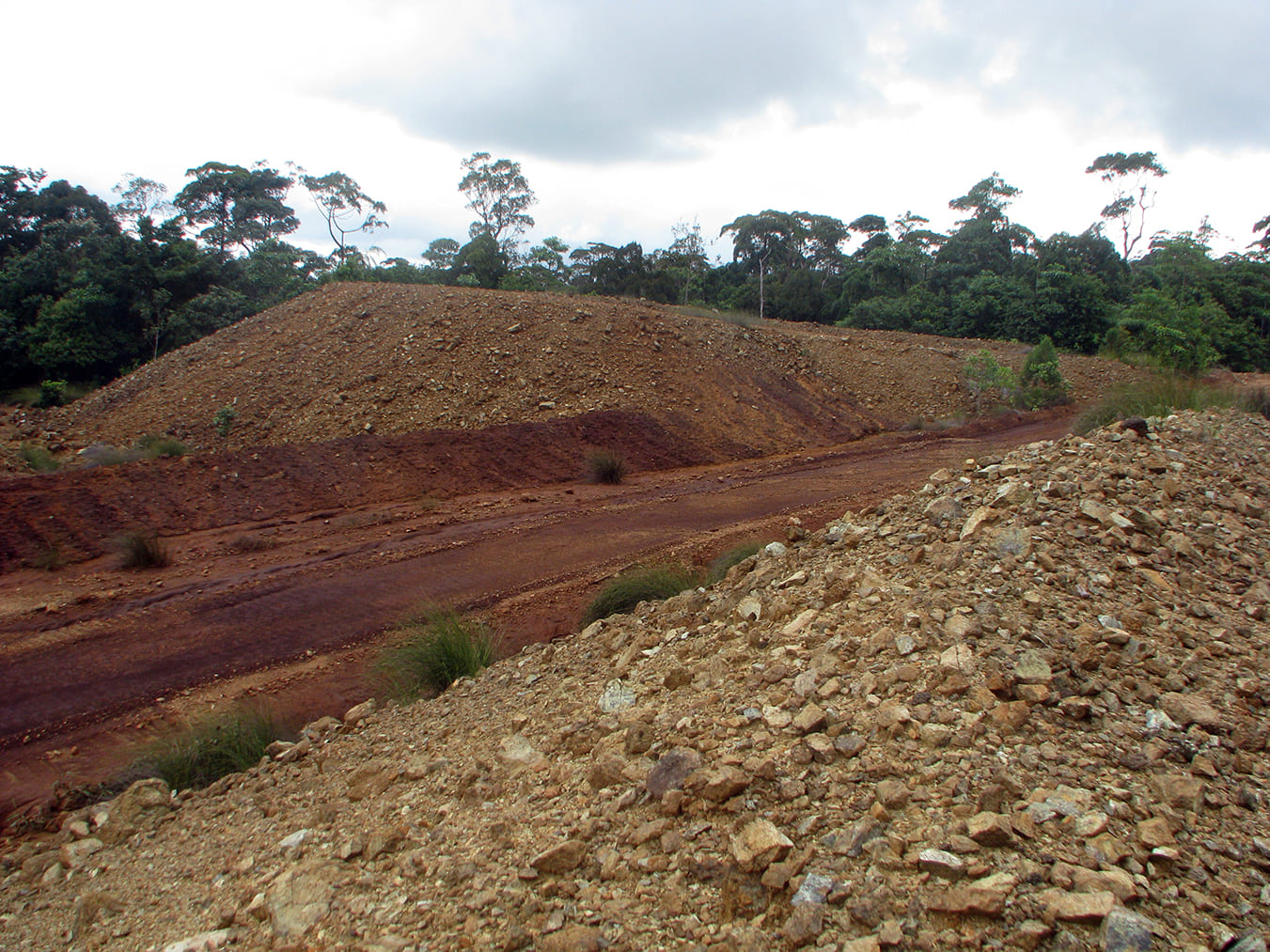
Nickel mining devastation by RTNMC, in Mount Bulanjao (Municipality of Bataraza)
The Rio Tuba Nickel Mining Corporation (RTNMC), owned by the powerful Zamora family, has been allowed to mine in previously ECAN-designated protected ‘core’ and ‘restricted’ zones. This has been possible though the connivance of the local government of Bataraza, and the Palawan Council for Sustainable Development (PCSD), which have revised zoning regulations to create a ‘Mineral Development Zone’ 1,000m above sea level in the Bulanjao range: a biodiversity hotspot and a sacred mountain to the Pala’wan.
Palawan island itself is a UNESCO Man and Biosphere Reserve, an internationally-recognized ecological and cultural treasure, but through silence and inertia UNESCO has served little more than to demonstrate how its declarations bring little or no benefits to local communities, especially when there is no clear political commitment to uphold them.
The Philippine government’s callous disregard for the rule of the law is well known: Mining companies get their way in protected areas too, with the Mining and Geosciences Bureau (MGB) continuously bending over backwards to let them destroy unique biodiversity hotspots with impunity. The endorsement of mining concessions in natural forest and protected areas not only contravenes the Strategic Environmental Plan (SEC law), but also the provisions contained in well known conventions such as The Convention on Biological Diversity (CBD) and the UN Declaration on the Rights of Indigenous Peoples, that the Philippine Government has already signed. Ironically enough the DENR, rather than safeguarding remaining forests, promotes studies to determine the capacity of Palawan to absorb mining.
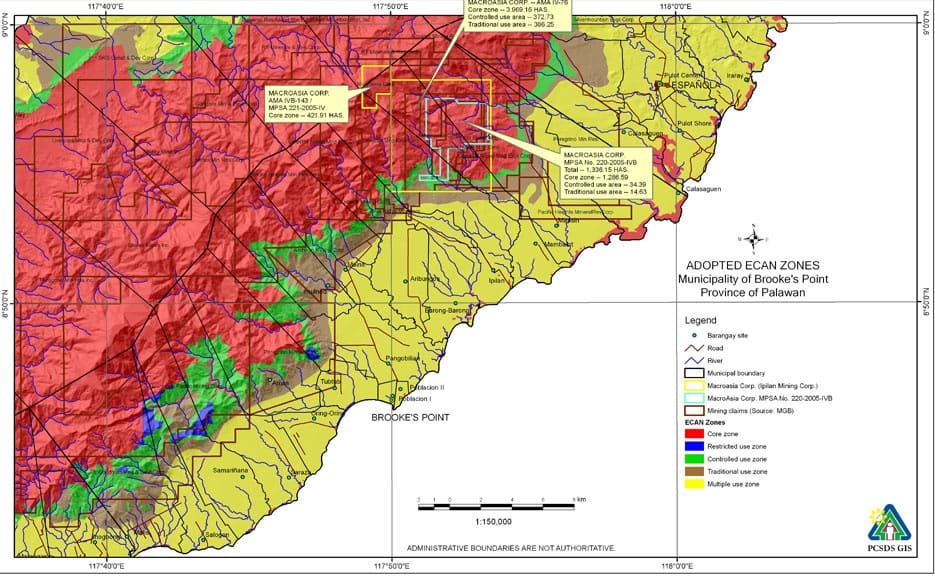
Map showing the overlapping of Macroasia mining tenements with ECAN ‘core zones’ and the Mount Mantalingahan Protected Landscape (MMPL)
Among the companies yet to start their operations are two whose potential for damaging Palawan ecology should not be underestimated. The MacroAsia Mining Corporation started exploration activities in 2009/2010, entering farmlands without permission, removing rice crops, and causing damage in the reserves where local indigenous people collect commercially valuable resins.
The flagship company of airline and cigarette magnate Lucio Tan (Philippines’ richest man) will now work with its partner Calmia Nickel, Inc. in an attempt to mine a forest harboring some of the oldest trees in the southern hemisphere, and several endangered species listed by the World Conservation Union. The company’s mining concession falls within the Mount Matalingahan Protected Landscape (MMPL), and within the ancestral domain of isolated and vulnerable Pala’wan groups. The neighboring concession belongs to the Lebach Mining Corporation (LEBACH), whose MPSA includes indigenous farming land, and also residential areas, school grounds, places of worship and other locations of public interest. In other words, should mining activities be allowed to start, local communities and resident populations would need to displace elsewhere.
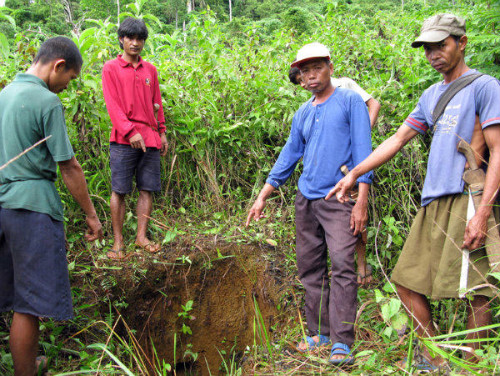
Indigenous Peoples showing the excavation of a Macroasia test pit in their swidden fields. A painful glimpse into what may be in store for Palawan. Photo by ALDAW
Behind the rhetoric of so-called ‘responsible mining’, and in spite of the moratorium, the mining industry in Southern Palawan is set to devastate precious watersheds, indigenous ancestral territories and productive rice-land. Once again, through a defective and incomplete moratorium ordinance, the rights of indigenous and local communities have been bypassed.
Furthermore, the mining “moratorium” doesn’t spare Pala’wan tribes from the plundering of their farmlands and ancestral forest which the people use daily for hunting-gathering, for the collection of herbal medicine, and for commercially valuable non-timber forest products (NTFPs) such as rattan, almaciga resin and wild honey.

A group of indigenous Pala’wan planting upland rice in the Municipality of Brooke’s Point.
Within a few years, the exempted companies could bring an end to the livelihoods of indigenous peoples and an environment that has been sustainably managed for generations.
While some still celebrate the approval of the moratorium as a victory, others suspect that this is nothing more than a political drama.
The fight to protect Palawan continues with the International organization Rainforest Rescue launching a joint ‘action letter’ to pressure various agencies of the Philippine Government to ensure that the remaining forest in Palawan is protected and that indigenous peoples’ rights are respected. Meanwhile, strong links and strategic alliances have been established between ground-based advocacy groups and international organizations.
International organizations are being asked to sign this joint letter by May 30th in solidarity with the Pala’wan indigenous peoples and local communities of the Philippines facing massive environmental degradation despite of the newly-signed 50-year mining moratorium.
The letter, along with the names of all signatories will be submitted to the President of the Philippines, the Provincial Government of Palawan, various authorities mentioned in the letter, and to the UNESCO.
If you want to additionally send your logo, you can send it to: christiane.zander@regenwald.org.
Across the world right now, Indigenous peoples are facing a renewed assault on their lands, rights, and ways of life.
From extractive industries pushing deeper into ancestral territories, to governments rolling back hard-won protections,
the threat is global—and it is growing.
What makes this moment especially dangerous is how little attention it receives.
Stories like this are disappearing in real time. Mainstream media
barely covers it and the coverage is fragmented. The public is left without the context
needed to understand what is truly at stake.
That is exactly why IC Magazine exists..
For more than 20 years, IC has reported on Indigenous struggles worldwide — consistently, independently, and without compromise.
We don’t follow news cycles; we trace patterns. We don’t sensationalize; we provide context.
And when the world looks away, we stay focused.
But this work is increasingly difficult to sustain.
We refuse to lock our reporting behind a paywall. We don’t sell access through subscriptions.
And we don’t answer to advertisers. IC Magazine survives solely because readers like you choose to
support independent Indigenous journalism.
Please donate today if you can. Every contribution helps us to continue this crucial work.
Thank you,
John Ahni Schertow
Founder and Editor in Chief