Last Updated on May 29, 2025
Four First Nations in northern Ontario are pushing back against the Ontario government’s Bill 5, saying the legislation violates their right to make decisions about their homelands. The Chiefs of Attawapiskat, Kitchenuhmaykoosib Inninuwug (KI), Ginoogaming, and Apitipi Anicinapek Nations say the government’s promise to “consult” them is not enough. They argue that what’s required is the right to co-govern—something they say was affirmed in Treaty 9 and must be respected by the Crown.
At the heart of their opposition is a legal challenge now before the Ontario Superior Court. The case asserts that Treaty 9 confirmed the Nations’ right to govern their territories and that this governance was meant to be shared with the Crown, not taken over.
“The Crown governments are the colonizers, and colonialism is a crime against humanity,” said Chief Sylvia Koostachin-Metatawabin of Attawapiskat. “The crime was taking over all decision-making authority and power, when that right was never given to the Crown.”
Chief Donny Morris of KI said Ontario’s process ignores this reality. “Ontario promises more consultation, but at the end of the day, they still decide. We’ve told them for two years: they need to get our consent. Anything less runs over our rights while our case is still in court.”
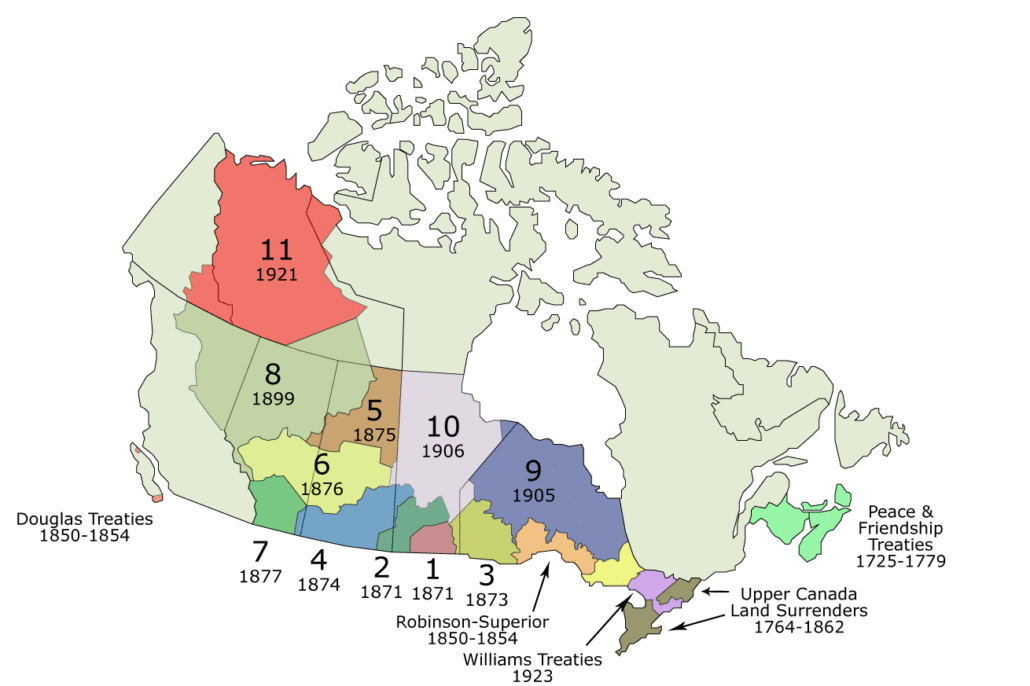
Treaty Locations c/o indigenousawarenesscanada.com
Ginoogaming First Nation Chief Sheri Taylor pointed out that Bill 5’s offer of economic development funds doesn’t change the core issue. “We shouldn’t have to choose between a basic standard of living and the right to decide our future. Our job as leaders is to protect the land and water, following the laws passed down to us. That’s what self-determination means.”
Apitipi Anicinapek Nation Chief June Black criticized the idea that Ontario knows best. “Telling us Bill 5 is good because it brings more money assumes they know what we need. That’s not a conversation—that’s control,” she said. Chief Black also raised environmental concerns about mining in the Ring of Fire, which sits on a major peatland that plays a key role in slowing climate change. “If that peatland is destroyed, the damage could be beyond repair. No one should move forward until the full risks are understood.”
The Nations involved say they are not against development—but they insist it must be done on equal terms, with full recognition of their rights. As the court case proceeds, they are calling on Ontario to stop making unilateral decisions and start acting in good faith.
Bill 5 is poised to create so-called ‘special economic zones’ that would let the government exempt companies or projects from complying with provincial laws or regulations. According to the CBC, it would also replace Ontario’s endangered species act with a new law that critics say waters down protections.
Across the world right now, Indigenous peoples are facing a renewed assault on their lands, rights, and ways of life.
From extractive industries pushing deeper into ancestral territories, to governments rolling back hard-won protections,
the threat is global—and it is growing.
What makes this moment especially dangerous is how little attention it receives.
Stories like this are disappearing in real time. Mainstream media
barely covers it and the coverage is fragmented. The public is left without the context
needed to understand what is truly at stake.
That is exactly why IC Magazine exists..
For more than 20 years, IC has reported on Indigenous struggles worldwide — consistently, independently, and without compromise.
We don’t follow news cycles; we trace patterns. We don’t sensationalize; we provide context.
And when the world looks away, we stay focused.
But this work is increasingly difficult to sustain.
We refuse to lock our reporting behind a paywall. We don’t sell access through subscriptions.
And we don’t answer to advertisers. IC Magazine survives solely because readers like you choose to
support independent Indigenous journalism.
Please donate today if you can. Every contribution helps us to continue this crucial work.
Thank you,
John Ahni Schertow
Founder and Editor in Chief