Last Updated on September 16, 2025
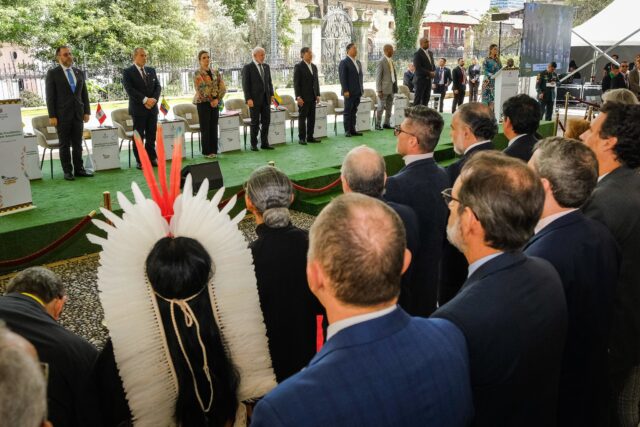
September 13, 2025, marked 18 years since the United Nations General Assembly adopted the UN Declaration on the Rights of Indigenous Peoples (UNDRIP). On the heels of that milestone, the Organization of American States (OAS) has announced concrete steps to advance the American Declaration on the Rights of Indigenous Peoples (ADRIP) across the Western Hemisphere.
At a meeting held in Mexico City this week, the OAS Working Group on ADRIP (WG-ADRIP) finalized operating regulations, adopted a 2025–2027 Work Plan, and elected co-chairs representing both Indigenous Peoples and State experts. The gathering also advanced the design of a template of indicators for national reporting, a tool intended to measure how governments are putting ADRIP into practice.
Adopted by the OAS in 2016 after almost thirty years of persistent advocacy, negotiation, and at times contentious debate, the ADRIP builds on the foundation of UNDRIP while extending its reach to the specific realities of the Americas. Unlike UNDRIP, which sets global standards, ADRIP is shaped by the distinct legacies of colonization, displacement, and legal battles that have marked the lives of Indigenous Peoples in Canada, the United States, Mexico, the Caribbean, and across Central and South America.
It also addresses urgent issues that UNDRIP doesn’t fully capture—such as the protection of Indigenous Peoples living in voluntary isolation, and the recognition of cross-border Indigenous communities whose ancestral territories predate modern state boundaries. Additionally, ADRIP considers the situation of Indigenous Peoples caught in or displaced by internal armed conflicts, which is a recurring challenge in parts of Latin America.
While both UNDRIP and ADRIP remain non-binding, their normative power is undeniable. They establish international standards that governments are increasingly expected to meet, even without the force of law.
For many Indigenous leaders, ADRIP promises to be a new political tool for accountability. The creation of measurable indicators and structured reporting mechanisms promises to transform broad commitments into trackable progress. With these tools, communities can press states to demonstrate not just rhetorical support for Indigenous rights, but concrete action in areas such as land restitution, language revitalization, health, and environmental stewardship—even if the final version of the document is less than ideal.
The Mexico City meeting suggests momentum is building. Whether that momentum translates into tangible rights protection will be closely watched by Indigenous communities across the hemisphere.
Across the world right now, Indigenous peoples are facing a renewed assault on their lands, rights, and ways of life.
From extractive industries pushing deeper into ancestral territories, to governments rolling back hard-won protections,
the threat is global—and it is growing.
What makes this moment especially dangerous is how little attention it receives.
Stories like this are disappearing in real time. Mainstream media
barely covers it and the coverage is fragmented. The public is left without the context
needed to understand what is truly at stake.
That is exactly why IC Magazine exists..
For more than 20 years, IC has reported on Indigenous struggles worldwide — consistently, independently, and without compromise.
We don’t follow news cycles; we trace patterns. We don’t sensationalize; we provide context.
And when the world looks away, we stay focused.
But this work is increasingly difficult to sustain.
We refuse to lock our reporting behind a paywall. We don’t sell access through subscriptions.
And we don’t answer to advertisers. IC Magazine survives solely because readers like you choose to
support independent Indigenous journalism.
Please donate today if you can. Every contribution helps us to continue this crucial work.
Thank you,
John Ahni Schertow
Founder and Editor in Chief