
Last Updated on December 31, 2025
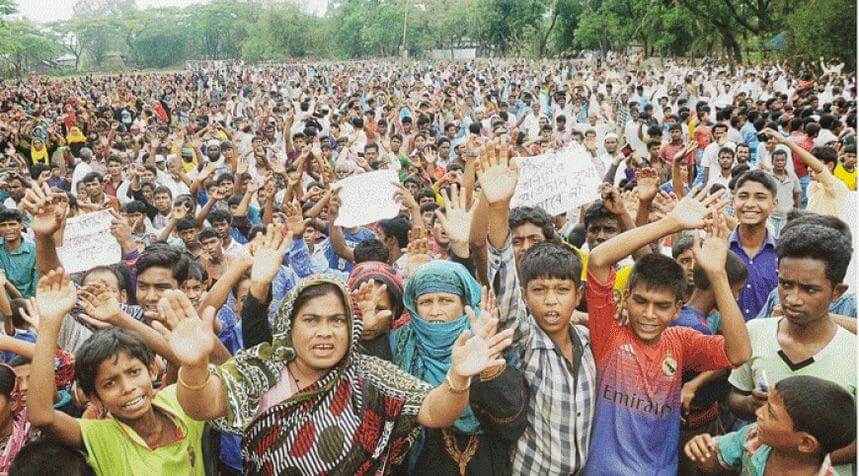
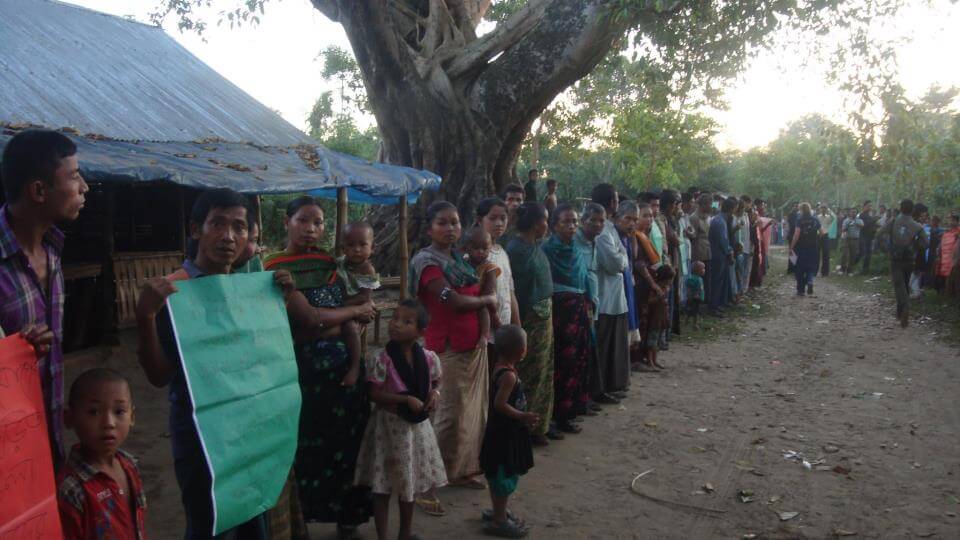
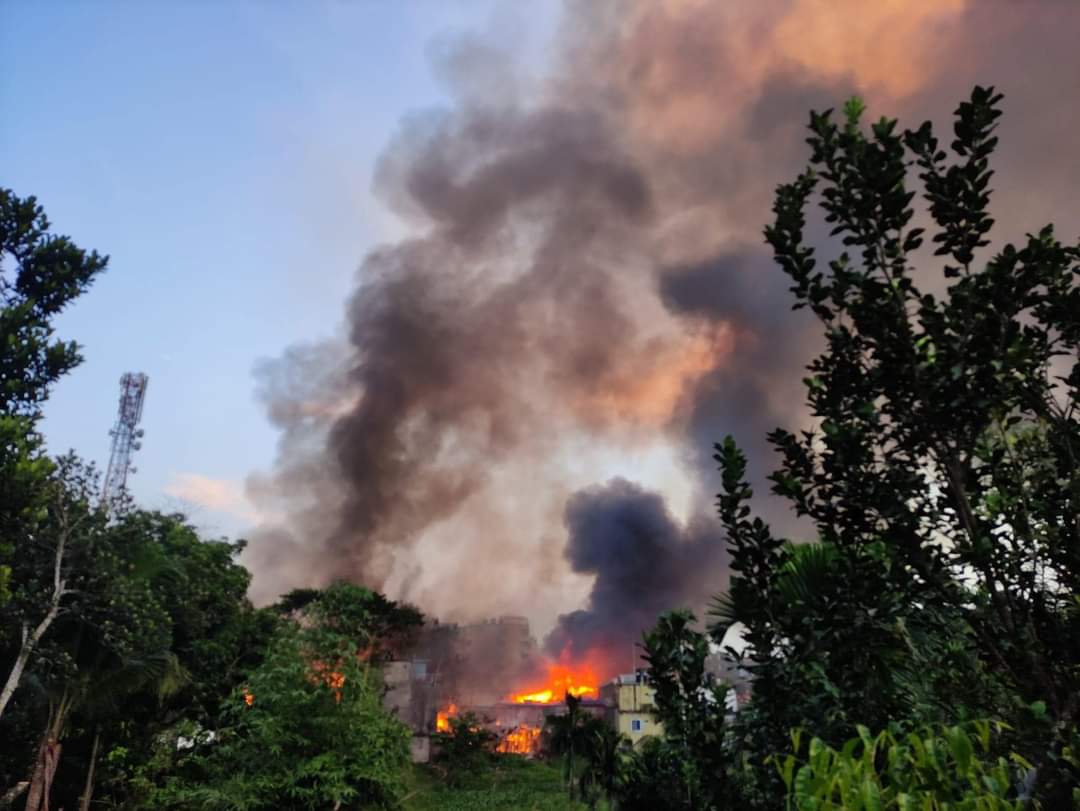
In September 2024, a Bengali crowd burned down over 100 houses and shops of the Indigenous peoples belonging to the Chakma community in the Khagrachari district of the Chittagong Hill Tracts (CHT) in Bangladesh. The Bangladesh Army personnel stationed nearby watched without intervening, then supported the crowd to carry out the arson. A year later, such attacks continue.
The house burning is part of an ongoing history of dispossession against the Indigenous communities in Bangladesh. According to Indigenous activists, violence is driven by the state’s refusal to recognize Indigenous land rights and self-determination, and is expressed through land grabs and forced disappearances as military activities expand across Indigenous territories.
The 2022 national census records approximately 1.65 million Indigenous people in Bangladesh, accounting for about 1 percent of the state’s population. The Bangladesh Indigenous Peoples Forum (BIPF) contests this number, claiming Indigenous peoples represent closer to four million people. What both agree on is that the majority of the 54 Indigenous peoples who speak at least 35 languages live in the three hilly districts of South East Bangladesh, collectively known as the CHT. The Chakmas are the largest Indigenous community in the country.

A map of Bangladesh, with the CHT highlighted in red.
Indigenous peoples in Bangladesh remain largely unrecognized and unrepresented within a national political framework that denies their indigeneity. What appears as semantic minoritization has, in practice, enabled systematic violence in the Chittagong Hill Tracts.
Indigenous peoples in Bangladesh are called ethnic minorities, a framing that denies their true identity: Indigenous, or Adivasi, a term that literally translates to ancient residents. This denial is systemized. Indigenous languages disappear under the Bengali cultural dominance, heroic acts of Indigenous resistance can be futile without institutional support.
The process of rejecting Indigenous rights began with Bangladesh’s birth in 1971. After independence, the new government adopted a unitary, Bengali-nationalist constitution that omitted recognition of “Indigenous peoples” and declared all citizens as “Bengalis.”
The CHT’s demand for autonomy and cultural recognition was thus rejected outright. The discontent is reflected in this quote from M.N. Larma, a Chakma leader and member of Parliament in 1973, “You cannot impose your national identity on others. We are not Bengalis; we are Jummas.” The Jumma peoples are a collective term for the 11 Indigenous peoples in the CHT.
In 1972–73, Larma founded the Parbatya Chattagram Jana Samhati Samiti (PCJSS), the Hill Tracts People’s Solidarity Association, to pursue autonomy and cultural preservation. After failed negotiations, the PCJSS formed an armed wing in 1976, the Shanti Bahini (Peace Force). Two decades of armed insurgency followed, with thousands of deaths, the displacement of over 100,000 Jumma peoples, and widespread human rights violations.
The Shanti Bahini fought for a self-governing state within Bangladesh known as “Jummaland”. The Bangladesh government responded with militarization and Bengali settlement policies. Although Indigenous communities formed 97.5% of CHT’s population pre-1947, recent estimates indicate this number to be now 35%. This decline can be mainly attributed to the state-sponsored Bengali settlement program that started in 1979, a clear settler strategy of “replace to erase.”
In 1997, then-Prime Minister Sheikh Hasina signed the CHT Peace Accord with the Shanti Bahini, after years of negotiation, which ended the armed conflict. The Peace Accord promised partial self-governance in the CHT, recognized it as a “tribal inhabited region,” and called for the withdrawal of temporary military camps.
Over 25 years have passed since the Accord was signed, and it remains mostly unimplemented. Most military camps remain, and key administrative powers have not been transferred to local councils. Bengali settlers still occupy large tracts of Indigenous land.
The Peace Accord that kindled sparks of hope among the Jumma eventually faded into a myriad of unkept promises and further conflicts.
The failure of the Accord caused the PCJSS to split into two rival factions: one loyal to the 1997 Accord, and the new UPDF (United People’s Democratic Front), which called for complete self-rule free from Dhaka’s control. Conflicts and political assassinations between the PCJSS and the UPDF continue to this day.
The failure of the 1997 Peace Accord to deliver meaningful autonomy and the continued presence of military camps and settler encroachment happened within a legal and political vocabulary that has refused to acknowledge the Jumma as Indigenous peoples with territorial rights.
Calling the Jumma and other Indigenous peoples merely “ethnic minorities,” “tribal groups,” or “small nationalities” strips their history of territorial rootedness and reduces political claims into private, individual claims that can be managed through policing, relocation, or settlement rather than through restitution, self-governance, or collective land rights.
The concept of minoritization is a colonial construct and represents a form of social subordination. Minoritization gives the “majority,” the colonizers, a shared right to define the minoritized group from the outside. Their narratives are filtered and repurposed to conform to the majority. Their “minority” label positions them as groups requiring integration – implying they must forcibly assimilate into the dominant society. Any refusal invites accusations of being enemies or terrorists.
This pattern of minoritizing Indigenous peoples is not unique to Bangladesh. The attempt of governments to deny Indigenous rights and self-determination using the framing of “ethnic minorities” is a global phenomenon; a notorious example is the genocide of the Uyghurs of China. International norms, most notably defined by the United Nations Declaration on the Rights of Indigenous Peoples (UNDRIP), make it clear that the recognition of indigeneity carries obligations, including the protection of indigenous lands and cultures, as well as the indigenous right to self-determination.
States that treat Indigenous Peoples as merely “minorities” can evade these obligations; this semantic choice translates into weaker legal claims lacking the indigenous right to self-determination, and as a result engender greater vulnerability to violent dispossession.
What may at first look like terminological hair-splitting is actually foundational to the safety of Indigenous communities. This helps explain why the Jummas’ struggle over their status remains central to understanding why episodes like the 2024 Khagrachari attacks occur and why they require remedies that go beyond criminal prosecutions to also include the implementation of the Accord and the recognition of Indigenous rights.
The fall of the 15-year fascist regime of Sheikh Hasina in August 2024 failed to bring any meaningful change in the human rights situation in CHT, as noted in the PCJSS Half-Yearly Report (January-June 2025) on the Human Rights Situation of CHT.
Although the interim government reconstituted the three Hill District Councils in the CHT, there have been no real efforts to fully implement the CHT Accord, or to stop attacks against the Jumma peoples. PCJSS reports 103 incidents of human rights violations committed in the CHT by the military and Bengali settlers between January and June 2025, including communal attacks, arrests, forced religious conversions, and rapes.
Any path forward must start with self-determination. Every political promise remains hollow so long as the government persists in reducing Indigenous Peoples into “ethnic minorities.” To repair decades of structural harm, Bangladesh must first confront the truth it has long refused to utter: Bangladesh is not only a Bengali nation, but also the ancestral homeland of its Indigenous peoples.
The denial of recognition, political participation, and representation leaves the CHT in a democratic vacuum, where voices of millions are left unheard. As Antar Chakma, Joint General Secretary of the PCP (the student wing of PCJSS) observed, “…this democratic vacuum is not new for CHT; rather this has long been present as a structural reality.”
Only when the Jummas are recognized as Indigenous peoples, with collective rights, historical rootedness, and the freedom to determine their own future, can there be any meaningful possibility of peace, justice, and self-determination in the Chittagong Hill Tracts.
This article is a part of Hotspots, a journalistic collaboration between IC, Professor Manuela Picq and her students at Amherst College.
Across the world right now, Indigenous peoples are facing a renewed assault on their lands, rights, and ways of life.
From extractive industries pushing deeper into ancestral territories, to governments rolling back hard-won protections,
the threat is global—and it is growing.
What makes this moment especially dangerous is how little attention it receives.
Stories like this are disappearing in real time. Mainstream media
barely covers it and the coverage is fragmented. The public is left without the context
needed to understand what is truly at stake.
That is exactly why IC Magazine exists..
For more than 20 years, IC has reported on Indigenous struggles worldwide — consistently, independently, and without compromise.
We don’t follow news cycles; we trace patterns. We don’t sensationalize; we provide context.
And when the world looks away, we stay focused.
But this work is increasingly difficult to sustain.
We refuse to lock our reporting behind a paywall. We don’t sell access through subscriptions.
And we don’t answer to advertisers. IC Magazine survives solely because readers like you choose to
support independent Indigenous journalism.
Please donate today if you can. Every contribution helps us to continue this crucial work.
Thank you,
John Ahni Schertow
Founder and Editor in Chief