Last Updated on January 8, 2026
On September 5, 2025, Nayarit’s governor Miguel Ángel Navarro Quintero called for an immediate halt to cartel violence after reports that criminal groups were testing explosive devices on Indigenous children. Nayarit, a coastal state wedged between Sinaloa and Jalisco, is home to the Naayeri peoples and other Indigenous nations of Mexico’s Sierra Madre Occidental. For these Indigenous communities, the governor’s statement merely confirmed what they have long endured: cartel violence has reached genocidal proportions.
Now, the Naayeri peoples face an impossible choice. Through an active convergence of cartel violence and state abandonment they must either flee their ancestral homelands or risk death. But this violence is not random: It follows a long-standing colonial logic that treats Indigenous land as expendable and Indigenous life as disposable.
The Naayeri—referred to as “Cora” in Spanish colonial records—have survived five centuries of invasion, massacres, and land theft. Today, they find themselves encircled by two of the world’s most powerful criminal organizations: the Sinaloa Cartel and the Cartel de Jalisco Nueva Generación (CJNG). In 2021 alone, an estimated 14,000 homicides were linked to CJNG and another 8,000 to the Sinaloa Cartel. For the Naayeri, this violence is not abstract. It unfolds in their villages, homes, and sacred spaces.
They are trapped between two brutal forces that punish resistance with terror and turn survival into exile. How long can a people endure before disappearance becomes policy by neglect?
Nayarit sits at the center of a strategic territorial conflict between the Sinaloa Cartel and CJNG. The region is one of Mexico’s primary opium-growing zones. In 2025, authorities destroyed approximately 2.8 million poppy plants across 18 fields covering more than 114,925 square meters, demonstrating both the scale of cultivation and the success of eradication operations. The state’s Pacific coastline also provides critical trafficking routes; the DEA estimates that roughly 95% of drugs moved by these cartels transit the Pacific corridor.
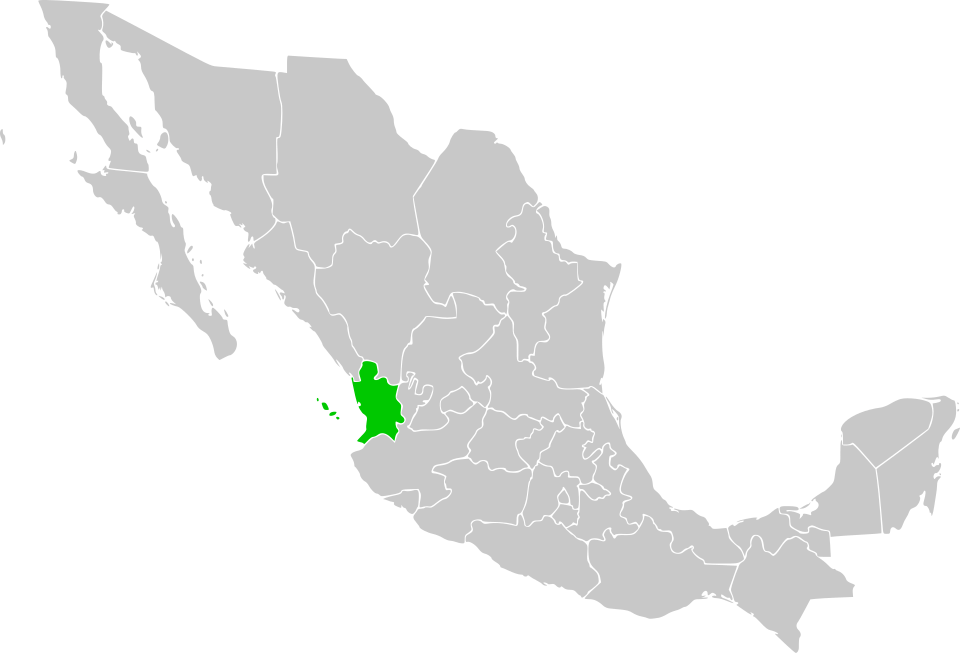
Location of Nayarit in Mexico
The Sinaloa Cartel is one of the largest crime syndicates globally. Founded by Joaquín Guzmán Loera (El Chapo) and Ismael Zambada García (El Mayo), the Sinaloa Cartel operates in over 40 countries with tens of thousands of members. It reached a turning point following El Mayo’s arrest on July 25, 2024, after Los Chapitos (El Chapo’s sons) were reportedly responsible for handing El Mayo over to US authorities.
Its largest rival is the Cartel de Jalisco Nueva Generación (CJNG), located across Naayeriit. This cartel began as a faction of the Sinaloa Cartel between 2009 and 2010, becoming independent in 2014 under the leadership of Nemesio Oseguera Cervantes, also known as “El Mencho.”
The Sierra Madre Occidental is valuable terrain for these cartels. For Indigenous peoples, it is home, history, and identity. As cartels expand, they increasingly control Indigenous territories through intimidation, coerced agreements, and constant surveillance. This mirrors earlier colonial practices in which colonial powers asserted control through violence and fear, eroding Indigenous governance structures. Scholar Patrick Wolfe describes this as the settler colonial “logic of elimination,” in which Indigenous peoples are removed from their land that are strategically appropriated by settler governments.
Both the Sinaloa Cartel and CJNG have grown into transnational criminal enterprises, dominating global drug routes and amassing enormous military and political power. Their rivalry has turned Indigenous territories into battlegrounds. Cartels enforce authority through forced recruitment, disappearances, and public executions designed to terrorize entire communities into submission.
The killing of Antonio Regis Nicolás, an Indigenous Nahua leader and human rights defender, exemplifies this strategy. In 2024, CJNG gunmen pulled him from his family and murdered him for defending Indigenous land. His assassination follows a familiar pattern. In 2018, Margarito Díaz González, a Wixárika spiritual leader and land defender, was also murdered by armed men. That year, ten human rights defenders were killed in Mexico—six of them Indigenous.
Violence against Indigenous leadership functions strategically: eliminate defenders, and entire communities fall silent. Global Witness has consistently documented that Indigenous peoples are disproportionately targeted among land and environmental defenders worldwide, often by organized crime operating with impunity.
Faced with escalating violence, many Indigenous families flee to survive.
In the municipality of Huajicori, more than 12,000 residents from 170 rural communities are currently displaced. According to Mexico’s National Institute of Statistics and Geography (INEGI), Indigenous peoples make up 26 percent of those affected.
Many Naayeri families have sought refuge in Tepic, Nayarit’s capital, relying on humanitarian aid from collection centers for basic necessities such as food, clothing, and water. Displacement, however, carries costs beyond physical survival. When Indigenous peoples are uprooted, they lose access to ceremonial spaces, communal governance, and the intergenerational transmission of language and culture.
Small communities are particularly vulnerable. Santa María de Picachos has an estimated population of only 281 people: El Riíto, just 339. The loss of even a few dozen families can push such communities toward cultural elimination. In this context, forced displacement is not merely a humanitarian crisis—it is a direct threat to Indigenous survival. UNICEF and UNESCO have warned that displacement places Indigenous languages and cultural practices at heightened risk, particularly when children grow up away from their territories.
In October 2024, at least 57 families were forcibly displaced from communities in the Sierra de Nayarit following renewed violence. Many belonged to the O’dam Indigenous community. Reports described forced recruitment, violent punishment, and bodies left in areas under criminal control. Videos circulating online showed cartel members openly discussing the coercion of Indigenous people into armed groups.
This violence functions systematically by Indigenous peoples from land coveted for trafficking routes and resource extraction while destroying community cohesion and Indigenous governance.
Genocide does not always arrive through formal policy. The United Nations Office on Genocide Prevention notes that genocide can occur through cumulative acts of violence, forced displacement, and the destruction of cultural life—even without explicit extermination orders.
Indigenous communities have repeatedly sought state protection, but trust in government institutions is thin. Nayarit has long been described as a “narco-state,” where political power and organized crime intertwine. Human rights organizations, including Amnesty International, have documented how corruption and militarized security strategies in Mexico often fail to protect Indigenous communities while enabling abuses to continue with impunity.
From 2011 to 2017, Governor Roberto Sandoval Castañeda oversaw major infrastructure projects while allegedly accumulating vast personal wealth. He has since been accused of embezzlement, collusion with cartels, and land seizures. A 2025 trial threatened him with a seven-year prison sentence. Despite public statements of concern, displaced Indigenous residents report being unable to secure meetings or meaningful assistance from local officials, including Tepic Mayor Sergio Rangel Cervantes. The absence of state protection enables cartel expansion while accelerating Indigenous displacement.
The displacement of the Naayeri did not begin with cartels. In 1529, Spanish conquistador Nuño de Guzmán murdered the Cora governor and numerous children during the early expansion of colonial rule. That massacre marked the beginning of centuries of forced removals, land theft, and violence.
Cartel terror today follows the same colonial logic: remove Indigenous peoples from valuable land and eliminate resistance. What has changed are the actors—not the structure.
The Naayeri peoples are not fleeing violence; they are being forced from their homelands by a system that has never valued Indigenous life unless it could be exploited. Cartel terror does not exist in a vacuum. It thrives where the state has long practiced dispossession, corruption, and abandonment.
Framed as a security crisis, the displacement of Indigenous peoples is rarely named for what it is: a continuation of genocide through renewed means of forced removal. Until Indigenous sovereignty is protected and Indigenous life is valued as human and non-negotiable, the choice imposed on the Naayeri—flee or die—will remain the defining logic of colonial rule in Mexico.
This article is a part of Hotspots, a journalistic collaboration between IC, Professor Manuela Picq and her students at Amherst College.
Across the world right now, Indigenous peoples are facing a renewed assault on their lands, rights, and ways of life.
From extractive industries pushing deeper into ancestral territories, to governments rolling back hard-won protections,
the threat is global—and it is growing.
What makes this moment especially dangerous is how little attention it receives.
Stories like this are disappearing in real time. Mainstream media
barely covers it and the coverage is fragmented. The public is left without the context
needed to understand what is truly at stake.
That is exactly why IC Magazine exists..
For more than 20 years, IC has reported on Indigenous struggles worldwide — consistently, independently, and without compromise.
We don’t follow news cycles; we trace patterns. We don’t sensationalize; we provide context.
And when the world looks away, we stay focused.
But this work is increasingly difficult to sustain.
We refuse to lock our reporting behind a paywall. We don’t sell access through subscriptions.
And we don’t answer to advertisers. IC Magazine survives solely because readers like you choose to
support independent Indigenous journalism.
Please donate today if you can. Every contribution helps us to continue this crucial work.
Thank you,
John Ahni Schertow
Founder and Editor in Chief