Last Updated on May 8, 2026
An international people’s tribunal examining Canada’s role in the deaths and disappearances of Indigenous children in residential schools will convene in Montreal later this month, bringing together survivors, legal experts and advocates in what they describe as a push for accountability beyond Canada’s existing reconciliation process.
The hearings, organized under the auspices of the Permanent Peoples’ Tribunal, are scheduled for May 25-29 at the Daphne Art Centre in Montreal. The tribunal will hear testimony related to missing Indigenous children, unmarked graves and the long-term impacts of the residential school system on Indigenous communities across Canada.
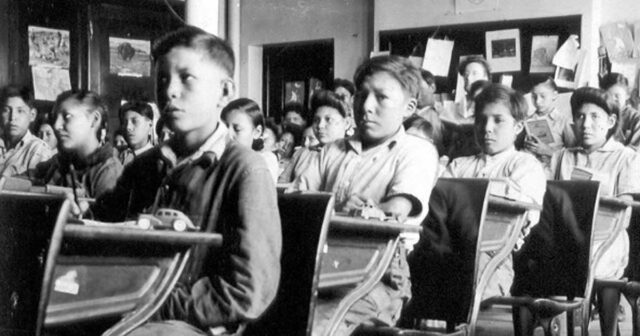
Organizers say the tribunal will review evidence alleging genocide and crimes against humanity committed through Canada’s residential school system, which forcibly removed Indigenous children from their families for more than a century.
The proceedings are being hosted by the Native Women’s Shelter of Montreal in partnership with Amnesty International. According to organizers, roughly 2,000 pieces of evidence are expected to be presented during the hearings.
“Our history has been minimized by the colonizer, but our truth will be told,” Na’kuset, executive director of the Native Women’s Shelter of Montreal, said in a statement announcing the tribunal.
The tribunal comes nearly five years after the discoveries of potential unmarked graves at former residential school sites reignited international scrutiny of Canada’s treatment of Indigenous peoples. A 2024 report presented to Canada’s Senate described evidence that Indigenous children who died in the institutions were often buried in unmarked or mass graves, with families frequently uninformed about what happened to their children.
The hearings will feature testimony from survivors, families, researchers and legal experts. Organizers say the tribunal’s findings will culminate in an advisory opinion and recommendations intended to pressure governments and institutions toward greater accountability.
The Permanent Peoples’ Tribunal, founded in 1979 in Bologna, Italy, emerged from the legacy of the Russell Tribunals, which investigated alleged war crimes during the Vietnam War and later abuses in Latin America. Established by Italian senator and jurist Lelio Basso, the tribunal was created as an independent forum to hear cases involving human rights violations and the denial of self-determination when formal international institutions failed to act.
Over the past four decades, the tribunal has held more than 50 sessions examining allegations of abuses around the world. Its proceedings have addressed issues including the Armenian genocide, violence against Indigenous peoples in the Brazilian Amazon, crimes committed during the wars in the former Yugoslavia, the treatment of migrants in Europe and North Africa, state violence in West Papua, and alleged human rights violations against Kurdish communities, Afghan women and Tamil people in Sri Lanka.
While the tribunal has no formal legal authority to enforce judgments, its findings have often been used by activists, scholars and human rights organizations to build international pressure campaigns and document historical abuses.
Organizers of the Montreal hearings say the proceedings are intended not only to document historical crimes, but also to examine ongoing harms linked to residential schools, including intergenerational trauma, child welfare removals and systemic inequities affecting Indigenous communities today.
The public can watch the Tribunal live from 9:00am-4:30pm EDT, May 25-29, 2026 at https://our-truths.com/
Across the world right now, Indigenous peoples are facing a renewed assault on their lands, rights, and ways of life.
From extractive industries pushing deeper into ancestral territories, to governments rolling back hard-won protections,
the threat is global—and it is growing.
What makes this moment especially dangerous is how little attention it receives.
Stories like this are disappearing in real time. Mainstream media
barely covers it and the coverage is fragmented. The public is left without the context
needed to understand what is truly at stake.
That is exactly why IC Magazine exists..
For more than 20 years, IC has reported on Indigenous struggles worldwide — consistently, independently, and without compromise.
We don’t follow news cycles; we trace patterns. We don’t sensationalize; we provide context.
And when the world looks away, we stay focused.
But this work is increasingly difficult to sustain.
We refuse to lock our reporting behind a paywall. We don’t sell access through subscriptions.
And we don’t answer to advertisers. IC Magazine survives solely because readers like you choose to
support independent Indigenous journalism.
Please donate today if you can. Every contribution helps us to continue this crucial work.
Thank you,
John Ahni Schertow
Founder and Editor in Chief