Last Updated on January 14, 2026
Dozens of churches across Canada have been damaged or destroyed by fire since 2021. A parallel firestorm has unfolded in political commentary and right-wing media with claims that the incidents represent a coordinated wave of anti-Christian violence linked to anger over the country’s residential school legacy.
That narrative has gained considerable traction not because it is supported by evidence, but because it aligns with a growing current of residential school denialism and increasingly aggressive far-right rhetoric that seeks to undermine reconciliation efforts in Canada.
Police agencies have confirmed that a number of church fires were deliberately set, but motives remain unclear in most cases. Investigators have not established a direct link between the fires and Indigenous activism, residential school burial investigations, or organized political action. Some fires were accidental; others remain unsolved.
Despite that uncertainty, prominent conservative politicians and commentators have framed the incidents as proof of widespread hostility toward Christians. Conservative Leader Pierre Poilievre has even described church burnings as “terrorist acts” and claimed that Christians in Canada are facing an epidemic of anti-Christian violence.
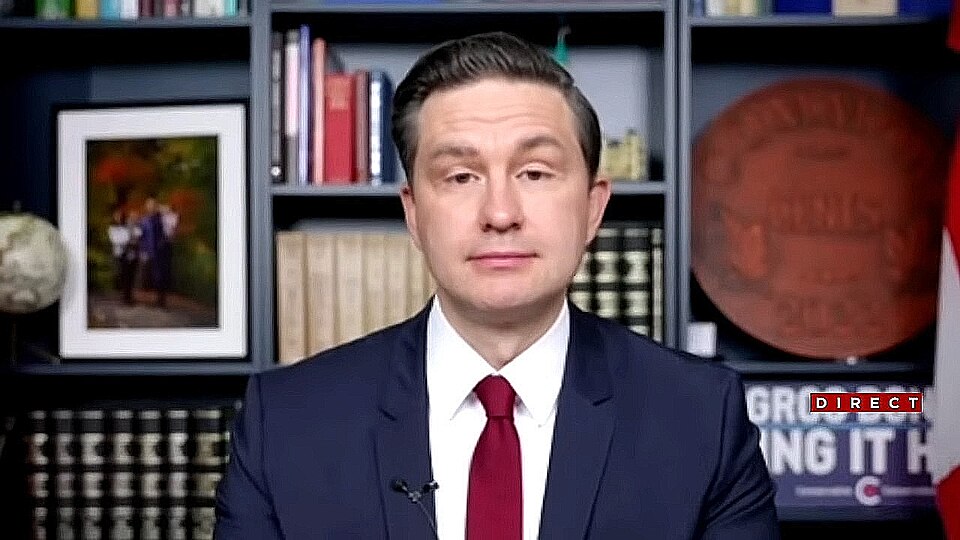
Pierre Poilievre interview with TVA Nouvelles June 2024
Scholars like Sean Carleton argue that such framing is part of a broader backlash against the growing public acknowledgment of residential school abuses by institutions that operated with impunity for more than a century.
Carleton, an historian at the University of Manitoba, told Ricochet Media that key players like Rebel News and The National Post are creating a “backlash narrative.”
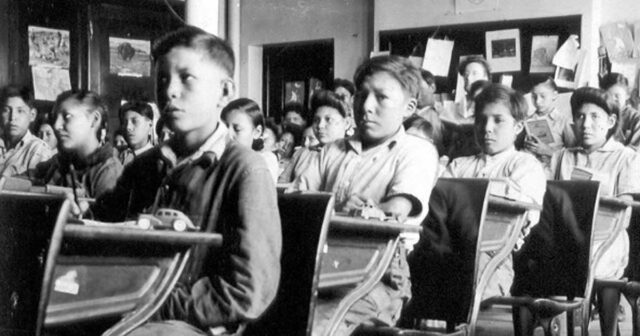
“They’re trying to use this as a distraction tactic to divert attention away from Truth and Reconciliation, from dealing with the truth that for over a hundred years the federal government colluded with churches to fund and administer a genocidal school system… that led to a number of deaths, including more than 4,000 deaths confirmed by church and state records.”
Far-right groups in Canada have increasingly adopted similar narratives casting reconciliation as an attack on Christian identity. Online spaces linked to conspiracy movements and white nationalist ideology frequently portray unmarked burial investigations as exaggerated, fabricated or politically motivated — claims repeatedly rejected by Indigenous communities and scholars.
Those same networks have amplified church fire stories, often presenting them as retaliation for “false” residential school claims.
“They’re trying to find as many different ways to discredit and delegitimize truth and reconciliation as possible” said Carleton, who currently teaches at the University of Manitoba.
NDP MP Leah Gazan is pushing back against the rhetoric by introducing legislation that would criminalize residential school denialism.
“If the bill is passed”, reports CityNews, “people could be charged under the Criminal Code for promoting hatred against Indigenous Peoples by condoning, justifying or downplaying the historical and lasting impact of residential schools.”
Carleton also argues that Canada’s right-wing is simultaneously attempting to create a narrative that suggests residential schools were positive, in order to absolve feelings of shame among everyday Canadians.
“It’s basically just obfuscation,” said Carleton. “They’re trying to say ‘these attacks on Christianity are the result of fake announcements about graves being discovered,’ and the Liberal government is too weak to push back on it.”
Fortunately, residential school survivors and Indigenous advocates aren’t being swayed by this new wave of right-wing rhetoric. They remain focused on getting accountability for past wrongs while ensuring that reconciliation is grounded in facts rather than fear. Meanwhile, law-enforcement officials continue to investigate church fires on a case-by-case basis while cautioning against broad conclusions in the absence of evidence.
Across the world right now, Indigenous peoples are facing a renewed assault on their lands, rights, and ways of life.
From extractive industries pushing deeper into ancestral territories, to governments rolling back hard-won protections,
the threat is global—and it is growing.
What makes this moment especially dangerous is how little attention it receives.
Stories like this are disappearing in real time. Mainstream media
barely covers it and the coverage is fragmented. The public is left without the context
needed to understand what is truly at stake.
That is exactly why IC Magazine exists..
For more than 20 years, IC has reported on Indigenous struggles worldwide — consistently, independently, and without compromise.
We don’t follow news cycles; we trace patterns. We don’t sensationalize; we provide context.
And when the world looks away, we stay focused.
But this work is increasingly difficult to sustain.
We refuse to lock our reporting behind a paywall. We don’t sell access through subscriptions.
And we don’t answer to advertisers. IC Magazine survives solely because readers like you choose to
support independent Indigenous journalism.
Please donate today if you can. Every contribution helps us to continue this crucial work.
Thank you,
John Ahni Schertow
Founder and Editor in Chief