Last Updated on March 13, 2013
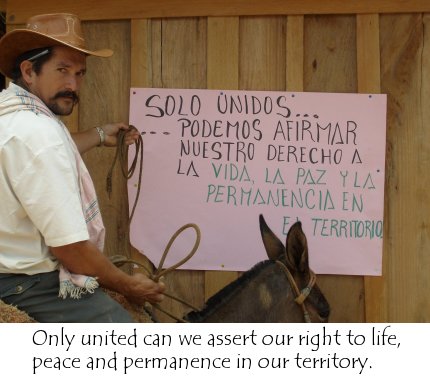
The Following Article is from http://www.movimientos.org/ – Turning legitimate protest into a crime is one of the preferred strategies of power groups when trying to contain social struggles and diminish responses to their demands. This strategy is most effective when it has the support of mass media, which lend themselves to discrediting protestors and undermining the support of public opinion. In recent years, indigenous struggles in particular have been the target of such tactics, a situation which was harshly denounced during the Continental Meeting of Indigenous Peoples and Nationalities of Abya Yala, which took place in Bolivia in October 2006:
“We are living in times of militarization and criminalization of social movements. Today as indigenous peoples we are submitted to a new rationale of the so-called democratic or neo-fascist security projects. If we do not struggle firmly united against this, our peoples will be only one step away from complete physical extermination as a result of the elimination of our territory, knowledge, identity and culture in general. From the perspective of these manifestations of colonialism, we are a hindrance preventing them from continuing to illicitly enrich themselves and to determine the future of nation states in accordance with what is most politically convenient to them”. (From the outcomes of the Working Group on Strategic Alliances at the Meeting).
Blanca Chancoso, Kichwa-Ecuadorian, recalls that the criminalization of indigenous struggles is not new, but that since the time of colonialization it has reproduced itself in various ways across the continent when people have tried to raise their voice in defence of their land, territories and of the rights of their peoples.
For Chancoso, resistance to criminalization can no longer take place only through acts of denunciation and protest. “These attitudes have to be nipped in the bud,” she stresses, involving a struggle to change the constitutional foundations of countries in order to guarantee the true exercise of rights, and to follow this with ongoing organization in defence of the changes which are achieved.
From the perspective of Father Antonio Bonanomi, indigenous peoples in Colombia – as elsewhere – are living through a very difficult time. One of the main factors in this is “the imperialist system which dominates politics in Colombia. Essentially indigenous peoples are seen as a hindrance. As a result of their culture, their defence of their territory and their love of the land, they are blocking efforts by multinationals to take control of the water and the forests, and of all natural resources. Indigenous culture is inherently anti-capitalist and anti-neoliberal and for this reason, capitalism and neoliberalism, which today are trying to dominate the world – and they dominate it, not only through politics but also with arms and laws – are enemies of the indigenous peoples and they consider them their enemies. From there stems the repression, displacement and laws against indigenous peoples.”
Referring specifically to the Nasa People of the Valley of Cauca, Bonanomi indicates that “throughout their history, the Nasa People have undergone great repression and persecution, but never as forcefully as it is today. Because it’s not only armed repression, it is often grounded in law. Essentially what is illegal is now being made legal and while what the State does has an appearance of being legal it is continuously violating the rights of indigenous peoples.”
Read the Full Article here, and here for a related one
Across the world right now, Indigenous peoples are facing a renewed assault on their lands, rights, and ways of life.
From extractive industries pushing deeper into ancestral territories, to governments rolling back hard-won protections,
the threat is global—and it is growing.
What makes this moment especially dangerous is how little attention it receives.
Stories like this are disappearing in real time. Mainstream media
barely covers it and the coverage is fragmented. The public is left without the context
needed to understand what is truly at stake.
That is exactly why IC Magazine exists..
For more than 20 years, IC has reported on Indigenous struggles worldwide — consistently, independently, and without compromise.
We don’t follow news cycles; we trace patterns. We don’t sensationalize; we provide context.
And when the world looks away, we stay focused.
But this work is increasingly difficult to sustain.
We refuse to lock our reporting behind a paywall. We don’t sell access through subscriptions.
And we don’t answer to advertisers. IC Magazine survives solely because readers like you choose to
support independent Indigenous journalism.
Please donate today if you can. Every contribution helps us to continue this crucial work.
Thank you,
John Ahni Schertow
Founder and Editor in Chief