Last Updated on April 10, 2025
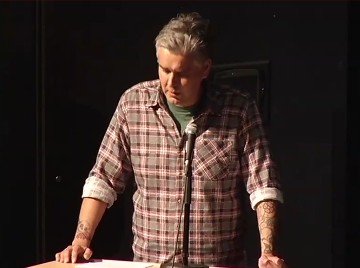
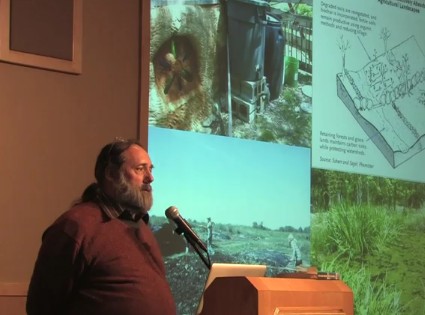
An informative and noteworthy introduction to ecovillages in the Copenhagen context by Permaculture Activist, Author and Co-founder of the Global Ecovillage Network, Albert K. Bates. Divide here into three segments, this talk was delivered at the 2009 Conference on Michigan’s Future: Energy, Economy and Environment.
As described by the Global Ecovillage Network (GEN), “Ecovillages are urban or rural communities of people who strive to integrate a supportive social environment with a low-impact way of life. To achieve this, they integrate various aspects of ecological design, permaculture, ecological building, green production, alternative energy, community building practices, and much more.”
In effect, “Ecovillages are living models of sustainability. They represent an effective, accessible way to combat the degradation of our social, ecological, and spiritual environments.”
There are about 420 modern ecovillages around the world today in countries like Palestine, Malaysia, Colombia, Israel, Mexico, Italy, Japan, Iceland and even Canada.
However, there are literally thousands of other ecovillages which have been rationally and methodically developed over thousands of years. Of course, these are traditional indigenous communities; that is, villages and networks of villages that are rooted in concept of Vivir Bien or “Living well” as popularized in the Cochabamba Accord.
In effect, ecovillages are modelled after Indigenous communities because they have stood the test time–certainly more than any of the “failed experiments” we’re just barely coping with today.
And in the Copenhagen context, ecovillages, be they modern or traditional, represent a benchmark of what we should be striving for. As Albert Bates points out in his talk, Models of Resilience and Regeneration, “What I’m talking about is Carbon-negative habitat. And eco-villages as vehicles for experimentation: food, buildings, energy, livelihoods that are branded carbon-negative. Let’s go beyond thinking of reducing 20 per cent this or five per cent that. Let’s think about 110, 120, 180 per cent changes in some of the things we do.”
For more information, visit www.ecovillage.org
Across the world right now, Indigenous peoples are facing a renewed assault on their lands, rights, and ways of life.
From extractive industries pushing deeper into ancestral territories, to governments rolling back hard-won protections,
the threat is global—and it is growing.
What makes this moment especially dangerous is how little attention it receives.
Stories like this are disappearing in real time. Mainstream media
barely covers it and the coverage is fragmented. The public is left without the context
needed to understand what is truly at stake.
That is exactly why IC Magazine exists..
For more than 20 years, IC has reported on Indigenous struggles worldwide — consistently, independently, and without compromise.
We don’t follow news cycles; we trace patterns. We don’t sensationalize; we provide context.
And when the world looks away, we stay focused.
But this work is increasingly difficult to sustain.
We refuse to lock our reporting behind a paywall. We don’t sell access through subscriptions.
And we don’t answer to advertisers. IC Magazine survives solely because readers like you choose to
support independent Indigenous journalism.
Please donate today if you can. Every contribution helps us to continue this crucial work.
Thank you,
John Ahni Schertow
Founder and Editor in Chief