
Last Updated on April 10, 2025
Traditional land owners won a major victory this month in their long running battle against the proposed Woodside gas hub project at James Price Point on Western Australia’s Kimberley coast.
On December 6, WA Supreme Court Justice Wayne Martin issued a ruling in favour of Goolarabooloo Traditional owners, finding that the WA government acted illegally when it used ‘compulsory acquisition’ notices to take Goolarabooloo lands for the proposed gas hub.
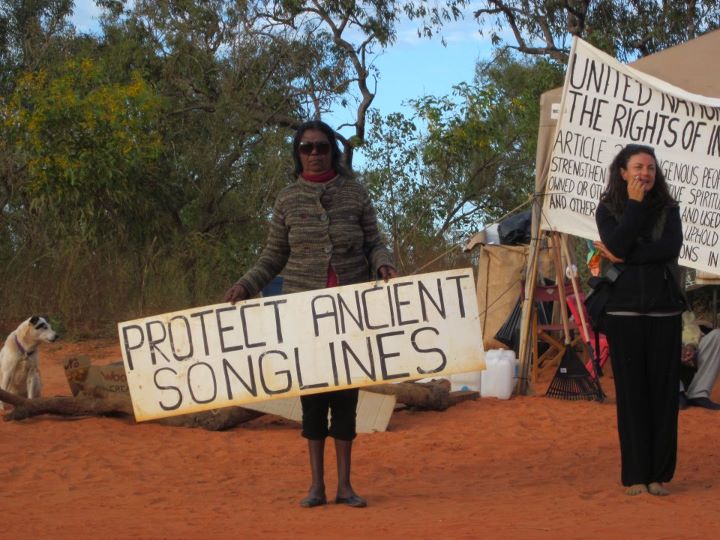
The land in question contains burial sites and it is part of a song cycle which is vital to Goolarabooloo life and culture. A song cycle is an oral heritage map that’s made up of ceremonial grounds, seasonal food places, vegetation for ceremonial usage as well as trees, shrubs, plants, ochre, land and water, all of which is needed, the Goolarabooloo say, “to sustain life both for humans and animals”.
Goolarabooloo traditional custodian Joseph Roe, recently told ABC Radio that James Price Point was “a special place… for me and my people” because a songline passes through it. Mr. Roe also explained that the area is important for initiations of young men and other cultural ceremonies, known as “secret men’s business”. Without it, Goolarabooloo culture would be in ruins.
Chief Justice Martin didn’t exactly side with Goolarabooloo culture; his judgment was issued on a technicality that the government will unfortunately be able to get around. As Chief Justice Martin pointed out, the government can simply re-issue the acquisition notices. WA Premier Colin Barret has since stated that his government will do just that.
Nevertheless, the ruling invalidates all decisions and agreements that have been made since the first acquisition notices were issued in September 2010.
That includes a controversial billion dollar trade-off that the Goolarabooloo Peoples were pressured into by the government. Under the threat of compulsory acquisition and the instance that the project is going to proceed proceed one way or another, the Goolarabooloo ‘agreed’ to sell their native title status for the life of the project, in exchange for $1.5 billion.
Now that agreement is quashed and Goolarabooloo have a second chance to defend their country and stand up to a government that probably couldn’t care less about harming Goolarabooloo culture, let alone protecting their rights as Indigenous Peoples.
Across the world right now, Indigenous peoples are facing a renewed assault on their lands, rights, and ways of life.
From extractive industries pushing deeper into ancestral territories, to governments rolling back hard-won protections,
the threat is global—and it is growing.
What makes this moment especially dangerous is how little attention it receives.
Stories like this are disappearing in real time. Mainstream media
barely covers it and the coverage is fragmented. The public is left without the context
needed to understand what is truly at stake.
That is exactly why IC Magazine exists..
For more than 20 years, IC has reported on Indigenous struggles worldwide — consistently, independently, and without compromise.
We don’t follow news cycles; we trace patterns. We don’t sensationalize; we provide context.
And when the world looks away, we stay focused.
But this work is increasingly difficult to sustain.
We refuse to lock our reporting behind a paywall. We don’t sell access through subscriptions.
And we don’t answer to advertisers. IC Magazine survives solely because readers like you choose to
support independent Indigenous journalism.
Please donate today if you can. Every contribution helps us to continue this crucial work.
Thank you,
John Ahni Schertow
Founder and Editor in Chief