Last Updated on November 13, 2011
BOTSWANA: JOY AS BUSHMEN WIN LANDMARK LEGAL CASE
Survival international
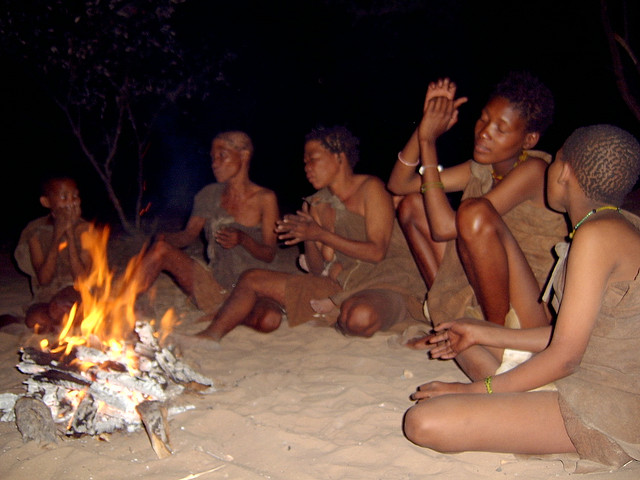
Scenes of jubilation greeted the Botswana High Court’s ruling today in favour of the Kalahari Bushmen.
The court ruled today that the Botswana government’s eviction of the Bushmen was ‘unlawful and unconstitutional’, and that they have the right to live on their ancestral land inside the Central Kalahari Game Reserve.
The court also ruled that the Bushmen applicants have the right to hunt and gather in the reserve, and should not have to apply for permits to enter it.
One of the judges, Justice Phumaphi, said the government’s refusal to allow the Bushmen to hunt ‘was tantamount to condemning the residents of the CKGR to death by starvation.’
However, the judges also said that the government is not obliged to provide services to Bushmen in the reserve.
Bushman spokesman Roy Sesana said outside the court, ‘Today is the happiest day for us Bushmen. We have been crying for so long, but today we are crying with happiness. Finally we have been set free.
The evictions have been very, very painful for my people. I hope that now we can go home to our land.’
Survival’s director Stephen Corry said today, ‘The court’s ruling is a victory for the Bushmen and for indigenous peoples everywhere in Africa. It is also a victory for Botswana. If the government quickly enacts the court ruling, then the campaign will end and the country really will have something to be proud of.’
The court case has been the longest and most expensive in Botswana’s history.
An online press file about the court case, including summaries, biographies, legal precedents, photos and video clips, is available at http://www.survival-international.org/bushmenpresspack
Related Stories on Google News
Across the world right now, Indigenous peoples are facing a renewed assault on their lands, rights, and ways of life.
From extractive industries pushing deeper into ancestral territories, to governments rolling back hard-won protections,
the threat is global—and it is growing.
What makes this moment especially dangerous is how little attention it receives.
Stories like this are disappearing in real time. Mainstream media
barely covers it and the coverage is fragmented. The public is left without the context
needed to understand what is truly at stake.
That is exactly why IC Magazine exists..
For more than 20 years, IC has reported on Indigenous struggles worldwide — consistently, independently, and without compromise.
We don’t follow news cycles; we trace patterns. We don’t sensationalize; we provide context.
And when the world looks away, we stay focused.
But this work is increasingly difficult to sustain.
We refuse to lock our reporting behind a paywall. We don’t sell access through subscriptions.
And we don’t answer to advertisers. IC Magazine survives solely because readers like you choose to
support independent Indigenous journalism.
Please donate today if you can. Every contribution helps us to continue this crucial work.
Thank you,
John Ahni Schertow
Founder and Editor in Chief